
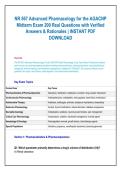
NR 567 Advanced Pharmacology for the AGACNP
Midterm Exam 200 Real Questions with Verified
Answers & Rationales | INSTANT PDF
DOWNLOAD
Overview
The NR 567 Advanced Pharmacology for the AGACNP (Adult-Gerontology Acute Care Nurse Practitioner) midterm
exam covers core pharmacological principles including pharmacokinetics, pharmacodynamics, drug classifications,
therapeutic decision-making, and medication management. Updated for 2026/2027, this resource reflects current
guidelines for sepsis, heart failure, anticoagulation, and antimicrobial stewardship .
Key Exam Topics
Content Area Key Focus
Pharmacokinetics & Pharmacodynamics Absorption, distribution, metabolism, excretion; drug-receptor interactions
Cardiovascular Pharmacology Antihypertensives, antiplatelets, anticoagulants, heart failure medications
Antimicrobial Therapy Antibiotics, antifungals, antivirals; resistance mechanisms; stewardship
Endocrine Pharmacology Insulins, thyroid medications, adrenal disorders, diabetes emergencies
Neuropharmacology Antiepileptics, sedatives, neuromuscular blockers, pain management
Critical Care Pharmacology Vasopressors, sedation, electrolyte management, reversal agents
Hematology & Oncology Anticoagulation reversal, growth factors, chemotherapy agents
Special Populations Geriatrics, pregnancy, renal/hepatic impairment, pharmacogenomics
Section 1: Pharmacokinetics & Pharmacodynamics
Q1. Which parameter primarily determines a drug's volume of distribution (Vd)?
A) Renal clearance
,B) Protein binding
C) Lipid solubility and tissue binding
D) Half-life
Correct Answer: C) Lipid solubility and tissue binding
Rationale: Vd reflects how extensively a drug distributes into tissues. Lipophilic drugs with
high tissue binding have larger Vd, indicating greater distribution out of the vascular
compartment .
Q2. A patient with severe hepatic failure will most likely have which change in drug
pharmacokinetics?
A) Increased renal excretion
B) Decreased oral absorption
C) Reduced metabolism and prolonged half-life of hepatically cleared drugs
D) Increased protein binding
Correct Answer: C) Reduced metabolism and prolonged half-life of hepatically
cleared drugs
Rationale: Hepatic failure reduces metabolism of drugs cleared by the liver (e.g.,
benzodiazepines, opioids, beta-blockers), increasing half-life and exposure. Dose
adjustments are required .
Q3. What is the primary mechanism of drug interaction when two highly protein-
bound drugs are administered together?
A) Increased renal excretion
B) Displacement from protein binding sites
C) Altered gastrointestinal absorption
D) Enzyme induction
Correct Answer: B) Displacement from protein binding sites
Rationale: Highly protein-bound drugs (e.g., warfarin, phenytoin) compete for binding sites
on albumin. Displacement increases free drug concentration, potentially leading to toxicity.
,Q4. A drug with zero-order kinetics exhibits which characteristic?
A) Constant fraction eliminated per unit time
B) Constant amount eliminated per unit time
C) Half-life remains constant regardless of dose
D) First-pass metabolism is extensive
Correct Answer: B) Constant amount eliminated per unit time
Rationale: Zero-order kinetics (e.g., phenytoin, ethanol, aspirin at high doses) means a
constant amount of drug is eliminated per unit time, independent of concentration. Half-life
increases with dose.
Q5. Which statement best describes the cytochrome P450 enzyme system?
A) All CYP enzymes are inducers
B) CYP3A4 metabolizes approximately 50% of all medications
C) CYP enzymes are not involved in prodrug activation
D) Inhibition of CYP enzymes decreases drug levels
Correct Answer: B) CYP3A4 metabolizes approximately 50% of all medications
Rationale: CYP3A4 is the most abundant and important CYP enzyme, responsible for
metabolizing about half of all clinically used drugs. Inhibition increases drug levels; induction
decreases them .
Q6. A patient taking warfarin is started on rifampin. What effect is expected?
A) Increased INR and bleeding risk
B) Decreased INR and reduced anticoagulant effect
C) No change in INR
D) Increased platelet aggregation
Correct Answer: B) Decreased INR and reduced anticoagulant effect
Rationale: Rifampin is a potent CYP2C9 and CYP3A4 inducer, accelerating warfarin
metabolism and reducing its anticoagulant effect. INR monitoring and dose adjustment are
required.
, Q7. What is the therapeutic index?
A) The ratio of ED50 to TD50
B) The ratio of TD50 to ED50
C) The dose required for 50% of maximum effect
D) The time to reach steady state
Correct Answer: B) The ratio of TD50 to ED50
Rationale: Therapeutic index = TD50 (toxic dose in 50% of population) / ED50 (effective
dose in 50% of population). Narrow therapeutic index drugs (e.g., warfarin, vancomycin,
phenytoin, lithium) require therapeutic drug monitoring .
Q8. Which drug requires therapeutic drug monitoring due to its narrow therapeutic
index?
A) Cefazolin
B) Vancomycin
C) Metformin
D) Lisinopril
Correct Answer: B) Vancomycin
Rationale: Vancomycin has a narrow therapeutic index. Trough levels are monitored to
ensure efficacy (10-20 mcg/mL depending on infection) and prevent nephrotoxicity and
ototoxicity .
Q9. A patient with chronic kidney disease (CKD) requires morphine for pain. What is
the primary concern?
A) Morphine has no active metabolites
B) Accumulation of active metabolites (M6G) causing respiratory depression
C) Morphine is hepatically excreted only
D) Morphine causes hypertension in the elderly
Correct Answer: B) Accumulation of active metabolites (M6G) causing respiratory
depression
Rationale: Morphine's active metabolite, morphine-6-glucuronide (M6G), accumulates in
renal failure, causing prolonged opioid effects and increased risk of respiratory depression.
Alternative opioids (e.g., fentanyl, hydromorphone) are preferred in CKD .
Midterm Exam 200 Real Questions with Verified
Answers & Rationales | INSTANT PDF
DOWNLOAD
Overview
The NR 567 Advanced Pharmacology for the AGACNP (Adult-Gerontology Acute Care Nurse Practitioner) midterm
exam covers core pharmacological principles including pharmacokinetics, pharmacodynamics, drug classifications,
therapeutic decision-making, and medication management. Updated for 2026/2027, this resource reflects current
guidelines for sepsis, heart failure, anticoagulation, and antimicrobial stewardship .
Key Exam Topics
Content Area Key Focus
Pharmacokinetics & Pharmacodynamics Absorption, distribution, metabolism, excretion; drug-receptor interactions
Cardiovascular Pharmacology Antihypertensives, antiplatelets, anticoagulants, heart failure medications
Antimicrobial Therapy Antibiotics, antifungals, antivirals; resistance mechanisms; stewardship
Endocrine Pharmacology Insulins, thyroid medications, adrenal disorders, diabetes emergencies
Neuropharmacology Antiepileptics, sedatives, neuromuscular blockers, pain management
Critical Care Pharmacology Vasopressors, sedation, electrolyte management, reversal agents
Hematology & Oncology Anticoagulation reversal, growth factors, chemotherapy agents
Special Populations Geriatrics, pregnancy, renal/hepatic impairment, pharmacogenomics
Section 1: Pharmacokinetics & Pharmacodynamics
Q1. Which parameter primarily determines a drug's volume of distribution (Vd)?
A) Renal clearance
,B) Protein binding
C) Lipid solubility and tissue binding
D) Half-life
Correct Answer: C) Lipid solubility and tissue binding
Rationale: Vd reflects how extensively a drug distributes into tissues. Lipophilic drugs with
high tissue binding have larger Vd, indicating greater distribution out of the vascular
compartment .
Q2. A patient with severe hepatic failure will most likely have which change in drug
pharmacokinetics?
A) Increased renal excretion
B) Decreased oral absorption
C) Reduced metabolism and prolonged half-life of hepatically cleared drugs
D) Increased protein binding
Correct Answer: C) Reduced metabolism and prolonged half-life of hepatically
cleared drugs
Rationale: Hepatic failure reduces metabolism of drugs cleared by the liver (e.g.,
benzodiazepines, opioids, beta-blockers), increasing half-life and exposure. Dose
adjustments are required .
Q3. What is the primary mechanism of drug interaction when two highly protein-
bound drugs are administered together?
A) Increased renal excretion
B) Displacement from protein binding sites
C) Altered gastrointestinal absorption
D) Enzyme induction
Correct Answer: B) Displacement from protein binding sites
Rationale: Highly protein-bound drugs (e.g., warfarin, phenytoin) compete for binding sites
on albumin. Displacement increases free drug concentration, potentially leading to toxicity.
,Q4. A drug with zero-order kinetics exhibits which characteristic?
A) Constant fraction eliminated per unit time
B) Constant amount eliminated per unit time
C) Half-life remains constant regardless of dose
D) First-pass metabolism is extensive
Correct Answer: B) Constant amount eliminated per unit time
Rationale: Zero-order kinetics (e.g., phenytoin, ethanol, aspirin at high doses) means a
constant amount of drug is eliminated per unit time, independent of concentration. Half-life
increases with dose.
Q5. Which statement best describes the cytochrome P450 enzyme system?
A) All CYP enzymes are inducers
B) CYP3A4 metabolizes approximately 50% of all medications
C) CYP enzymes are not involved in prodrug activation
D) Inhibition of CYP enzymes decreases drug levels
Correct Answer: B) CYP3A4 metabolizes approximately 50% of all medications
Rationale: CYP3A4 is the most abundant and important CYP enzyme, responsible for
metabolizing about half of all clinically used drugs. Inhibition increases drug levels; induction
decreases them .
Q6. A patient taking warfarin is started on rifampin. What effect is expected?
A) Increased INR and bleeding risk
B) Decreased INR and reduced anticoagulant effect
C) No change in INR
D) Increased platelet aggregation
Correct Answer: B) Decreased INR and reduced anticoagulant effect
Rationale: Rifampin is a potent CYP2C9 and CYP3A4 inducer, accelerating warfarin
metabolism and reducing its anticoagulant effect. INR monitoring and dose adjustment are
required.
, Q7. What is the therapeutic index?
A) The ratio of ED50 to TD50
B) The ratio of TD50 to ED50
C) The dose required for 50% of maximum effect
D) The time to reach steady state
Correct Answer: B) The ratio of TD50 to ED50
Rationale: Therapeutic index = TD50 (toxic dose in 50% of population) / ED50 (effective
dose in 50% of population). Narrow therapeutic index drugs (e.g., warfarin, vancomycin,
phenytoin, lithium) require therapeutic drug monitoring .
Q8. Which drug requires therapeutic drug monitoring due to its narrow therapeutic
index?
A) Cefazolin
B) Vancomycin
C) Metformin
D) Lisinopril
Correct Answer: B) Vancomycin
Rationale: Vancomycin has a narrow therapeutic index. Trough levels are monitored to
ensure efficacy (10-20 mcg/mL depending on infection) and prevent nephrotoxicity and
ototoxicity .
Q9. A patient with chronic kidney disease (CKD) requires morphine for pain. What is
the primary concern?
A) Morphine has no active metabolites
B) Accumulation of active metabolites (M6G) causing respiratory depression
C) Morphine is hepatically excreted only
D) Morphine causes hypertension in the elderly
Correct Answer: B) Accumulation of active metabolites (M6G) causing respiratory
depression
Rationale: Morphine's active metabolite, morphine-6-glucuronide (M6G), accumulates in
renal failure, causing prolonged opioid effects and increased risk of respiratory depression.
Alternative opioids (e.g., fentanyl, hydromorphone) are preferred in CKD .


