

Criminal Law Revision
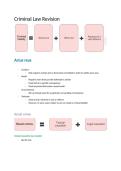
Actus reus
- Conduct
- Only requires certain acts to have been committed in order to satisfy actus reus
- Result
- Requires more than just the defendant’s actions
- Must lead to a specific consequence
- Must be proved that action caused result
- Circumstances
- AR can include need for a particular surrounding circumstance
- Omission
- General rule: Omission is not an offence
- However, in some cases, failure to act can result in criminal liability
Result crimes
Factual causation (see murder)
- But for test
,Legal causation:
- Absence of an intervening act, which breaks the chain of causation
- Operating and substantial cause of the prohibited consequence: R v Pagett
- Substantial cause, not de minimus: R v Hughes
- Caused by defendant’s culpable act: R v Dalloway
- Need not be the only cause: R v Benge
- Novus Actus Interveniens (NAI): event/act of victim/third party, which renders the defendant’s
part in the consequence very small, breaking the chain of causation.
- Chain of causation will be broken by a free, deliberate and informed act of a third party.
Absence of NAI:
- Medical negligence: R v Smith
- Acts of third party: R v Pagett
- Free, deliberate and informed
- Acts of the victim:
- Fright and flight (R v Roberts): Was the escape foreseeable by the reasonable person?
- Refusing medical treatment (R v Blaue): Generally not NAI.
- Suicide (R v Wallace): Whether defendant has caused suicide is a question of fact that
the juries should apply their common sense to
- May not break chain of causation if:
- V nonetheless dies from original wound: R v Dear
- The act was reasonably foreseeable: R v Roberts/ R v Williams and
Davies
- D’s unlawful act was a significant and operating cause of death and at
the time of the attack, it was reasonably foreseeable that the victim
would die by suicide as a result of V’s injuries: R v Wallace.
- May break chain of causation if:
- Injuries inflicted by D heal, but V goes on to commit suicide
- It was a voluntary and informed decision of the victim to act: R v
Kennedy
- Thin skull rule
- Must take victim as they find them
- Natural events
- Will only break chain of causation if they are extraordinary and not reasonably
foreseeable
Omissions
,General rule: Defendant cannot be criminally liable for failure to act, as there is no general duty to
prevent harm (R v Smith (William)):
- ‘Omission, without a duty, will not create an indictable offence’
The prosecution must prove that:
i. The crime is one which is capable of being committed by an omission. Some offences can only
be committed by an act, e.g. unlawful act manslaughter (R v Lowe);
ii. the accused was under a legal duty to act;
iii. the accused breached that duty;
iv. the breach caused the actus reus of the offence to occur; and
v. should the offence so require, that the accused had the required mens rea.
Common situations where the defendant has a legal duty to act:
- Statute
- Special relationship (R v Hood)
- Doctors and patients
- Parent and child
- Spouses
- Voluntary assumption of a duty of care (R v Nicholls)
- Contract (R v Pittwood)
- The defendant creating a dangerous situation (R v Miller)
- Need only be reasonable. Defendant not expected to risk their own life.
- Legal duty to act: public office holders (R v Dytham)
Omissions and causation:
- If D had acted, D could have made a causal difference
- Defendant cannot cause by omission
- D can fail to uncause when D has a duty to uncause, but this is different to causing
- Example:
- If V self-injects dangerous drugs into their own arm and suffers an overdose, the
cause of V's death is their own act of self-injection.
- The drugs are causing V to die.
- But if the supplier of the drug is present when V overdoses, the supplier will
have a duty to try to uncause what V has caused.
, Mens rea
Intention
2 types of intention:
- Direct: Aim/ purpose of D’s act (R v Moloney)
- Up to the jury: common sense.
- Indirect/ oblique (R v Woollin): Where D does something manifestly dangerous and someone
dies or is seriously injured, but that was not the primary aim of the defendant.
- The jury are not entitled to find oblique intention unless they are sure that death or
serious injury was a virtual certainty as a result of the defendant’s action and the
defendant appreciated that.
- SHOULD NOT BE CONFUSED WITH MOTIVE/DESIRE
Recklessness (R v G and another)
- When someone takes an unjustifiable risk, aware of the danger that the prohibited harm may
occur upon taking that risk.
- Does not intend to cause a harmful result but sees the risk and goes ahead anyway.
- Unreasonable to take the risk
Knowledge and belief
- These words have been held to allow for the defendant, who is absolutely certain as to the
existence of a particular circumstance, or is at least possibly aware that the particular
circumstance exists.
- E.g. S22 Theft Act 1968
Dishonesty
- In common with most offences under the Theft Act 1968
- Not actually defined in the act
- Supreme Court considered this requirement in the case of Ivey v Genting Casinos.
Negligence
Actus reus
- Conduct
- Only requires certain acts to have been committed in order to satisfy actus reus
- Result
- Requires more than just the defendant’s actions
- Must lead to a specific consequence
- Must be proved that action caused result
- Circumstances
- AR can include need for a particular surrounding circumstance
- Omission
- General rule: Omission is not an offence
- However, in some cases, failure to act can result in criminal liability
Result crimes
Factual causation (see murder)
- But for test
,Legal causation:
- Absence of an intervening act, which breaks the chain of causation
- Operating and substantial cause of the prohibited consequence: R v Pagett
- Substantial cause, not de minimus: R v Hughes
- Caused by defendant’s culpable act: R v Dalloway
- Need not be the only cause: R v Benge
- Novus Actus Interveniens (NAI): event/act of victim/third party, which renders the defendant’s
part in the consequence very small, breaking the chain of causation.
- Chain of causation will be broken by a free, deliberate and informed act of a third party.
Absence of NAI:
- Medical negligence: R v Smith
- Acts of third party: R v Pagett
- Free, deliberate and informed
- Acts of the victim:
- Fright and flight (R v Roberts): Was the escape foreseeable by the reasonable person?
- Refusing medical treatment (R v Blaue): Generally not NAI.
- Suicide (R v Wallace): Whether defendant has caused suicide is a question of fact that
the juries should apply their common sense to
- May not break chain of causation if:
- V nonetheless dies from original wound: R v Dear
- The act was reasonably foreseeable: R v Roberts/ R v Williams and
Davies
- D’s unlawful act was a significant and operating cause of death and at
the time of the attack, it was reasonably foreseeable that the victim
would die by suicide as a result of V’s injuries: R v Wallace.
- May break chain of causation if:
- Injuries inflicted by D heal, but V goes on to commit suicide
- It was a voluntary and informed decision of the victim to act: R v
Kennedy
- Thin skull rule
- Must take victim as they find them
- Natural events
- Will only break chain of causation if they are extraordinary and not reasonably
foreseeable
Omissions
,General rule: Defendant cannot be criminally liable for failure to act, as there is no general duty to
prevent harm (R v Smith (William)):
- ‘Omission, without a duty, will not create an indictable offence’
The prosecution must prove that:
i. The crime is one which is capable of being committed by an omission. Some offences can only
be committed by an act, e.g. unlawful act manslaughter (R v Lowe);
ii. the accused was under a legal duty to act;
iii. the accused breached that duty;
iv. the breach caused the actus reus of the offence to occur; and
v. should the offence so require, that the accused had the required mens rea.
Common situations where the defendant has a legal duty to act:
- Statute
- Special relationship (R v Hood)
- Doctors and patients
- Parent and child
- Spouses
- Voluntary assumption of a duty of care (R v Nicholls)
- Contract (R v Pittwood)
- The defendant creating a dangerous situation (R v Miller)
- Need only be reasonable. Defendant not expected to risk their own life.
- Legal duty to act: public office holders (R v Dytham)
Omissions and causation:
- If D had acted, D could have made a causal difference
- Defendant cannot cause by omission
- D can fail to uncause when D has a duty to uncause, but this is different to causing
- Example:
- If V self-injects dangerous drugs into their own arm and suffers an overdose, the
cause of V's death is their own act of self-injection.
- The drugs are causing V to die.
- But if the supplier of the drug is present when V overdoses, the supplier will
have a duty to try to uncause what V has caused.
, Mens rea
Intention
2 types of intention:
- Direct: Aim/ purpose of D’s act (R v Moloney)
- Up to the jury: common sense.
- Indirect/ oblique (R v Woollin): Where D does something manifestly dangerous and someone
dies or is seriously injured, but that was not the primary aim of the defendant.
- The jury are not entitled to find oblique intention unless they are sure that death or
serious injury was a virtual certainty as a result of the defendant’s action and the
defendant appreciated that.
- SHOULD NOT BE CONFUSED WITH MOTIVE/DESIRE
Recklessness (R v G and another)
- When someone takes an unjustifiable risk, aware of the danger that the prohibited harm may
occur upon taking that risk.
- Does not intend to cause a harmful result but sees the risk and goes ahead anyway.
- Unreasonable to take the risk
Knowledge and belief
- These words have been held to allow for the defendant, who is absolutely certain as to the
existence of a particular circumstance, or is at least possibly aware that the particular
circumstance exists.
- E.g. S22 Theft Act 1968
Dishonesty
- In common with most offences under the Theft Act 1968
- Not actually defined in the act
- Supreme Court considered this requirement in the case of Ivey v Genting Casinos.
Negligence


