

Written by students who passed Immediately available after payment Read online or as PDF Wrong document? Swap it for free 4.6 TrustPilot
logo-home
Document preview thumbnail
Preview 2 out of 10 pages
Exam (elaborations)

Answer Key for Mid-term exam 3 Form A

Document preview thumbnail
Preview 2 out of 10 pages

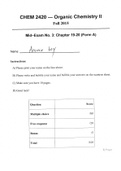
CHEM 2420 --Organic Chemistry II Fall 2015 Mid-Exam No. 3: Chapter 19-20 (Form A) Name: ,) ÿ_aÿ Instructions: A) Please print your name on the line above. B) Please write and bubble your name and bulÿble your answers on the scantron sheet. C) Make sure you have 10 pages. D) Good luck! Question Score Multiple choice /80 Bonus Total Free response /20 /5 /105 1 IPaÿoe Section 1. Multiple Choice (80 points) Bubble the choice that best completes each phrase and/or answers the question on the Scantron sheet provided. Answers written in this section of the exam will NOT be graded (20 X 4 = 80 points), 1. What is the IUPAC name of the following compound? COON CH3 @ 5-chloro-4-methylbenzoic acid 3-chloro-4-methylbenzoic acid c. 4-methyl-5-chlorobenzoic acid d. 3-chloro-4-methylbenzaldehyde 2. What is the correct assignment of the names of the following heterocycles? 4 a. 1 = pyrrole; 2 = thiophene; 3 = pyridine; 4 = piperidine b. 1 = thiophene; 2 = furan; 3 = pyrrole; 4 = imidazole c. 1 = pyridine; 2 = thiophene; 3 = pyrrole; 4 = furan 1 = pyridine; 2 = pyrrole; 3 = thiophene; 4 = imidazole . a, s b. sp What is the hybridization of the oxygen atom of tetrahydrofuran(THF)? 2 IP a g e 4. Which of the following heterocycles 1 2 4 a. 4 b. 2and4 c. 3 and 4 ')d'. 1 and 3 ° J Which of the following has the substituted phenols shown in the correct order o{ decreasing acidit phenolic hydrogen atom (i.e., more acidic less acidic)? ................. NO2 CH3 OMe Cl 1 2 3 4 a. 4321 b. 4231 c. 423 .'4123 , What is the major organic product obtained from the following reaction? COOH COOH excess H2CrO4 COOH COOH HOOC COOH a. 1 b. 2 G;)3 d. 4 3 IP a ÿ' e 7. What is the major organic product obtained from the following reaction? COOCH3 COOCH3 COOCH3 COOCH3 CH3CI, AICI3 CH3 3 a. 1 b. 2 , Which of the following substituents is ortho/para directing and deactivating in electrophilic aromatic substitution reactions? a. COCH3 b. NHCOCH3 .r CHzCH3 9. What is the electrophile in the reaction of benzene with ethanoyl chloride and A1C13? C. (CH3)3C+ d. benzene 10. What is the electrophile in the reaction of aniline with sodium nitrite and hydrochloric acid to form arene diazonium salt? a. NO2+ NO+ c. N2+ d. NH2+ 11. Which of the following sets of substituents are all ortho/para directing in electrophilic aromatic substitution reactions? "ÿ a. C1, CH3, CN, NH2 b. Br, OH, COCH3, NHCH3 OH, CH3, NHCOCH3 4{Page d, OCH3, CN, NO2, COCH3 12. Which of the following sets of substituents are all meta directing in electrophilic aromatic substitution reactions? a. CH3, OH, Br, CF3 '@bd. CCO1,C NHH32, ,N CON2, ,S COO3OHH, CN . NH2, COCH3, OH, NH3+ 13. Which of the following sets of substituents are all activating groups in electrophilic aromatic substitution reactions? a. CH3, OCH3, COCH3, NH2 b. C1, CN, NH2, NO2 c. el, NH2, CH3, COCH3 (ÿ CH3, NH2, phenyl, OCH3 14. What is the major organic product obtained from the following y.y. ÿ- COOCH3 COOCH3 COOCHa COOCH3 COOCHa HNOa, H2SO4 '1," ÿ("ÿ J :N NO2 2 a. 1 2 4 15. Which of the following is the structure for N-methylpyrrolidine (N-methylazacyclopentane)? 51Page I, IH IV, IH Vl 1", A)I E) V 16. Which of the following compounds are secondary (2°) amines? 1. (CH3CH2)3CNHC6H5 %ÿ} 2. CH3CH2CH(NH2)CH2CH2CH2CH3 3. CHBCH2CH2NHCH2CH3 Z ÿ 4. CHBCH2CH2CH2CH2N(CH2CH3)2 a. 1 and 2 ,. 1, ,a2n adn 3d 3 d. 1, 2, 3 and 4 17. What is the hybridization of the nitrogen atoms labeled i, ii, and iii in the following molecule? iii i H ii a. i = sp2;; ii = sp2; iii = sp3 b. i = sp2; ii = sp3; iiÿ sp2 i = sp2; ii = sp2; iii= $1)2 i sp3; ii = sip2; ii['= sp2 61Paÿ,,e 18. What is the major organic product obtained from the 1. NaNO2, HCI 2. KI Br Br E}r I 3 4 Br a, 1 @2 C. 3 d. 4 19. Give the major product for the following reaction. Br2 ar Br S 2 c. 3 d. 4 20. Give the major product for the following reaction. 7lPage NO2 1 NO2 1. HNO3, H2SO4 2. NaOH ) C. 3 d. 4 81PaSe Section 2. Free Response (20 points) Write CLEARLY in complete sentences o1" show all work if the problem calls for it. Remember to show all lone pair electrons if drawing a mechanism. o Mechanism. Draw the mechanism by which the following reaction occurs. Be sure to show curved arrows to indicate the movement of electrons as well as all lone pair electrons. (2 X 6 = 12 points) a. ,!'ÿ'N ÿ @ Q AICI3 @ lO € Aÿcl} b, NO2 OCH3 NO2 OCH3 4/ ,,f %+../1o r p " M.7 9lPaoe 42, . Synthesis, Provide all reactants, reagents, and intermediate products for preparation of the following product from starting material (8 points). SO3H CH3 CH3 %Y I q-._ Bonus (5 points): Draw the other FOUR resonance structures of pyrrole. ,ÿ:.O N ' O H © 4 -0 4 ,l 10]Page

Content preview

CHEM 2420 --Organic Chemistry II
Fall 2015

Mid-Exam No. 3: Chapter 19-20 (Form A)


Name: ,) ÿ_aÿ


Instructions:

A) Please print your name on the line above.

B) Please write and bubble your name and bulÿble your answers on the scantron sheet.


C) Make sure you have 10 pages.


D) Good luck!


Question Score


Multiple choice /80


Free response /20


Bonus /5


Total /105

1 IPaÿoe

, Section 1. Multiple Choice (80 points)
Bubble the choice that best completes each phrase and/or answers the question on the Scantron sheet
provided. Answers written in this section of the exam will NOT be graded (20 X 4 = 80 points),


1. What is the IUPAC name of the following compound?

COON


CH3


3-chloro-4-methylbenzoic acid
@ 5-chloro-4-methylbenzoic acid
c. 4-methyl-5-chlorobenzoic acid
d. 3-chloro-4-methylbenzaldehyde


2. What is the correct assignment of the names of the following heterocycles?


4

a. 1 = pyrrole; 2 = thiophene; 3 = pyridine; 4 = piperidine
b. 1 = thiophene; 2 = furan; 3 = pyrrole; 4 = imidazole
c. 1 = pyridine; 2 = thiophene; 3 = pyrrole; 4 = furan
1 = pyridine; 2 = pyrrole; 3 = thiophene; 4 = imidazole


. What is the hybridization of the oxygen atom of tetrahydrofuran(THF)?

a, s

b. sp


2 IP a g e

Connected book
 image
Peter O\'Neill Environmental Chemistry
Publisher: 2017 ISBN: 9781351450683 Edition: Unknown

Document information

Uploaded on
April 25, 2021
Number of pages
10
Written in
2020/2021
Type
Exam (elaborations)
Contains
Questions & answers
$7.99

Wrong document? Swap it for free Within 14 days of purchase and before downloading, you can choose a different document. You can simply spend the amount again.
Written by students who passed
Immediately available after payment
Read online or as PDF

Sold
0
Followers
0
Items
3
Last sold
-


Why students choose Stuvia

Created by fellow students, verified by reviews

Quality you can trust: written by students who passed their tests and reviewed by others who've used these notes.

Didn't get what you expected? Choose another document

No worries! You can instantly pick a different document that better fits what you're looking for.

Pay as you like, start learning right away

No subscription, no commitments. Pay the way you're used to via credit card and download your PDF document instantly.

Student with book image

“Bought, downloaded, and aced it. It really can be that simple.”

Alisha Student

Working on your references?

Create accurate citations in APA, MLA and Harvard with our free citation generator.

Working on your references?

Frequently asked questions

