

1 Inquire through: | Professional | Confidential Support
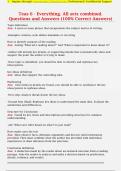
Teas 6 - Everything. All sets combined.
Questions and Answers (100% Correct Answers)
Topic Definition
Ans: A noun or noun phrase that encapsulates the subject matter of writing.
-Examples: arteries, acid, alleles mammals or recycling
How to identify purpose of the reading
Ans: Asking "What am I reading about?" And "What is important to know about it?"
-Author will include key details, or supporting details that systematically show and
support the point the author is trying to make.
-Once topic is identified, you should be able to identify and rephrase key
ideas/points.
Key Ideas definition
Ans: Ideas that support the controlling idea.
Rephrasing
Ans: -Once hints in details are found, you should be able to synthesize the key
ideas/points to rephrase ideas.
-First step: Analyze (break down) the key ideas.
-Second Step (final): Rephrase key ideas to understand the main idea. Evaluate the
similarities and differences.
Structure for Conclusion
Ans: Found by key terms and descriptions providing structure for common
understanding.
-Ask "What can I infer based on what I've just read?"
How reader uses the text
Ans: Must observe facts, delineate arguments and discern valid information
provided. Then must combine what the author has provided with individual
experiences to draw inference from the selection.
Conclusion definition
Ans: A deduction made by the reader about an unstated outcome from a reading
passage. Asks the reader to analyze and make a decision based on predictions,
details, evidence, and results.
,2 Inquire through: | Professional | Confidential Support
Inference defintion
Ans: "Reading between the lines" of what is stated. Otherwise, applying logic to facts
and evidence coupled with recognizing the context clues provided. Suggests an idea
by details and evidence in passage.
Key terms include what?
Ans: Those that provide sequence or chronology, descriptive words and phrases,
and words that convey value judgements and opinion.
-Can provide explicit information and implicit information that allow the reader to
make inference.
Explicit information definition
Ans: Clearly stated
Implicit information defintion
Ans: Something not clearly stated
What to identify to delineate key points that support the topic?
Ans: Identify the topic and authors main idea
What to demonstrate
Ans: Comprehension of a text by explaining how supporting details clarify the main
idea.
-Ask "What's the topic and what's the authors main idea about the topic?" Then
examine supporting details and how they relate to the main idea.
Comprehension defintion
Ans: Ability to understand
Delineate defintion
Ans: Describe precisely
Evidence defintion
Ans: Proof to support idea
How to identify main idea
Ans: Read that passage then locate the sentences that emphasize, elaborate, or
clarify this information.
Topic answers what questions?
Ans: "Who or what is the paragraph about?"
Location of topic
Ans: Should appear near the beginning of the paragraph and include main idea.
,3 Inquire through: | Professional | Confidential Support
-Topic must not be too specific or too general.
Identify supporting or key ideas
Ans: Ask the topic sentence: Who, What, When, Where, Why, and How?
What else is important for key ideas?
Ans: Discerning between relevant and irrelevant ideas
Relevant ideas defintion
Ans: Connected to the idea being discussed
-Relate back to topic sentence.
Irrelevant ideas defintion
Ans: Not applicable to the idea
-Unrelated, and some times random.
Procedures
Ans: Can be found in an text, like recipes and manuals.
Sequential information offers readers the ability to safely, effectively, and efficiently,
complete activities.
-Process of writing, editing, and revising.
Language features and Structure
Ans: Includes: signal words, words that assist the reader in recognizing the
relationship among steps, and simple, objective language.
-Objective language: Impartial, non-judgmental, not-personal, and non-emotional.
Directions
Ans: -Once reader has identified all features of procedure.
-Very specific, using language that tells how to accomplish the steps.
Common Types of Procedural Text
Ans: Include: Steps in an activity and steps in operating a system or object.
Highest Occurring Components of Procedural Writing are?
Ans: Headings/subheadings, numbering/alphabetizing, steps, charts, diagrams, and
photographs for step clarification.
Printed Communications
Ans: Include: Memos, announcements, advertisements.
, 4 Inquire through: | Professional | Confidential Support
-Join people together that have common interests and share information amongst
those that desire further detail.
Printed Public Announcement
Ans: -Inform public about organizations, upcoming events, and services.
-Message is short, design is simple and eye-pleasing, and information is easily
accessible.
-Content should include: Link to information access, information about supporting
organization, and supporting details (In images and short phrases, if possible)
Classified Advertisment
Ans: Printed Advertisment selling of soliciting something.
-Generally short, detailed text offering items and services.
-Example: Print/Online newspapers, magazines, blogs and forums.
~Blogs: Website that is usually informal and independently run.
~Forums: Online message board.
-Included in Advertisement:: Headline that engages the reader, item or service
offered, a call to action (phone number, email, address)
Graphic Representation
Ans: Allows readers to comprehend important verbal and written ideas in accessible
form.
- Most include titles and subheads that summarize complex information. Common
features: titles, subheads, keys/legends, and scales.
-Also, assist readers in selecting important information that might otherwise be
missing by portraying the key parts that make up a whole.
Include- Bar, pie, and flow charts, graphs, maps, and illustrations.
Features of Graphic Representation
Ans: Maps: titles, legends, and scales.
~Titles: Articulate the purpose of the map.
~Legend: Clarifies what the symbols, colors, and shapes represent.
~Scale: The distance between points.
Teas 6 - Everything. All sets combined.
Questions and Answers (100% Correct Answers)
Topic Definition
Ans: A noun or noun phrase that encapsulates the subject matter of writing.
-Examples: arteries, acid, alleles mammals or recycling
How to identify purpose of the reading
Ans: Asking "What am I reading about?" And "What is important to know about it?"
-Author will include key details, or supporting details that systematically show and
support the point the author is trying to make.
-Once topic is identified, you should be able to identify and rephrase key
ideas/points.
Key Ideas definition
Ans: Ideas that support the controlling idea.
Rephrasing
Ans: -Once hints in details are found, you should be able to synthesize the key
ideas/points to rephrase ideas.
-First step: Analyze (break down) the key ideas.
-Second Step (final): Rephrase key ideas to understand the main idea. Evaluate the
similarities and differences.
Structure for Conclusion
Ans: Found by key terms and descriptions providing structure for common
understanding.
-Ask "What can I infer based on what I've just read?"
How reader uses the text
Ans: Must observe facts, delineate arguments and discern valid information
provided. Then must combine what the author has provided with individual
experiences to draw inference from the selection.
Conclusion definition
Ans: A deduction made by the reader about an unstated outcome from a reading
passage. Asks the reader to analyze and make a decision based on predictions,
details, evidence, and results.
,2 Inquire through: | Professional | Confidential Support
Inference defintion
Ans: "Reading between the lines" of what is stated. Otherwise, applying logic to facts
and evidence coupled with recognizing the context clues provided. Suggests an idea
by details and evidence in passage.
Key terms include what?
Ans: Those that provide sequence or chronology, descriptive words and phrases,
and words that convey value judgements and opinion.
-Can provide explicit information and implicit information that allow the reader to
make inference.
Explicit information definition
Ans: Clearly stated
Implicit information defintion
Ans: Something not clearly stated
What to identify to delineate key points that support the topic?
Ans: Identify the topic and authors main idea
What to demonstrate
Ans: Comprehension of a text by explaining how supporting details clarify the main
idea.
-Ask "What's the topic and what's the authors main idea about the topic?" Then
examine supporting details and how they relate to the main idea.
Comprehension defintion
Ans: Ability to understand
Delineate defintion
Ans: Describe precisely
Evidence defintion
Ans: Proof to support idea
How to identify main idea
Ans: Read that passage then locate the sentences that emphasize, elaborate, or
clarify this information.
Topic answers what questions?
Ans: "Who or what is the paragraph about?"
Location of topic
Ans: Should appear near the beginning of the paragraph and include main idea.
,3 Inquire through: | Professional | Confidential Support
-Topic must not be too specific or too general.
Identify supporting or key ideas
Ans: Ask the topic sentence: Who, What, When, Where, Why, and How?
What else is important for key ideas?
Ans: Discerning between relevant and irrelevant ideas
Relevant ideas defintion
Ans: Connected to the idea being discussed
-Relate back to topic sentence.
Irrelevant ideas defintion
Ans: Not applicable to the idea
-Unrelated, and some times random.
Procedures
Ans: Can be found in an text, like recipes and manuals.
Sequential information offers readers the ability to safely, effectively, and efficiently,
complete activities.
-Process of writing, editing, and revising.
Language features and Structure
Ans: Includes: signal words, words that assist the reader in recognizing the
relationship among steps, and simple, objective language.
-Objective language: Impartial, non-judgmental, not-personal, and non-emotional.
Directions
Ans: -Once reader has identified all features of procedure.
-Very specific, using language that tells how to accomplish the steps.
Common Types of Procedural Text
Ans: Include: Steps in an activity and steps in operating a system or object.
Highest Occurring Components of Procedural Writing are?
Ans: Headings/subheadings, numbering/alphabetizing, steps, charts, diagrams, and
photographs for step clarification.
Printed Communications
Ans: Include: Memos, announcements, advertisements.
, 4 Inquire through: | Professional | Confidential Support
-Join people together that have common interests and share information amongst
those that desire further detail.
Printed Public Announcement
Ans: -Inform public about organizations, upcoming events, and services.
-Message is short, design is simple and eye-pleasing, and information is easily
accessible.
-Content should include: Link to information access, information about supporting
organization, and supporting details (In images and short phrases, if possible)
Classified Advertisment
Ans: Printed Advertisment selling of soliciting something.
-Generally short, detailed text offering items and services.
-Example: Print/Online newspapers, magazines, blogs and forums.
~Blogs: Website that is usually informal and independently run.
~Forums: Online message board.
-Included in Advertisement:: Headline that engages the reader, item or service
offered, a call to action (phone number, email, address)
Graphic Representation
Ans: Allows readers to comprehend important verbal and written ideas in accessible
form.
- Most include titles and subheads that summarize complex information. Common
features: titles, subheads, keys/legends, and scales.
-Also, assist readers in selecting important information that might otherwise be
missing by portraying the key parts that make up a whole.
Include- Bar, pie, and flow charts, graphs, maps, and illustrations.
Features of Graphic Representation
Ans: Maps: titles, legends, and scales.
~Titles: Articulate the purpose of the map.
~Legend: Clarifies what the symbols, colors, and shapes represent.
~Scale: The distance between points.


