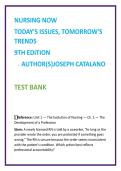
NURSING NOW
TODAY'S ISSUES, TOMORROW'S
TRENDS
9TH EDITION
• AUTHOR(S)JOSEPH CATALANO
TEST BANK
1️⃣ Reference: Unit 1️ — The Evolution of Nursing — Ch. 1️ — The
Development of a Profession
Stem: A newly licensed RN is told by a coworker, “As long as the
provider wrote the order, you are protected if something goes
wrong.” The RN is unsure because the order seems inconsistent
with the patient’s condition. Which action best reflects
professional accountability?
,A. Follow the order exactly because the provider is responsible
for it
B. Carry out the order after documenting that the provider
wrote it
C. Question the order and seek clarification before
implementation
D. Ask the unlicensed assistive personnel to monitor the patient
closely instead
Correct Answer: C
Rationale — Correct Answer: Professional nurses are
accountable for their own actions and must use independent
judgment when an order appears unsafe or inappropriate.
Clarifying questionable orders is part of professional
responsibility and protects patient safety.
Rationale — A: Nurses do not lose accountability because an
order was written by another provider. Blind obedience is not
professional practice.
Rationale — B: Documentation does not remove the duty to
question unsafe care.
Rationale — D: Delegating monitoring does not resolve the
safety concern and may delay intervention.
Teaching Point: Accountability requires questioning unsafe
orders, not passive compliance.
Citation: Catalano, J. (2024). Nursing Now: Today’s Issues,
Tomorrow’s Trends (9th ed.). Unit 1️, Ch. 1️.
,2⃣ Reference: Unit 1️ — The Evolution of Nursing — Ch. 1️ — The
Development of a Profession
Stem: During a unit orientation, a nurse manager asks staff
what most clearly distinguishes a profession from a job. Which
response is best?
A. “It requires technical skills learned on the job.”
B. “It is guided by a code of ethics and specialized knowledge.”
C. “It depends on physicians to define practice standards.”
D. “It focuses mainly on completing assigned tasks efficiently.”
Correct Answer: B
Rationale — Correct Answer: A profession is characterized by
specialized knowledge, a code of ethics, accountability, and self-
regulation. These features separate professional practice from
routine employment.
Rationale — A: Technical skill alone does not define a
profession.
Rationale — C: Professions help define their own standards
rather than depending entirely on another discipline.
Rationale — D: Task completion is important, but it does not
capture the full meaning of a profession.
Teaching Point: A profession is defined by knowledge, ethics,
accountability, and self-regulation.
Citation: Catalano, J. (2024). Nursing Now: Today’s Issues,
Tomorrow’s Trends (9th ed.). Unit 1️, Ch. 1️.
, 3️⃣ Reference: Unit 1️ — The Evolution of Nursing — Ch. 1️ — The
Development of a Profession
Stem: An RN in a busy medical unit notices that a new graduate
repeatedly says, “I only do what I am told.” The manager wants
to strengthen professional practice. Which behavior best
demonstrates nursing as a profession?
A. Waiting for direction before each decision
B. Using evidence, policies, and clinical judgment to guide care
C. Avoiding disagreement with the interdisciplinary team
D. Focusing on speed rather than reasoning
Correct Answer: B
Rationale — Correct Answer: Professional nursing practice
requires independent judgment grounded in evidence, policy,
and standards of care. This reflects autonomy and
accountability.
Rationale — A: Overreliance on direction weakens professional
judgment.
Rationale — C: Collaboration matters, but nurses must still
advocate and speak up when needed.
Rationale — D: Efficiency matters, but it cannot replace sound
clinical reasoning.
Teaching Point: Professional nursing combines evidence,
standards, and independent judgment.
TODAY'S ISSUES, TOMORROW'S
TRENDS
9TH EDITION
• AUTHOR(S)JOSEPH CATALANO
TEST BANK
1️⃣ Reference: Unit 1️ — The Evolution of Nursing — Ch. 1️ — The
Development of a Profession
Stem: A newly licensed RN is told by a coworker, “As long as the
provider wrote the order, you are protected if something goes
wrong.” The RN is unsure because the order seems inconsistent
with the patient’s condition. Which action best reflects
professional accountability?
,A. Follow the order exactly because the provider is responsible
for it
B. Carry out the order after documenting that the provider
wrote it
C. Question the order and seek clarification before
implementation
D. Ask the unlicensed assistive personnel to monitor the patient
closely instead
Correct Answer: C
Rationale — Correct Answer: Professional nurses are
accountable for their own actions and must use independent
judgment when an order appears unsafe or inappropriate.
Clarifying questionable orders is part of professional
responsibility and protects patient safety.
Rationale — A: Nurses do not lose accountability because an
order was written by another provider. Blind obedience is not
professional practice.
Rationale — B: Documentation does not remove the duty to
question unsafe care.
Rationale — D: Delegating monitoring does not resolve the
safety concern and may delay intervention.
Teaching Point: Accountability requires questioning unsafe
orders, not passive compliance.
Citation: Catalano, J. (2024). Nursing Now: Today’s Issues,
Tomorrow’s Trends (9th ed.). Unit 1️, Ch. 1️.
,2⃣ Reference: Unit 1️ — The Evolution of Nursing — Ch. 1️ — The
Development of a Profession
Stem: During a unit orientation, a nurse manager asks staff
what most clearly distinguishes a profession from a job. Which
response is best?
A. “It requires technical skills learned on the job.”
B. “It is guided by a code of ethics and specialized knowledge.”
C. “It depends on physicians to define practice standards.”
D. “It focuses mainly on completing assigned tasks efficiently.”
Correct Answer: B
Rationale — Correct Answer: A profession is characterized by
specialized knowledge, a code of ethics, accountability, and self-
regulation. These features separate professional practice from
routine employment.
Rationale — A: Technical skill alone does not define a
profession.
Rationale — C: Professions help define their own standards
rather than depending entirely on another discipline.
Rationale — D: Task completion is important, but it does not
capture the full meaning of a profession.
Teaching Point: A profession is defined by knowledge, ethics,
accountability, and self-regulation.
Citation: Catalano, J. (2024). Nursing Now: Today’s Issues,
Tomorrow’s Trends (9th ed.). Unit 1️, Ch. 1️.
, 3️⃣ Reference: Unit 1️ — The Evolution of Nursing — Ch. 1️ — The
Development of a Profession
Stem: An RN in a busy medical unit notices that a new graduate
repeatedly says, “I only do what I am told.” The manager wants
to strengthen professional practice. Which behavior best
demonstrates nursing as a profession?
A. Waiting for direction before each decision
B. Using evidence, policies, and clinical judgment to guide care
C. Avoiding disagreement with the interdisciplinary team
D. Focusing on speed rather than reasoning
Correct Answer: B
Rationale — Correct Answer: Professional nursing practice
requires independent judgment grounded in evidence, policy,
and standards of care. This reflects autonomy and
accountability.
Rationale — A: Overreliance on direction weakens professional
judgment.
Rationale — C: Collaboration matters, but nurses must still
advocate and speak up when needed.
Rationale — D: Efficiency matters, but it cannot replace sound
clinical reasoning.
Teaching Point: Professional nursing combines evidence,
standards, and independent judgment.