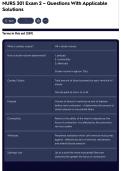
NURS 301 Exam 2 – Questions With Applicable
Solutions
Save
Terms in this set (359)
What is cardiac output? HR x stroke volume
How is stroke volume determined? 1. preload
2. contractility
3. afterload
Stroke volume is approx. 70cc
Cardiac Output Total amount of blood pumped by each ventricle in 1
minute
Normal adult at rest is 4L to 8L
Preload Volume of blood in ventricles at end of diastole
before next contraction - it determines the amount of
stretch placed on myocardial fibers
Contractility Refers to the ability of the heart to depolarize, the
force of contraction. It is affected by the autonomic
nervous system
Afterload Peripheral resistance which Left ventricle must pump
against - affected by size of ventricle, wall tension,
and arterial blood pressure
Starling's Law Up to a point the more myocardial fibers are
stretched the greater the force of contraction
,Preload and Afterload
Autonomic Regulation of the - Barorecptors in aortic arch and carotids responsive
Cardiovascular System to stretch
- Chemoreceptors in aortic arch and carotids
responsive to pH, PO2 and PCo2
- Information conveyed to vasomotor center in
brainstem
Sympathetic Stimulation - Release of Epinephrine and Norepinephrine
- Epi and NE stimulate β-1 Receptors
- NE stimulates α-1 receptors
- Increases Heart rate, conduction, contractility, and
peripheral vasoconstriction
Parasympathetic Stimulation - Mediated by Vagus Nerve
- Slows Heart Rate, Contractility and Conduction
What are the 3 major types of blood Arteries, capillaries, veins
vessels?
Diagnostic Studies of Heart - CXR
- ECG
- Holter Monitor/ Event Monitor
- Echocardiogram (2-D or Transesophageal)
- Exercise Stress Test/Stress Echo
Cardiac Enzymes Indicate damage to myocardial cells and include CK-
MB, troponins, troponin T, and Troponin I
CK-MB Cardiac-specific isoenzyme - rises with myocardial
damage
Rise in 3-12 hours
Peak in 24 hours
Return to baseline in 48-72 hours
,Troponins Protein found in myocardial cells - help regulate
contractile process
Troponin T - Should be <0.2 ng/L
- First detected 3-5 hrs, stays elevated for 14-21 days
Troponin I - Should be <0.03 ng/L
- First detected 3 hrs, stays elevated 7-10 days
Blood Pressure Force exerted by blood against artery wall during
ventricular contraction (systolic) & ventricular
relaxation (diastolic)
- Must be adequate to maintain tissue perfusion
during activity & rest
- Blood pressure - Products of Cardiac Output X SVR
- SNS, Cardiovascular, Renal, & Endocrine systems
regulates BP
Hypertension Systolic is > 140 mmHg & diastolic is > 90 mmHg
for extended periods of time
Negative effects: gradually damages blood vessels
Target organs: Heart, Kidneys, Brain, & Eyes
HTN puts individuals at risk for: - MI
- CHF
- CVA
- Renal Failure
- Retinal Damage/Impaired Vision
Who is at risk for HTN? - Increased age
- Hispanics and African Americans have higher rates
of uncontrolled blood pressure
Classification of Hypertension - SBP < 120 DBP < 80
Normal
, Classification of Hypertension - SBP 120-139 DBP 80-89
Prehypertension Life style changes
Classification of Hypertension - Stage SBP 140-159 or DBP 90-99
1 HTN Initiate some type of pharmacological agent to help
lower BP (ex: diuretic)
Classification of Hypertension - Stage SBP >160 or DBP > 100
2 HTN May initiate a couple types of medications (ex:
diuretic and a beta-blocker)
Some medication regimens work better for certain
people (can be a process of trial and error)
Primary HTN From an unidentified cause (majority of people with
high blood pressure)
Secondary HTN Related to identified cause (ex: genetic condition
causing narrowing of the aorta)
Risk Factors for HTN - Obesity (BMI > = 30)
- Dyslipidemia
- Diabetes
- Metabolic syndrome
- Sedentary lifestyle
- Impaired renal function
- Age ( > 55 men, > 65 women)
- Family History
Solutions
Save
Terms in this set (359)
What is cardiac output? HR x stroke volume
How is stroke volume determined? 1. preload
2. contractility
3. afterload
Stroke volume is approx. 70cc
Cardiac Output Total amount of blood pumped by each ventricle in 1
minute
Normal adult at rest is 4L to 8L
Preload Volume of blood in ventricles at end of diastole
before next contraction - it determines the amount of
stretch placed on myocardial fibers
Contractility Refers to the ability of the heart to depolarize, the
force of contraction. It is affected by the autonomic
nervous system
Afterload Peripheral resistance which Left ventricle must pump
against - affected by size of ventricle, wall tension,
and arterial blood pressure
Starling's Law Up to a point the more myocardial fibers are
stretched the greater the force of contraction
,Preload and Afterload
Autonomic Regulation of the - Barorecptors in aortic arch and carotids responsive
Cardiovascular System to stretch
- Chemoreceptors in aortic arch and carotids
responsive to pH, PO2 and PCo2
- Information conveyed to vasomotor center in
brainstem
Sympathetic Stimulation - Release of Epinephrine and Norepinephrine
- Epi and NE stimulate β-1 Receptors
- NE stimulates α-1 receptors
- Increases Heart rate, conduction, contractility, and
peripheral vasoconstriction
Parasympathetic Stimulation - Mediated by Vagus Nerve
- Slows Heart Rate, Contractility and Conduction
What are the 3 major types of blood Arteries, capillaries, veins
vessels?
Diagnostic Studies of Heart - CXR
- ECG
- Holter Monitor/ Event Monitor
- Echocardiogram (2-D or Transesophageal)
- Exercise Stress Test/Stress Echo
Cardiac Enzymes Indicate damage to myocardial cells and include CK-
MB, troponins, troponin T, and Troponin I
CK-MB Cardiac-specific isoenzyme - rises with myocardial
damage
Rise in 3-12 hours
Peak in 24 hours
Return to baseline in 48-72 hours
,Troponins Protein found in myocardial cells - help regulate
contractile process
Troponin T - Should be <0.2 ng/L
- First detected 3-5 hrs, stays elevated for 14-21 days
Troponin I - Should be <0.03 ng/L
- First detected 3 hrs, stays elevated 7-10 days
Blood Pressure Force exerted by blood against artery wall during
ventricular contraction (systolic) & ventricular
relaxation (diastolic)
- Must be adequate to maintain tissue perfusion
during activity & rest
- Blood pressure - Products of Cardiac Output X SVR
- SNS, Cardiovascular, Renal, & Endocrine systems
regulates BP
Hypertension Systolic is > 140 mmHg & diastolic is > 90 mmHg
for extended periods of time
Negative effects: gradually damages blood vessels
Target organs: Heart, Kidneys, Brain, & Eyes
HTN puts individuals at risk for: - MI
- CHF
- CVA
- Renal Failure
- Retinal Damage/Impaired Vision
Who is at risk for HTN? - Increased age
- Hispanics and African Americans have higher rates
of uncontrolled blood pressure
Classification of Hypertension - SBP < 120 DBP < 80
Normal
, Classification of Hypertension - SBP 120-139 DBP 80-89
Prehypertension Life style changes
Classification of Hypertension - Stage SBP 140-159 or DBP 90-99
1 HTN Initiate some type of pharmacological agent to help
lower BP (ex: diuretic)
Classification of Hypertension - Stage SBP >160 or DBP > 100
2 HTN May initiate a couple types of medications (ex:
diuretic and a beta-blocker)
Some medication regimens work better for certain
people (can be a process of trial and error)
Primary HTN From an unidentified cause (majority of people with
high blood pressure)
Secondary HTN Related to identified cause (ex: genetic condition
causing narrowing of the aorta)
Risk Factors for HTN - Obesity (BMI > = 30)
- Dyslipidemia
- Diabetes
- Metabolic syndrome
- Sedentary lifestyle
- Impaired renal function
- Age ( > 55 men, > 65 women)
- Family History