
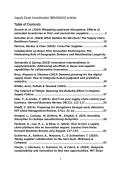
Supply Chain Coordination (EBM036C0) Articles
Table of Contents
Durach et al. (2024) Mitigating upstream disruptions: Effects of
extended inventories in first- and second-tier suppliers..................3
Scholten et al. (2025) What Options Do We Have? The Supply Chain
Resilience Funnel........................................................................10
Falcone, Barker, & Chen (2025). Cross-Tier Supplier......................19
Collaboration on Buyer Firm Innovation Performance: The
Moderating Role of Geographic Distance and Relationship Longevity
................................................................................................. 19
Selviaridis & Spring (2025) Innovation intermediation in
supplynetworks: Addressing shortfalls in buyer and supplier
capabilities for collaborative innovation.......................................28
Brau, Aloysius & Siemsen (2023) Demand planning for the digital
supply chain: How to integrate human judgment and predictive
analytics.................................................................................... 39
Dillibe, Aron, Pathak & Tanasak (2025).........................................47
The Internet of Things: Reducing the Bullwhip Effect in Hospital
Supply Chains............................................................................. 47
Choi, T., & Linton, T. (2011). Don’t let your supply chain control your
business. Harvard Business Review, 89(12), 112–117....................55
Sheffi, Y. (2015). Preparing for disruptions through early detection.
MIT Sloan Management Review, 57(1), 31–42...............................57
Hempel, L., Conway,. M. Doheny, M., Singhal, S. 2026. Decoding
disruption to reshape manufacturing footprints. .........................59
Ferdows, K., Lee, H. L., & Zhao, X. (2022). How to turn a supply
chain platform into an innovation engine: Lessons from Haier.
Harvard Business Review, July–August, 127–133. ........................61
Gutierrez, A., Kothari, A., Mazuera, C., & Schoenherr, T. (2020).
Taking supplier collaboration to the next level. McKinsey &
Company. ................................................................................. 63
Visnjic, I., Monteiro, F., Tushman, M., & Ciorra, E. (2025). Integrate
sustainability and innovation to find new opportunities. MIT Sloan
1
,Management Review. ................................................................66
Moreno, A. (2025). How digital integration is reconfiguring value
chains. Harvard Business Review, September–October, 50–59. .....68
Wingate, D., Burns, B. L., & Barney, J. B. (2025). Why AI will not
provide sustainable competitive advantage. MIT Sloan Management
Review. .................................................................................... 71
Netland, T. (2025). Demystifying Industry 4.0: Navigating
automation and augmentation. IEEE Engineering Management
Review, 53(6), 47–54. ................................................................73
2
,Tutorial papers
Durach et al. (2024) Mitigating upstream disruptions: Effects of
extended inventories in first- and second-tier suppliers
1. Introduction — Why the paper matters
Durach et al. begin from a very practical but underexplored problem in supply chain management: when
an upstream disruption occurs, what really protects a buyer’s performance? Much of the established
literature says inventory matters, but most of that literature treats inventory as something that sits
inside the focal firm. The paper argues that this is too narrow. In reality, firms are embedded in multi-
tier supply chains, and some of the resources that matter most in a disruption are not controlled by the
focal buyer at all. They may be held by the buyer’s direct suppliers, or even further upstream by indirect,
second-tier suppliers.
The article therefore shifts attention from the usual buyer–supplier dyad to a triad composed of the
buyer, a first-tier supplier, and a second-tier supplier. This is important because it reveals that first-tier
suppliers do not merely supply the buyer directly; they also act as a bridge between the buyer and the
second-tier supplier. That bridging position means they can shape whether upstream inventory at the
second tier is actually useful to the buyer in a disruption. In other words, the paper is not only about
inventory levels; it is also about access, control, and propagation of resources across tiers.
The authors use the 2011 Great East Japan Earthquake (GEJE) as their empirical setting. This context is
powerful because it was a large, hard-to-predict event that hit upstream production in Japan and
therefore created a real-world test of whether inventory buffers in different tiers actually mattered for
downstream firms. Their key questions are simple but important: do first-tier and second-tier
inventories improve buyer performance after an upstream disruption, and does the value of those
inventories depend on the buyer’s own inventory and on the degree of competition for the suppliers’
inventory?
Bullet-point study notes
The paper challenges the idea that only the buyer’s own inventory matters.
Main shift: from firm-level to multi-tier network-level thinking.
Unit of interest is the buyer–first-tier–second-tier triad.
First-tier suppliers matter not only as suppliers, but as bridges to second-tier resources.
Empirical setting: Great East Japan Earthquake (2011).
Core question: how does inventory slack across tiers affect buyer performance after disruption?
1. Introduction
Supply chains are increasingly exposed to hard-to-predict disruptions such as earthquakes,
volcanic eruptions, and pandemics.
Inventories are a key lever to manage disruption risk, but most prior research focuses on
inventory within the focal firm.
This paper argues that firms are embedded in multi-tier supply chains, so inventory held by
suppliers may also affect buyer performance.
3
, The paper shifts attention from the buyer–supplier dyad to the buyer–first-tier–second-tier
triad.
Special emphasis is placed on the bridging role of first-tier suppliers:
o They are not only direct suppliers to the buyer.
o They also connect second-tier supplier resources to the buyer.
Empirical context:
o 2011 Great East Japan Earthquake (GEJE).
Research questions:
o Are first-tier and second-tier supplier inventory slack relevant for buyer performance
after an upstream disruption?
o Does the value of supplier inventory slack depend on:
the buyer’s own inventory slack?
the number of buyers competing for the first-tier supplier?
2. Theory and hypothesis development — Inventory as a resource distributed across the
chain
The theoretical foundation of the paper is the extended resource-based view. Instead of assuming that
valuable resources are only internal to the firm, the extended RBV recognizes that firms can derive value
from resources located in their network. Durach et al. position inventory slack as one of those network
resources. In stable times, inventory slack is often seen as inefficient, costly, and contrary to lean
thinking. But in disruptive times, inventory slack becomes valuable because it can sustain operations
when normal flows of materials are interrupted. The same inventory can therefore look wasteful in one
context and strategic in another.
The authors explain this through different types of rent. A firm can generate value from its own
inventory, but it can also benefit from inbound spillover rents generated by supplier inventory and from
relational rents that emerge when inventories and other resources are aligned across multiple firms.
This framing is important because it recasts supplier inventory from something external and incidental
into something that can systematically influence the buyer’s performance. The paper’s logic is not
simply “more inventory is better.” Rather, it is that inventory slack in the right place, under the right
conditions, becomes a resource that can protect the buyer from the consequences of disruption.
From there, the article develops four main hypotheses. First, both first-tier and second-tier supplier
inventory slack should positively relate to buyer financial performance after an upstream disruption.
Second, first-tier inventory should matter more than second-tier inventory, because it is closer to the
buyer and easier to access. Third, supplier inventory should be most valuable when the buyer itself has
little inventory, implying a substitution effect between internal and external inventory. Fourth, the
positive value of supplier inventory should decline when more buyers are competing for that inventory,
because scarcity increases pricing power, complexity, and access problems. The authors also extend that
competitive logic to the second tier, arguing that if second-tier suppliers also serve many first-tier firms,
second-tier inventory becomes harder to access and less beneficial to the focal buyer.
2. Theory and Hypothesis Development
Extended resource-based view
The paper uses the extended RBV:
o Valuable resources are not only internal to the firm.
4


