

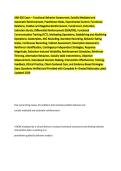
ABA 626 Exam – Functional Behavior Assessment, Socially Mediated and
Automatic Reinforcement, Practitioner Roles, Experimental Control, Functional
Relations, Positive and Negative Reinforcement, Punishment, Extinction,
Extinction Bursts, Differential Reinforcement (DRA/DRI), Functional
Communication Training (FCT), Motivating Operations, Establishing and Abolishing
Operations, Scatterplots, ABC Recording, Narrative Recording, Behavior Rating
Scales, Continuous Recording, Indirect Assessment, Descriptive Assessment,
Reinforcer Identification, Contingency-Independent Strategies, Response
Magnitude, Extinction-Induced Variability, Reinforcement Schedules, Reinforcer
Thinning, Alternative Behaviors, Socially Valid Interventions, Objective
Measurement, Data-Based Decision Making, Intervention Effectiveness, Training,
Feedback, Ethical Practice, Client-Centered Care, and Evidence-Based Strategies
Exam Questions Verified and Provided with Complete A+ Graded Rationales Latest
Updated 2026
Two overarching classes of conditions that maintain problem behavior are:
socially mediated and automatic reinforcement
A BCBA employed by a school district to conduct functional assessment and develop behavior
intervention plans is working as a:
practitioner guided by behavior analysis
, According to Cooper, Heron and Heward (2020), the experimental branch of behavior analysis
formally began with:
Skinner's publication: The Behavior of Organisms
Mr. Goldstein decides to give his students points, useable for extra free time, when they raise
their hands and wait to be called on. He discovers that more students raise their hands and
fewer students blurt out answers when he awards points than when he does not. This finding
seems to show:
a functional relationship between points and hand-raising.
If a behavior analyst wants to develop a behavior intervention plan based on the strongest
possible, empirically-derived information about the target behavior, they are most likely to do
so only after demonstrating:
experimental control over the behavior
a functional relationship between an independent and the behavior
a reliable change in the behavior given repeated manipulation of a particular aspect of the
environment
When Ms. Smith was in the checkout line at the groery store her child had a tantrum because
she could buy him candy. She was embarrassed and gave in, and he immediately calmed. Now
the child begins to loudly ask for candy as the approach the check out, but Ms. Smith carries a
bag of treats in her pocket that she can give him. Based on their current behavior it would
appear that in the original episode:
yelling was positively reinforced and giving candy was negatively reinforced.
Automatic Reinforcement, Practitioner Roles, Experimental Control, Functional
Relations, Positive and Negative Reinforcement, Punishment, Extinction,
Extinction Bursts, Differential Reinforcement (DRA/DRI), Functional
Communication Training (FCT), Motivating Operations, Establishing and Abolishing
Operations, Scatterplots, ABC Recording, Narrative Recording, Behavior Rating
Scales, Continuous Recording, Indirect Assessment, Descriptive Assessment,
Reinforcer Identification, Contingency-Independent Strategies, Response
Magnitude, Extinction-Induced Variability, Reinforcement Schedules, Reinforcer
Thinning, Alternative Behaviors, Socially Valid Interventions, Objective
Measurement, Data-Based Decision Making, Intervention Effectiveness, Training,
Feedback, Ethical Practice, Client-Centered Care, and Evidence-Based Strategies
Exam Questions Verified and Provided with Complete A+ Graded Rationales Latest
Updated 2026
Two overarching classes of conditions that maintain problem behavior are:
socially mediated and automatic reinforcement
A BCBA employed by a school district to conduct functional assessment and develop behavior
intervention plans is working as a:
practitioner guided by behavior analysis
, According to Cooper, Heron and Heward (2020), the experimental branch of behavior analysis
formally began with:
Skinner's publication: The Behavior of Organisms
Mr. Goldstein decides to give his students points, useable for extra free time, when they raise
their hands and wait to be called on. He discovers that more students raise their hands and
fewer students blurt out answers when he awards points than when he does not. This finding
seems to show:
a functional relationship between points and hand-raising.
If a behavior analyst wants to develop a behavior intervention plan based on the strongest
possible, empirically-derived information about the target behavior, they are most likely to do
so only after demonstrating:
experimental control over the behavior
a functional relationship between an independent and the behavior
a reliable change in the behavior given repeated manipulation of a particular aspect of the
environment
When Ms. Smith was in the checkout line at the groery store her child had a tantrum because
she could buy him candy. She was embarrassed and gave in, and he immediately calmed. Now
the child begins to loudly ask for candy as the approach the check out, but Ms. Smith carries a
bag of treats in her pocket that she can give him. Based on their current behavior it would
appear that in the original episode:
yelling was positively reinforced and giving candy was negatively reinforced.


