
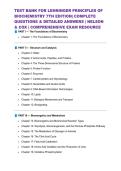
TEST BANK FOR LEHNINGER PRINCIPLES OF
BIOCHEMISTRY 7TH EDITION| COMPLETE
QUESTIONS & DETAILED ANSWERS | NELSON
& COX | COMPREHENSIVE EXAM RESOURCE
PART I — The Foundations of Biochemistry
• Chapter 1: The Foundations of Biochemistry
PART II — Structure and Catalysis
• Chapter 2: Water
• Chapter 3: Amino Acids, Peptides, and Proteins
• Chapter 4: The Three-Dimensional Structure of Proteins
• Chapter 5: Protein Function
• Chapter 6: Enzymes
• Chapter 7: Carbohydrates and Glycobiology
• Chapter 8: Nucleotides and Nucleic Acids
• Chapter 9: DNA-Based Information Technologies
• Chapter 10: Lipids
• Chapter 11: Biological Membranes and Transport
• Chapter 12: Biosignaling
PART III — Bioenergetics and Metabolism
• Chapter 13: Bioenergetics and Biochemical Reaction Types
• Chapter 14: Glycolysis, Gluconeogenesis, and the Pentose Phosphate Pathway
• Chapter 15: The Metabolism of Glycogen in Animals
• Chapter 16: The Citric Acid Cycle
• Chapter 17: Fatty Acid Catabolism
• Chapter 18: Amino Acid Oxidation and the Production of Urea
• Chapter 19: Oxidative Phosphorylation
, • Chapter 20: Photosynthesis and Carbohydrate Synthesis in Plants
• Chapter 21: Lipid Biosynthesis
• Chapter 22: Biosynthesis of Amino Acids, Nucleotides, and Related Molecules
• Chapter 23: Hormonal Regulation and Integration of Mammalian Metabolism
PART IV — Information Pathways
• Chapter 24: Genes and Chromosomes
• Chapter 25: DNA Metabolism
• Chapter 26: RNA Metabolism
• Chapter 27: Protein Metabolism
• Chapter 28: Regulation of Gene Expression
📘 LEHNINGER PRINCIPLES OF
BIOCHEMISTRY — 7TH EDITION
Nelson & Cox | Complete Test Bank | All
Chapters |
═══════════════════════════════════════
CHAPTER 1: THE FOUNDATIONS OF BIOCHEMISTRY
═══════════════════════════════════════
Q1. Which of the following best defines biochemistry?
A. The study of chemical reactions in the laboratory B. The study of living organisms at
the organismal level C. The study of the chemical components and processes of living
organisms D. The study of geological chemical reactions E. The study of
pharmaceutical compounds
, CORRECT ANSWER: C. The study of the chemical components and processes
of living organisms RATIONALE: Biochemistry is defined as the science
concerned with the chemical basis of life — studying the structure, function, and
interactions of biological molecules within living systems.
Q2. Which of the following is NOT a major class of biomolecules?
A. Proteins B. Lipids C. Nucleic acids D. Carbohydrates E. Silicates
CORRECT ANSWER: E. Silicates RATIONALE: The four major classes of
biomolecules are proteins, lipids, nucleic acids, and carbohydrates. Silicates are
inorganic minerals not classified as biomolecules.
Q3. The cellular theory states that:
A. All organisms are composed of atoms B. All living things are made of one or more
cells C. Cells only arise from chemical reactions D. All organisms photosynthesize E.
Cells are the smallest units of matter
CORRECT ANSWER: B. All living things are made of one or more cells
RATIONALE: The cell theory holds that the cell is the fundamental unit of life, all living
organisms are composed of cells, and all cells arise from pre-existing cells.
Q4. Which element is MOST abundant by mass in living organisms?
A. Carbon B. Hydrogen C. Nitrogen D. Oxygen E. Phosphorus
CORRECT ANSWER: D. Oxygen RATIONALE: Oxygen is the most abundant
element by mass in living organisms, primarily because water (which contains oxygen)
constitutes the majority of cell mass.
Q5. The molecular logic of life refers to:
A. The random nature of biochemical reactions B. The fact that all biochemical
processes follow the same physical and chemical laws C. The spiritual basis of biology
D. The diversity of metabolic pathways E. The complexity of the human genome
, CORRECT ANSWER: B. The fact that all biochemical processes follow the
same physical and chemical laws RATIONALE: The "molecular logic of life"
refers to the principle that life operates according to the same physical and chemical
laws that govern the nonliving universe — predictable and consistent.
Q6. Prokaryotic cells differ from eukaryotic cells in that they:
A. Contain ribosomes B. Have a plasma membrane C. Lack a membrane-enclosed
nucleus D. Carry out metabolism E. Contain DNA
CORRECT ANSWER: C. Lack a membrane-enclosed nucleus
RATIONALE: Prokaryotes lack a nuclear membrane; their genetic material exists free
in the cytoplasm as a nucleoid region. Eukaryotes have a true membrane-enclosed
nucleus.
Q7. Which of the following is a characteristic unique to living organisms?
A. Consisting of atoms B. Undergoing chemical reactions C. Self-replication D.
Conducting electricity E. Being subject to gravity
CORRECT ANSWER: C. Self-replication RATIONALE: Self-replication —
the ability to reproduce and pass genetic information to offspring — is a defining
characteristic of living organisms that distinguishes them from non-living matter.
Q8. The genome of an organism refers to:
A. The total protein content of a cell B. The complete set of genes or genetic material C.
The organelles in a cell D. The metabolic pathways in a cell E. The total lipid content
CORRECT ANSWER: B. The complete set of genes or genetic material
RATIONALE: The genome is the entirety of an organism's hereditary information
encoded in DNA (or RNA in some viruses), including all genes and non-coding
sequences.
Q9. Which of the following best describes metabolism?
BIOCHEMISTRY 7TH EDITION| COMPLETE
QUESTIONS & DETAILED ANSWERS | NELSON
& COX | COMPREHENSIVE EXAM RESOURCE
PART I — The Foundations of Biochemistry
• Chapter 1: The Foundations of Biochemistry
PART II — Structure and Catalysis
• Chapter 2: Water
• Chapter 3: Amino Acids, Peptides, and Proteins
• Chapter 4: The Three-Dimensional Structure of Proteins
• Chapter 5: Protein Function
• Chapter 6: Enzymes
• Chapter 7: Carbohydrates and Glycobiology
• Chapter 8: Nucleotides and Nucleic Acids
• Chapter 9: DNA-Based Information Technologies
• Chapter 10: Lipids
• Chapter 11: Biological Membranes and Transport
• Chapter 12: Biosignaling
PART III — Bioenergetics and Metabolism
• Chapter 13: Bioenergetics and Biochemical Reaction Types
• Chapter 14: Glycolysis, Gluconeogenesis, and the Pentose Phosphate Pathway
• Chapter 15: The Metabolism of Glycogen in Animals
• Chapter 16: The Citric Acid Cycle
• Chapter 17: Fatty Acid Catabolism
• Chapter 18: Amino Acid Oxidation and the Production of Urea
• Chapter 19: Oxidative Phosphorylation
, • Chapter 20: Photosynthesis and Carbohydrate Synthesis in Plants
• Chapter 21: Lipid Biosynthesis
• Chapter 22: Biosynthesis of Amino Acids, Nucleotides, and Related Molecules
• Chapter 23: Hormonal Regulation and Integration of Mammalian Metabolism
PART IV — Information Pathways
• Chapter 24: Genes and Chromosomes
• Chapter 25: DNA Metabolism
• Chapter 26: RNA Metabolism
• Chapter 27: Protein Metabolism
• Chapter 28: Regulation of Gene Expression
📘 LEHNINGER PRINCIPLES OF
BIOCHEMISTRY — 7TH EDITION
Nelson & Cox | Complete Test Bank | All
Chapters |
═══════════════════════════════════════
CHAPTER 1: THE FOUNDATIONS OF BIOCHEMISTRY
═══════════════════════════════════════
Q1. Which of the following best defines biochemistry?
A. The study of chemical reactions in the laboratory B. The study of living organisms at
the organismal level C. The study of the chemical components and processes of living
organisms D. The study of geological chemical reactions E. The study of
pharmaceutical compounds
, CORRECT ANSWER: C. The study of the chemical components and processes
of living organisms RATIONALE: Biochemistry is defined as the science
concerned with the chemical basis of life — studying the structure, function, and
interactions of biological molecules within living systems.
Q2. Which of the following is NOT a major class of biomolecules?
A. Proteins B. Lipids C. Nucleic acids D. Carbohydrates E. Silicates
CORRECT ANSWER: E. Silicates RATIONALE: The four major classes of
biomolecules are proteins, lipids, nucleic acids, and carbohydrates. Silicates are
inorganic minerals not classified as biomolecules.
Q3. The cellular theory states that:
A. All organisms are composed of atoms B. All living things are made of one or more
cells C. Cells only arise from chemical reactions D. All organisms photosynthesize E.
Cells are the smallest units of matter
CORRECT ANSWER: B. All living things are made of one or more cells
RATIONALE: The cell theory holds that the cell is the fundamental unit of life, all living
organisms are composed of cells, and all cells arise from pre-existing cells.
Q4. Which element is MOST abundant by mass in living organisms?
A. Carbon B. Hydrogen C. Nitrogen D. Oxygen E. Phosphorus
CORRECT ANSWER: D. Oxygen RATIONALE: Oxygen is the most abundant
element by mass in living organisms, primarily because water (which contains oxygen)
constitutes the majority of cell mass.
Q5. The molecular logic of life refers to:
A. The random nature of biochemical reactions B. The fact that all biochemical
processes follow the same physical and chemical laws C. The spiritual basis of biology
D. The diversity of metabolic pathways E. The complexity of the human genome
, CORRECT ANSWER: B. The fact that all biochemical processes follow the
same physical and chemical laws RATIONALE: The "molecular logic of life"
refers to the principle that life operates according to the same physical and chemical
laws that govern the nonliving universe — predictable and consistent.
Q6. Prokaryotic cells differ from eukaryotic cells in that they:
A. Contain ribosomes B. Have a plasma membrane C. Lack a membrane-enclosed
nucleus D. Carry out metabolism E. Contain DNA
CORRECT ANSWER: C. Lack a membrane-enclosed nucleus
RATIONALE: Prokaryotes lack a nuclear membrane; their genetic material exists free
in the cytoplasm as a nucleoid region. Eukaryotes have a true membrane-enclosed
nucleus.
Q7. Which of the following is a characteristic unique to living organisms?
A. Consisting of atoms B. Undergoing chemical reactions C. Self-replication D.
Conducting electricity E. Being subject to gravity
CORRECT ANSWER: C. Self-replication RATIONALE: Self-replication —
the ability to reproduce and pass genetic information to offspring — is a defining
characteristic of living organisms that distinguishes them from non-living matter.
Q8. The genome of an organism refers to:
A. The total protein content of a cell B. The complete set of genes or genetic material C.
The organelles in a cell D. The metabolic pathways in a cell E. The total lipid content
CORRECT ANSWER: B. The complete set of genes or genetic material
RATIONALE: The genome is the entirety of an organism's hereditary information
encoded in DNA (or RNA in some viruses), including all genes and non-coding
sequences.
Q9. Which of the following best describes metabolism?


