

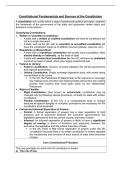
Constitutional Fundamentals and Sources of the Constitution
A constitution will usually define a state’s fundamental political principles, establish
the framework of the government of the state and guarantee certain rights and
freedoms to the citizens.
Classifying Constitutions:
• Written or Unwritten Constitution:
o A state with a written or codified constitution will have its constitution set
out in a single document.
o A state, such as the UK, with an unwritten or uncodified constitution will
have the constitution made up of different sources (statute, case law, etc.).
• Republican or Monarchical:
o A state with a republican constitution will usually have a president, often
elected directly or indirectly, as the head of state.
o A state with monarchical constitution like the UK, will have an unelected
monarch as head of stead, which play largely ceremonial role.
• Federal or Unitary:
o Federal constitution: Division of power between the central government
and regional government.
o Unitary Constitution: Single sovereign legislative body, with power being
concentrated at the centre.
▪ In the UK, the Parliament of Westminster is the supreme or sovereign
law-making body and other law-making bodies derive their law-making
powers from powers they have been given by the Westminster
Parliament.
• Rigid or Flexible:
o Rigid Constitution: Also known as entrenched, constitution may be
changed only by following special procedure, normally for state with written
constitution.
o Flexible Constitution: In the UK, it is comparatively easy to change
because no special (lengthy or complex) procedures are necessary for the
constitution to be amended.
• Formal and Informal Separation of Powers:
o Formal: A formal separation of powers has a clear separation of both
functions and of personnel between the executive (government), the
legislative (parliament) and the judicial (courts) branches of state.
o Informal: An informal separation of powers is likely to have a significant
degree of overlap in terms of functions and personnel between the
executive, the legislative and the judicial branches of state.
▪ In the UK, there is little formal separation of powers under the UK
constitution because there is no written constitution to strictly separate
the membership and functions of each branch of state other branches
of state.
Core Constitutional Principles
The core principles on which the UK constitution is based:
a) The rule of law.
, a. There should be no arbitrary exercise of power by the state or government
(must be permitted by the law).
b. Laws should be made properly, following a set of procedure.
c. Laws should be clear (accessible).
d. Laws should be certain (law should not operate retrospectively).
e. There should be equality before the law (citizens have equal access and
the law should treat all persons in the same way).
f. The judiciary should be independent and impartial.
b) The separation of powers.
a. The legislature or parliament – the body that makes the law (Monarch,
House of Lord, House of Common).
b. The executive or government – the body that implements the law
(Monarch, Prime Minister, Other Government Ministers, Civil Service,
Members of Police and Armed Forces).
c. The judiciary or court – The body that resolves disputes about the law
(Monarch, All Legally Qualified Judges, Magistrates).
d. The UK used a checks and balances approach.
c) The sovereignty of parliament.
a. A common law doctrine accepted by the judiciary under which the courts
acknowledge that legislation enacted by Parliament takes precedence
over common law.
Sources of the UK Constitution
Acts of Parliament
The test for a constitutional statute:
a) The statute must condition the legal relationship between citizen and state in
some general, overarching manner. OR
b) The statute must change the scope of fundamental constitutional rights.
NB. constitutional statute cannot be impliedly repealed but may be repealed by
express word or words so specific that make Parliament’s intention to repeal very
clear. Note each Act may be repealed by an ordinary Act of Parliament, no special
procedure or majority was required.
Key Examples:
• Magna Carta 1215: First assertion of the limits on the power of the Monarch and
the rights of individuals. It embodies the principle that government must be
conducted according to the law and with the consent of the governed.
• Bill of Rights 1690: This imposed limitations on the powers of the Crown and
its relationship with Parliament. Parliament should meet on a regular basis and
elections to Parliament should be free from interference by the Monarch.
o ‘Freedom of speech and debates in proceedings in Parliament ought not
to be impeached or questioned in any court or place out of Parliament.
• Act of Union 1706-07: United England and Scotland under a single Parliament
of Great Britain.
• Parliament Acts 1911 and 1949: Altered the relationship between the House of
Lords and the House of Commons. The elected House of Common would prevail
, over the unelected House of Lords. Legislation can be enacted without the
consent of the House of Lords.
• Police and Criminal Evidence Act 1984: It provides the police with extensive
powers of arrest, search and detention, and important safeguards to prevent
abuse of powers by the police.
• Public Order Act 1986: Limitations to be placed on the rights of citizens to hold
marches and meeting in public places.
• Human Rights Act 1998: Incorporated ECHR into domestic law. Allows citizens
to raise alleged breach of human rights before domestic courts.
• Acts of Devolution: The Acts of devolution created a devolved system of
government in various parts of the UK.
• Constitutional Reform Act 2005: Transferred Lord Chancellor’s powers as
head of the judiciary to the Lord Chief Justice; House of lord can elect its own
Speaker; provided for the creation of a Supreme Court; created a new body to
oversee the appointment of judges (Judicial Appointments Commission).
• European Union (Withdrawal) Act 2018 and European Union (Withdrawal
Agreement) Act 2020: Ended the supremacy of EU Law and introduced the
concept of retained EU law or assimilated law.
Case Law
a) Residual Freedom: Citizens are free to do or say whatever they wish unless the
law clearly states that such an action or statement is prohibited.
b) Action of the State must have legal authority: Established through common
law that actions taken by state officials must have a legal basis if they are to be
lawful. Entick v Carrington: This case established the principle that state
officials could not act in an arbitrary manner and that the exercise of power by
the state had to have clear legal authority.
c) Legal disputes should be resolved by the judiciary: Case of Prohibitions
(Prohibitions del Roy) (1607) 12 Co Rep 63: Monarch had no power to decide
legal matters by way of arbitrary rulings, and that legal disputes should properly
be resolved by the court.
d) Habeas Corpus and individual liberty: An individual who has been detained
by the state has the right to have the legality of that detention tested before a
court, developed originally through the common law.
e) Right to have a fair hearing: A fundamental constitutional principle developed
through common law.
f) Judicial Review of Executive Actions: A mechanism that enables the courts
to ensure that the Government and other public bodies exercise the powers that
they have been granted in the power way and do not breach the rule of law.
g) Parliamentary Sovereignty: A common law doctrine accepted by the judiciary.
Enrolled Act: Once an Act of Parliament has been entered onto the
parliamentary roll, the courts will not question the validity of the Act or hold the
Act to be void, cannot deem it unconstitutional.
h) The Interpretation of Statute: R (Miller) v Secretary of State for Exiting the
European Union (Miller No.1): The Supreme Court interpreted the ECA 1972
as preventing the Government from using the royal prerogative as the legal basis
for the notice of withdrawal from the EU.
, The Royal Prerogative
Dicey, ‘the residue of discretionary or arbitrary authority, which at any given time is
legally left in the hands of the Crown… Every act which the government can lawfully
do without the authority of an Act of Parliament is done in virtue of this prerogative.’
Some powers which the govt exercises are derived from royal prerogative:
• What remains of the absolute powers that were exercised by the monarch and
have not been removed by Parliament.
• Most of the powers are by convention exercised by the Prime Minister and other
government ministers on the Monarch’s behalf.
• Acts of Parliament can remove prerogative powers (e.g., Crown Proceedings
Act 1947 and Fixed Term Parliaments Act 2011)
• Where statute and the Royal prerogative come into conflict, statute will prevail.
Government cannot use the prerogative in a way that contradicts a statutory
power.
• The ability of the Government to spend money to exercise its prerogative
powers does depend on Parliament’s willingness to vote to provide the
necessary funds. Government cannot use a prerogative power to authorise
expenditure.
The judiciary is responsible for deciding the extent of the royal prerogative. Through
case law, courts have established that new prerogative powers cannot be created
or the scope of existing powers extended.
Key Areas of Prerogative:
• Foreign Affairs:
o Declarations of war and the deployment of armed forces overseas.
o Making Treaties.
o The recognition of foreign states.
• Domestic Affairs:
o The summoning of Parliament.
o The appointment and dismissal of the Prime Minister and other government
ministers.
o The giving of Royal Assent to bills.
o The dissolution of Parliament.
o Defence of the realm.
o The exercise of the prerogatives of pardon and mercy.
o Granting public honours.
o The setting up of public bodies to disburse funds made available by
Parliament.
The Royal Prerogative and Statute
• Parliament can remove or suspend prerogative powers by statute.
o Crown Proceedings Act 1947 removed Crown immunity from legal claims
against it in both tort and contract.
A constitution will usually define a state’s fundamental political principles, establish
the framework of the government of the state and guarantee certain rights and
freedoms to the citizens.
Classifying Constitutions:
• Written or Unwritten Constitution:
o A state with a written or codified constitution will have its constitution set
out in a single document.
o A state, such as the UK, with an unwritten or uncodified constitution will
have the constitution made up of different sources (statute, case law, etc.).
• Republican or Monarchical:
o A state with a republican constitution will usually have a president, often
elected directly or indirectly, as the head of state.
o A state with monarchical constitution like the UK, will have an unelected
monarch as head of stead, which play largely ceremonial role.
• Federal or Unitary:
o Federal constitution: Division of power between the central government
and regional government.
o Unitary Constitution: Single sovereign legislative body, with power being
concentrated at the centre.
▪ In the UK, the Parliament of Westminster is the supreme or sovereign
law-making body and other law-making bodies derive their law-making
powers from powers they have been given by the Westminster
Parliament.
• Rigid or Flexible:
o Rigid Constitution: Also known as entrenched, constitution may be
changed only by following special procedure, normally for state with written
constitution.
o Flexible Constitution: In the UK, it is comparatively easy to change
because no special (lengthy or complex) procedures are necessary for the
constitution to be amended.
• Formal and Informal Separation of Powers:
o Formal: A formal separation of powers has a clear separation of both
functions and of personnel between the executive (government), the
legislative (parliament) and the judicial (courts) branches of state.
o Informal: An informal separation of powers is likely to have a significant
degree of overlap in terms of functions and personnel between the
executive, the legislative and the judicial branches of state.
▪ In the UK, there is little formal separation of powers under the UK
constitution because there is no written constitution to strictly separate
the membership and functions of each branch of state other branches
of state.
Core Constitutional Principles
The core principles on which the UK constitution is based:
a) The rule of law.
, a. There should be no arbitrary exercise of power by the state or government
(must be permitted by the law).
b. Laws should be made properly, following a set of procedure.
c. Laws should be clear (accessible).
d. Laws should be certain (law should not operate retrospectively).
e. There should be equality before the law (citizens have equal access and
the law should treat all persons in the same way).
f. The judiciary should be independent and impartial.
b) The separation of powers.
a. The legislature or parliament – the body that makes the law (Monarch,
House of Lord, House of Common).
b. The executive or government – the body that implements the law
(Monarch, Prime Minister, Other Government Ministers, Civil Service,
Members of Police and Armed Forces).
c. The judiciary or court – The body that resolves disputes about the law
(Monarch, All Legally Qualified Judges, Magistrates).
d. The UK used a checks and balances approach.
c) The sovereignty of parliament.
a. A common law doctrine accepted by the judiciary under which the courts
acknowledge that legislation enacted by Parliament takes precedence
over common law.
Sources of the UK Constitution
Acts of Parliament
The test for a constitutional statute:
a) The statute must condition the legal relationship between citizen and state in
some general, overarching manner. OR
b) The statute must change the scope of fundamental constitutional rights.
NB. constitutional statute cannot be impliedly repealed but may be repealed by
express word or words so specific that make Parliament’s intention to repeal very
clear. Note each Act may be repealed by an ordinary Act of Parliament, no special
procedure or majority was required.
Key Examples:
• Magna Carta 1215: First assertion of the limits on the power of the Monarch and
the rights of individuals. It embodies the principle that government must be
conducted according to the law and with the consent of the governed.
• Bill of Rights 1690: This imposed limitations on the powers of the Crown and
its relationship with Parliament. Parliament should meet on a regular basis and
elections to Parliament should be free from interference by the Monarch.
o ‘Freedom of speech and debates in proceedings in Parliament ought not
to be impeached or questioned in any court or place out of Parliament.
• Act of Union 1706-07: United England and Scotland under a single Parliament
of Great Britain.
• Parliament Acts 1911 and 1949: Altered the relationship between the House of
Lords and the House of Commons. The elected House of Common would prevail
, over the unelected House of Lords. Legislation can be enacted without the
consent of the House of Lords.
• Police and Criminal Evidence Act 1984: It provides the police with extensive
powers of arrest, search and detention, and important safeguards to prevent
abuse of powers by the police.
• Public Order Act 1986: Limitations to be placed on the rights of citizens to hold
marches and meeting in public places.
• Human Rights Act 1998: Incorporated ECHR into domestic law. Allows citizens
to raise alleged breach of human rights before domestic courts.
• Acts of Devolution: The Acts of devolution created a devolved system of
government in various parts of the UK.
• Constitutional Reform Act 2005: Transferred Lord Chancellor’s powers as
head of the judiciary to the Lord Chief Justice; House of lord can elect its own
Speaker; provided for the creation of a Supreme Court; created a new body to
oversee the appointment of judges (Judicial Appointments Commission).
• European Union (Withdrawal) Act 2018 and European Union (Withdrawal
Agreement) Act 2020: Ended the supremacy of EU Law and introduced the
concept of retained EU law or assimilated law.
Case Law
a) Residual Freedom: Citizens are free to do or say whatever they wish unless the
law clearly states that such an action or statement is prohibited.
b) Action of the State must have legal authority: Established through common
law that actions taken by state officials must have a legal basis if they are to be
lawful. Entick v Carrington: This case established the principle that state
officials could not act in an arbitrary manner and that the exercise of power by
the state had to have clear legal authority.
c) Legal disputes should be resolved by the judiciary: Case of Prohibitions
(Prohibitions del Roy) (1607) 12 Co Rep 63: Monarch had no power to decide
legal matters by way of arbitrary rulings, and that legal disputes should properly
be resolved by the court.
d) Habeas Corpus and individual liberty: An individual who has been detained
by the state has the right to have the legality of that detention tested before a
court, developed originally through the common law.
e) Right to have a fair hearing: A fundamental constitutional principle developed
through common law.
f) Judicial Review of Executive Actions: A mechanism that enables the courts
to ensure that the Government and other public bodies exercise the powers that
they have been granted in the power way and do not breach the rule of law.
g) Parliamentary Sovereignty: A common law doctrine accepted by the judiciary.
Enrolled Act: Once an Act of Parliament has been entered onto the
parliamentary roll, the courts will not question the validity of the Act or hold the
Act to be void, cannot deem it unconstitutional.
h) The Interpretation of Statute: R (Miller) v Secretary of State for Exiting the
European Union (Miller No.1): The Supreme Court interpreted the ECA 1972
as preventing the Government from using the royal prerogative as the legal basis
for the notice of withdrawal from the EU.
, The Royal Prerogative
Dicey, ‘the residue of discretionary or arbitrary authority, which at any given time is
legally left in the hands of the Crown… Every act which the government can lawfully
do without the authority of an Act of Parliament is done in virtue of this prerogative.’
Some powers which the govt exercises are derived from royal prerogative:
• What remains of the absolute powers that were exercised by the monarch and
have not been removed by Parliament.
• Most of the powers are by convention exercised by the Prime Minister and other
government ministers on the Monarch’s behalf.
• Acts of Parliament can remove prerogative powers (e.g., Crown Proceedings
Act 1947 and Fixed Term Parliaments Act 2011)
• Where statute and the Royal prerogative come into conflict, statute will prevail.
Government cannot use the prerogative in a way that contradicts a statutory
power.
• The ability of the Government to spend money to exercise its prerogative
powers does depend on Parliament’s willingness to vote to provide the
necessary funds. Government cannot use a prerogative power to authorise
expenditure.
The judiciary is responsible for deciding the extent of the royal prerogative. Through
case law, courts have established that new prerogative powers cannot be created
or the scope of existing powers extended.
Key Areas of Prerogative:
• Foreign Affairs:
o Declarations of war and the deployment of armed forces overseas.
o Making Treaties.
o The recognition of foreign states.
• Domestic Affairs:
o The summoning of Parliament.
o The appointment and dismissal of the Prime Minister and other government
ministers.
o The giving of Royal Assent to bills.
o The dissolution of Parliament.
o Defence of the realm.
o The exercise of the prerogatives of pardon and mercy.
o Granting public honours.
o The setting up of public bodies to disburse funds made available by
Parliament.
The Royal Prerogative and Statute
• Parliament can remove or suspend prerogative powers by statute.
o Crown Proceedings Act 1947 removed Crown immunity from legal claims
against it in both tort and contract.


