

Written by students who passed Immediately available after payment Read online or as PDF Wrong document? Swap it for free 4.6 TrustPilot
logo-home
Document preview thumbnail
Preview 3 out of 17 pages
Exam (elaborations)

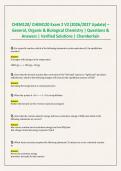
CHEM120/ CHEM120 Exam 2 V2 (2026/2027 Update) – General, Organic & Biological Chemistry | Questions & Answers | Verified Solutions | Chamberlain

Document preview thumbnail
Preview 3 out of 17 pages

…..DLDD CHEM120/ CHEM120 Exam 2 V2 (2026/2027 Update) – General, Organic & Biological Chemistry | Questions & Answers | Verified Solutions | Chamberlain Q. For a specific reaction, which of the following statements can be made about K, the equilibrium constant? Answer It changes with changes in the temperature 2H2O (g) — 2H2 (g) + O2 (g) Q. Given that the forward reaction (the conversion of the "left hand" species to "right hand" species) is endothermic, which of the following changes will decrease the equilibrium amount of H2O? Answer Increasing the temperature at constant pressure Q. When the system A + B —- C + D is at equilibrium Answer Neither the forward nor the reverse reaction has stopped Q. Given that the reaction absorbs energy and has an activation energy of 50kJ/mol, which of the following statements are correct? Answer •the revers reaction has an activation energy less than 50kJ/mol •the change in internal energy is greater than 0 Q. Which items correctly complete the following statement? A catalyst can act in a chemical reaction to: Answer •lower the activation energy •provide a new path for the reaction Q. Which of the following is a weak acid? Answer HF Q. When the concentration of reactant molecules is increased, the rate of reaction increases. The best explanation is: As a reactant concentration increases, Answer The frequency of molecular collisions increases Q. The combustion of ethane (C2H6) is represented by the equation: 2C2H6 (g) + 7O2 (g) — 4CO2 (g) + 6H2O (l) Answer In this reaction: CO2 is formed twice as fast as ethane is consumed Q. Which of the following weak acids ionizes to give the strongest conjugate base? HCN Answer A + 3B — 2C + D Q. The reaction is first order with respect to reactant A and second order with respect to reactant B. If the concentration of A is doubled and the concentration of B is halved, the rate of the reaction would______by a factor of____. Answer Decrease, 2 Q. In a sample of pure water, only one of the following statements is always true at all conditions of temperature and pressure. Which one is always true? Answer [H3O+] = [OH-] Q. Which of the following is true about a 0.10 M solution of a weak acid, HX? Answer [HX] [H+] Q. Which of the following solutions has the lowest pH at 25*C? Answer 0.2 Benzoic acid Q. For a reaction 2A + B — 2C, with the rate equation: Rate=k[A]^2[B] Answer The order with respect to A is 2 and the order overall is 3 Q. Under what condition is the H3O+ concentration in water expected to be 0? Answer Never Q. Which of the following statements concerning equilibrium is false? Answer The equilibrium constant usually is independent of temperature Q. A solution in which the pOH is 12.5 would be described as _______. Answer distinctly acidic Q. Which of the following statements about weak acids is false? Answer The Ka values for weak acids are numbers that are greater than 1 Q. Consider the reaction A (g) + B (g) — D (g) + heat A.) 100*C, 50 atm B.) 100*C, 10 atm C.) 500*C, 50 atm D.) 100*C, 10 atm, catalyst E.) 100*C, 25 atm Answer 100*C, 50 atm Q. Acid. Ionization Constant (Ka value) Answer I. 1.0x10⁻³ II. 3.0x10⁻⁵ III. 2.6x10⁻⁷ IV. 4.0x10⁻⁹ V. 7.3x10⁻¹¹ V Q. Which of the following statements is false? A.) Solvolysis is the reaction of a substance with the solvent in which it is dissolved B.) hydrolysis is the reaction of a substance with water C.) the anion of a weak acid reacts with water to form nonionized acid and OH- ions D.) according to Brønsted-Lowry the anions of strong acids are very strong bases E.) the conjugate acid of a strong base is a very weak acid Answer D.) According to Brønsted-Lowry the anions of strong acids are very strong bases Q. The value of Ka for benzoic acid, C6H5OOH, is 6.3x10⁻⁵. When sodium benzoate is dissolved in water, the reaction that occurs is_______, resulting in a solution that is______. Answer C6H5COO- (aq) + H2O (l) — C6H5COOH (aq) + OH- (aq); basic Q. Consider the exothermic combustion of coal. Which of the following could increase the rate of reaction? A.) using smaller pieces of coal B.) increasing the concentration of oxygen C.) lowering the temperature D.) both a and b are correct E.) choices a b and c are all correct Answer D.) both a and b are correct Q. Which of the following statements about catalyst are false? A.) a catalyst lowers the activation energy. B.) a catalyst can make a non-spontaneous reaction, spontaneous. C.) a catalyst speeds up both the forward and reverse reaction. D.) a catalyst speed up the rate of reaction E.) catalyst are often transition metals and transition metal oxides. Answer B.) a catalyst can make a non-spontaneous reaction spontaneous Q. Which of the following statements about reaction mechanisms is false? A.) a reaction can have more than one possible mechanism. B.) a reaction mechanism must be consistent with the experimentally observed rate law. C.) the slowest step in the reaction mechanism is called the rate determining step. D.) reaction mechanisms involve complex reaction steps. E.) reaction mechanisms are difficult to prove. Answer D.) reaction mechanisms involve complex reaction steps. (collisions between more than two reacted/reaction. Intermediates is not common.) Q. True or False: Enantiomers are mirror images of each other. Answer True Q. The compound 2-propanone is also known as Answer Acetone Q. True or False: Ethers can only be straight chain compounds. Answer False Q. Aldehydes have higher boiling points than alkanes of similar mass because of Answer Dipole-dipole interactions Q. True or False: 2-butanol is a chiral molecule. Answer True Which is more soluble in water? Butane or 1-propanol? 1-propanol more soluble in water? 1-propanol or ethyl methyl ether? 1-propanol more sol. in water? ethanol or 1-hexanol? ethanol True or False: An acetal is formed from an aldehyde or ketone and one molecule of alcohol. False True or False: Phenols behave as weak acids in water True. Acetone can be produced by the body when a person is dieting with high proteins True or False: The carbonyl group does not have a dipole FALSE T or F: Alcohols can be dehydrated to form alkenes. True T or F: Alcohol can form hydrogen bonds. True The carbonyl group consists of A carbon-oxygen double bond T or F: A hemiacetal has alkoxy and hydroxyl functional groups bonded to the same carbon True Aldehydes and ketones may be reduced to Alcohols T or F: Hexanal would be soluble in water False Thiols can be gently oxidized to Disulfides T or F: Alcohols, ethers, and thiols contain oxygen atoms. FALSE T or F: The suffix -al indicates an aldehyde in the IUPAC system of naming TRUE T or F: Secondary alcohols can be oxidized to ketones TRUE T or F: Alcohols form hydrogen bonds; this accounts for their higher boiling points when compared to similar-sized alkanes TRUE What are the bond angles in a typical carbonyl group? 120 degrees How do sugars form cyclic hemiacetals? A molecule of sugar reacts with itself In the oxidation of an alcohol to a ketone, there is A loss of hydrogen T or F: A chiral carbon atom can have fewer than four different groups bonded to it. FALSE Thiols are strong-smelling compounds responsible for Skunky or bad-smelling odors Enantiomers are molecules that have which of the following? Nonsuperimposable mirror images T or F: The suffix -one indicates an aldehyde in the IUPAC system of naming. FALSE, ketone ends in -one Collision Theory of Kinetics is a model for the reaction between two compounds. They are: Orientation and Kinetic energy speed NOTE: with improper speed or orientation the reaction will NOT occur Transition State Theory of Kinetics the model that explains the energetics of a chemical reaction. -Collide with sufficient energy to initiate the breaking and making of bonds provided there is proper orientation. -The required energy is the activation energy. -The breaking and making of bonds is the transition state (activated complex). The breaking and making of bonds is the transition state The sufficient energy to initiate the breaking and making of bonds Activation energy Which combinations of orientation and kinetic energy will always result in no chemical reaction. I. Correct orientation, insufficient kinetic energy II. Correct orientation, sufficient kinetic energy III. Incorrect orientation, insufficient kinetic energy IV. Incorrect orientation, sufficient kinetic energy. I, III, and IV Mechanisms are proposed to explain how the reactants in a chemical reaction become the products, in a step-by-step manner. Mechanisms of a reaction - Bimolecular collisions favored - Slow step is the rate determining step - Stoichiometric coefficients in elementary steps are the orders with respect to the reactants and products. - Reaction intermediates not allowed in derived rate law - Fast equilibrium steps prior to the slow step used to remove reaction intermediates. To validate a mechanism, the mechanism must - give the overall balanced reaction when the elementary steps are added together.- give the experimental derived rate law. A mechanism must be experimentally proven before accepted as fact. The rate law for the reaction Cl!aq + H!S aq → S s + 2 HCl(aq) is found to be rate = k[Cl2][H2S]. Which of the following mechanisms are consistent with the rate law? (a) Cl2 ⎯→⎯ Cl+ + Cl- (slow) Cl- + H2S ⎯→⎯ HCl + HS- (fast) Cl+ + HS- ⎯→⎯ HCl + S (fast) Cl2 + H2S ⎯→⎯ S + 2 HCl (b) Cl2 + H2S ⎯→⎯ HCl + Cl+ + HS- (slow) Cl+ + HS- ⎯→⎯ HCl + S (fast) Cl2 + H2S ⎯→⎯ S + 2 HCl (c) Cl2 ←→⎯ Cl + Cl (fast, equilibrium) Cl + H2S ←→⎯ HCl + HS (fast, equilibrium) HS + Cl ⎯→⎯ HCl + S (slow) Cl2 + H2S ⎯→⎯ S + 2 HCl B, the slow step is the determining step. increasing temperature __________ the rate of reaction by increasing fraction of molecules with _____________ to initiate a chemical reaction. (activation energy) increases; sufficient kinetic energy Arrhenius equation k= Ae^(-Ea / RT) or ln(k) = Ea/R * (1/T) +ln(A) y = m x + b The Eafor a chemical reaction is experimentally calculated by plotting ______ versus the _______, ___ vs ___ natural log of the rate constant; the inverse of the temperature; ln(k); 1/T Arrhenius equation comparing two rates or unknown activation energy ln (k2/k1) = (Ea/ R) * (1/ T1 - 1/T2) The rate constant of a reaction is tripled when the temperature is increased from 298 K to 308 K. Find EA. R= 8.314 83.834 kJ/ mol The following gas phase reaction is first order. N2O5→ NO2 + NO3 The activation energy for the reaction is 88 kJ/mol. The value of k at 0oC is 9.16 x 10⁻³s-1. What would be the value of k for this reaction at room temperature, 25 oC? At what temperature would this reaction have a k value of 3.00 x 10⁻²s-1? k2= 0.237 T2= 281 K Catalysts ________ the rate of a reaction but are _________ during the reaction. increase; not consumed two types of catalysts Homogeneous: same phase Heterogenous: different phase Catalysts ______ activation energy to increase the number of _________ with proper orientation. lower; successful collisions Catalysts ________ the fraction of molecules with the proper orientation for reaction. Increase correct orientation + increase collisions with sufficient KE = _______ rate of reaction increase; increased Which of the following are false for catalysts? Catalysts...... I. are not consumed by the chemical reaction. II. lower activation energy to increase number of successful collisions. III. increase the fraction of molecules with proper orientation for reaction. IV. in the same phase as the reactants are heterogeneous catalysts. IV only Enzymes are the _____ efficient catalyst known to man and are essential in _____ most; biochemistry Equilibrium/ dynamic equilibrium the forward and reverse reactions continue with no net change in concentration. Also known as dynamic equilibrium. (all the concentrations on the graph have a slope of 0) Equilibrium constants are ________ specific and _________specific. reaction; temperature the concentration equilibrium constant is the activities of the _______ over the activities of the ________. Products; Reactants NOTE: solids and liquids (and aq for ONLY GAS EQUIL) are not accounted for Which of the equilibrium expressions are written incorrectly for the given chemical reaction? I. N2 (g) + 3H2(G) - 2NH3 (g); Kp= P^2 NH3/ PN2 P^3H2 II. CO2 (aq) + H2O (l) - H2CO3 (aq); Kc = [H2CO3]/[CO2][H2O] iii 2NO2 (g) - N2O4 (g); Kc= [N2O4]/[NO2] iv. CaCO3 (s) - CaO (s) + CO2 (g) ; Kp= P-CO2 A) I, II, III, and IV B) IV only C) II and IV D) II only E) None are written incorrectly E). I and IV are the correct solutions ii included a liquid, iii is missing a squared value in the denominator Kp= Kc(RT)^Δn Δn moles of gaseous products - moles of gaseous reactants (coefficient sums of each) Activity for ______ and _______ does not change during course of reaction, i.e. _______ does not change, the activity is always 1. solids and liquids; concentrations For the synthesis of gaseous hydrogen iodide from gaseous hydrogen and iodine, therelationship between Kp and Kc is H2(g) + I2(g) = 2HI(g) Kp = Kc, the delta n value is 0 so the value of RT is one and that makes Kc = Kp product favored Reactions with large values of K have high percent yields K1 reactant favored Reactions with small values of K have low percent yields K1 QK too much reactant, needs to shift to the right to get to equilibrium Q=K equilibrium QK too much product, system needs to shift left to reach equilibrium. The reaction

Content preview

…..DLDD\\\\\\\

CHEM120/ CHEM120 Exam 2 V2 (2026/2027 Update) –
General, Organic & Biological Chemistry | Questions &
Answers | Verified Solutions | Chamberlain

Q. For a specific reaction, which of the following statements can be made about K, the equilibrium
constant?

Answer
It changes with changes in the temperature

2H2O (g) <—> 2H2 (g) + O2 (g)


Q. Given that the forward reaction (the conversion of the "left hand" species to "right hand" species) is
endothermic, which of the following changes will decrease the equilibrium amount of H2O?

Answer
Increasing the temperature at constant pressure


Q. When the system A + B <—-> C + D is at equilibrium
Answer
Neither the forward nor the reverse reaction has stopped


Q. Given that the reaction absorbs energy and has an activation energy of 50kJ/mol, which of the
following statements are correct?

Answer
•the revers reaction has an activation energy less than 50kJ/mol
•the change in internal energy is greater than 0


Q. Which items correctly complete the following statement? A catalyst can act in a chemical reaction
to:

Answer
•lower the activation energy
•provide a new path for the reaction

,Q. Which of the following is a weak acid?
Answer
HF


Q. When the concentration of reactant molecules is increased, the rate of reaction increases. The best
explanation is: As a reactant concentration increases,

Answer
The frequency of molecular collisions increases


Q. The combustion of ethane (C2H6) is represented by the equation:
2C2H6 (g) + 7O2 (g) —> 4CO2 (g) + 6H2O (l)

Answer
In this reaction:
CO2 is formed twice as fast as ethane is consumed


Q. Which of the following weak acids ionizes to give the strongest conjugate base?
HCN


Answer
A + 3B —> 2C + D

Q. The reaction is first order with respect to reactant A and second order with respect to reactant B. If
the concentration of A is doubled and the concentration of B is halved, the rate of the reaction
would______by a factor of____.

Answer
Decrease, 2


Q. In a sample of pure water, only one of the following statements is always true at all conditions of
temperature and pressure. Which one is always true?

Answer
[H3O+] = [OH-]

, Q. Which of the following is true about a 0.10 M solution of a weak acid, HX?
Answer
[HX] > [H+]


Q. Which of the following solutions has the lowest pH at 25*C?
Answer
0.2 Benzoic acid


Q. For a reaction 2A + B —> 2C, with the rate equation: Rate=k[A]^2[B]
Answer
The order with respect to A is 2 and the order overall is 3


Q. Under what condition is the H3O+ concentration in water expected to be 0?
Answer
Never


Q. Which of the following statements concerning equilibrium is false?
Answer
The equilibrium constant usually is independent of temperature


Q. A solution in which the pOH is 12.5 would be described as _______.
Answer
distinctly acidic


Q. Which of the following statements about weak acids is false?
Answer
The Ka values for weak acids are numbers that are greater than 1

Q. Consider the reaction A (g) + B (g) <—> D (g) + heat
A.) 100*C, 50 atm
B.) 100*C, 10 atm
C.) 500*C, 50 atm
D.) 100*C, 10 atm, catalyst
E.) 100*C, 25 atm

Answer
100*C, 50 atm

Document information

Uploaded on
March 18, 2026
Number of pages
17
Written in
2025/2026
Type
Exam (elaborations)
Contains
Questions & answers
$12.49

Wrong document? Swap it for free Within 14 days of purchase and before downloading, you can choose a different document. You can simply spend the amount again.
Written by students who passed
Immediately available after payment
Read online or as PDF

Sold
4
Followers
0
Items
374
Last sold
3 months ago


Why students choose Stuvia

Created by fellow students, verified by reviews

Quality you can trust: written by students who passed their tests and reviewed by others who've used these notes.

Didn't get what you expected? Choose another document

No worries! You can instantly pick a different document that better fits what you're looking for.

Pay as you like, start learning right away

No subscription, no commitments. Pay the way you're used to via credit card and download your PDF document instantly.

Student with book image

“Bought, downloaded, and aced it. It really can be that simple.”

Alisha Student

Working on your references?

Create accurate citations in APA, MLA and Harvard with our free citation generator.

Working on your references?

Frequently asked questions
