UV ST
Edrftgyihu jiuh
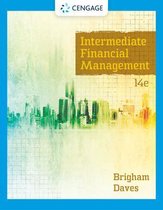
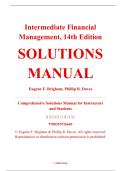
Intermediate Financial
IA UV
Management, 14th Edition
_M I
SOLUTIONS
ED_
MANUAL
A
CAOP
Eugene F. Brigham, Phillip R. Daves
PNRN
Comprehensive Solutions Manual for Instructors
and Students
OOV IS
||| ||| || ||| || | || ||| | || ||| |
9780357516669
ED EU
© Eugene F. Brigham & Phillip R. Daves. All rights reserved.
Reproduction or distribution without permission is prohibited.
S
? R
© MEDGEEK
?
,TU S
VIATU
TABLE OF CONTENTS
Solutions Manual – Intermediate Financial Management (14th Edition)
Authors: Eugene F. Brigham and Phillip R. Daves
ISBN: 9780357516669
PART I: FUNDAMENTAL CONCEPTS
_MVI
Chapter 1: An Overview of Financial Management and the Financial Environment
Chapter 2: Risk and Return: Part I
Chapter 3: Risk and Return: Part II
Chapter 4: Bond Valuation
Chapter 5: Financial Statements, Cash Flow, and Taxes
Chapter 6: Analysis of Financial Statements
ED_
PART II: CORPORATE VALUATION
A
Chapter 7: Stocks and Their Valuation
Chapter 8: Financial Planning and Forecasting Financial Statements
Chapter 9: Corporate Valuation and Value-Based Management
CAOP
PART III: PROJECT VALUATION AND CAPITAL BUDGETING
Chapter 10: The Cost of Capital
Chapter 11: The Basics of Capital Budgeting: Evaluating Cash Flows
Chapter 12: Cash Flow Estimation and Risk Analysis
Chapter 13: Real Options
PNRN
PART IV: STRATEGIC FINANCING DECISIONS
Chapter 14: Distributions to Shareholders: Dividends and Repurchases
Chapter 15: Capital Structure Decisions: Part I
OOV IS
Chapter 16: Capital Structure Decisions: Part II
Chapter 17: Dynamic Capital Structures and Corporate Valuation
PART V: TACTICAL FINANCING DECISIONS
Chapter 18: Initial Public Offerings, Investment Banking, and Financial Restructuring
EDSEU
Chapter 19: Lease Financing
Chapter 20: Hybrid Financing: Preferred Stock, Warrants, and Convertibles
PART VI: WORKING CAPITAL MANAGEMENT
Chapter 21: Supply Chain and Working Capital Management
? R
Chapter 22: Short-Term Financial Management
PART VII: SPECIAL TOPICS
,TU S
VIATU
Chapter 23: Derivatives and Hedging
Chapter 24: Enterprise Risk Management
Chapter 25: Bankruptcy, Reorganization, and Liquidation
Chapter 26: Mergers, LBOs, Divestitures, and Holding Companies
Chapter 27: Multinational Financial Management
Chapter 28: Ethics, Economics, and Financial Management
Chapter 29: Asset-Backed Securities
_MVI
Chapter 30: Pension Plan Management
Chapter 31: Financial Management in Not-for-Profit Businesses
ED_
A
CAOP
PNRN
OOV IS
EDSEU
? R
,TU S
VIATU
Chapter 1
An Overview of Financial Management and
The Financial Environment
_MVI
ANSWERS TO BEGINNING-OF-CHAPTER QUESTIONS
1-1 The primary goal is assumed to be shareholder wealth maximization, which translates to
stock price maximization. That, in turn, means maximizing the PV of future free cash
flows.
Maximizing shareholder wealth requires that the firm produce things that customers
want, and at the lowest cost consistent with high quality. It also means holding risk
down, which will result in a relatively low cost of capital, which is necessary to
ED_
maximize the PV of a given cash flow stream.
This also gets into the issue of capital structure—how much debt should we use? The
A
more debt the firm uses, the lower its taxes, and the fewer shares outstanding, hence less
dilution of earnings. However, more debt means more risk. So, it’s necessary to
consider capital structure when attempting to maximize share prices.
Dividend policy is also an issue—how much of its earnings should the firm pay out as
dividends? The answer to that question depends on a number of factors, including the
CAOP
firm’s investment opportunities, its access to capital markets, its stockholders’ desires
(and their tax rates), and the kind of signals stockholders get from dividend actions.
Shareholder wealth maximization is partially consistent and partially inconsistent
with generally accepted societal goals. It is consistent because well-run firms produce
good products at low costs, sell them at competitive prices, employ people, pay taxes, and
generally improve society. However, without constraints, firms would tend to form
monopolies and end up charging prices that are too high and not producing enough
PNRN
output. They might also pollute the air and water, engage in unfair labor practices, and so
on. So, constraints (antitrust, labor, environmental, etc. laws) should be and are imposed
on businesses. That said, stock price maximization is consistent with a strong
economy, economic progress, and ―the good life‖ for most citizens.
In standard introductory microeconomics courses, we assume that firms attempt to
maximize profits. In more advanced econ courses, the goal is broadened to value
OOV IS
maximizing, so finance and economics are indeed consistent.
As WorldCom, Enron, and other corporate scandals demonstrated very clearly,
managers do not always have stockholders’ interests as a primary goal—some managers
have their own interests. This point is discussed further below.
EDSEU
1- 1
© 2022 Cengage Learning. All Rights Reserved. May not be scanned, copied or duplicated, or posted to a publicly accessible
? R
website, in whole or in part.
Edrftgyihu jiuh
Intermediate Financial
IA UV
Management, 14th Edition
_M I
SOLUTIONS
ED_
MANUAL
A
CAOP
Eugene F. Brigham, Phillip R. Daves
PNRN
Comprehensive Solutions Manual for Instructors
and Students
OOV IS
||| ||| || ||| || | || ||| | || ||| |
9780357516669
ED EU
© Eugene F. Brigham & Phillip R. Daves. All rights reserved.
Reproduction or distribution without permission is prohibited.
S
? R
© MEDGEEK
?
,TU S
VIATU
TABLE OF CONTENTS
Solutions Manual – Intermediate Financial Management (14th Edition)
Authors: Eugene F. Brigham and Phillip R. Daves
ISBN: 9780357516669
PART I: FUNDAMENTAL CONCEPTS
_MVI
Chapter 1: An Overview of Financial Management and the Financial Environment
Chapter 2: Risk and Return: Part I
Chapter 3: Risk and Return: Part II
Chapter 4: Bond Valuation
Chapter 5: Financial Statements, Cash Flow, and Taxes
Chapter 6: Analysis of Financial Statements
ED_
PART II: CORPORATE VALUATION
A
Chapter 7: Stocks and Their Valuation
Chapter 8: Financial Planning and Forecasting Financial Statements
Chapter 9: Corporate Valuation and Value-Based Management
CAOP
PART III: PROJECT VALUATION AND CAPITAL BUDGETING
Chapter 10: The Cost of Capital
Chapter 11: The Basics of Capital Budgeting: Evaluating Cash Flows
Chapter 12: Cash Flow Estimation and Risk Analysis
Chapter 13: Real Options
PNRN
PART IV: STRATEGIC FINANCING DECISIONS
Chapter 14: Distributions to Shareholders: Dividends and Repurchases
Chapter 15: Capital Structure Decisions: Part I
OOV IS
Chapter 16: Capital Structure Decisions: Part II
Chapter 17: Dynamic Capital Structures and Corporate Valuation
PART V: TACTICAL FINANCING DECISIONS
Chapter 18: Initial Public Offerings, Investment Banking, and Financial Restructuring
EDSEU
Chapter 19: Lease Financing
Chapter 20: Hybrid Financing: Preferred Stock, Warrants, and Convertibles
PART VI: WORKING CAPITAL MANAGEMENT
Chapter 21: Supply Chain and Working Capital Management
? R
Chapter 22: Short-Term Financial Management
PART VII: SPECIAL TOPICS
,TU S
VIATU
Chapter 23: Derivatives and Hedging
Chapter 24: Enterprise Risk Management
Chapter 25: Bankruptcy, Reorganization, and Liquidation
Chapter 26: Mergers, LBOs, Divestitures, and Holding Companies
Chapter 27: Multinational Financial Management
Chapter 28: Ethics, Economics, and Financial Management
Chapter 29: Asset-Backed Securities
_MVI
Chapter 30: Pension Plan Management
Chapter 31: Financial Management in Not-for-Profit Businesses
ED_
A
CAOP
PNRN
OOV IS
EDSEU
? R
,TU S
VIATU
Chapter 1
An Overview of Financial Management and
The Financial Environment
_MVI
ANSWERS TO BEGINNING-OF-CHAPTER QUESTIONS
1-1 The primary goal is assumed to be shareholder wealth maximization, which translates to
stock price maximization. That, in turn, means maximizing the PV of future free cash
flows.
Maximizing shareholder wealth requires that the firm produce things that customers
want, and at the lowest cost consistent with high quality. It also means holding risk
down, which will result in a relatively low cost of capital, which is necessary to
ED_
maximize the PV of a given cash flow stream.
This also gets into the issue of capital structure—how much debt should we use? The
A
more debt the firm uses, the lower its taxes, and the fewer shares outstanding, hence less
dilution of earnings. However, more debt means more risk. So, it’s necessary to
consider capital structure when attempting to maximize share prices.
Dividend policy is also an issue—how much of its earnings should the firm pay out as
dividends? The answer to that question depends on a number of factors, including the
CAOP
firm’s investment opportunities, its access to capital markets, its stockholders’ desires
(and their tax rates), and the kind of signals stockholders get from dividend actions.
Shareholder wealth maximization is partially consistent and partially inconsistent
with generally accepted societal goals. It is consistent because well-run firms produce
good products at low costs, sell them at competitive prices, employ people, pay taxes, and
generally improve society. However, without constraints, firms would tend to form
monopolies and end up charging prices that are too high and not producing enough
PNRN
output. They might also pollute the air and water, engage in unfair labor practices, and so
on. So, constraints (antitrust, labor, environmental, etc. laws) should be and are imposed
on businesses. That said, stock price maximization is consistent with a strong
economy, economic progress, and ―the good life‖ for most citizens.
In standard introductory microeconomics courses, we assume that firms attempt to
maximize profits. In more advanced econ courses, the goal is broadened to value
OOV IS
maximizing, so finance and economics are indeed consistent.
As WorldCom, Enron, and other corporate scandals demonstrated very clearly,
managers do not always have stockholders’ interests as a primary goal—some managers
have their own interests. This point is discussed further below.
EDSEU
1- 1
© 2022 Cengage Learning. All Rights Reserved. May not be scanned, copied or duplicated, or posted to a publicly accessible
? R
website, in whole or in part.