
PRACTICE QUESTIONS + ANSWERS NURSING
STUDENTS NZ
Correct
Incorrect
Your answers
1 of 15
Term
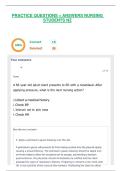
A 58-year-old adult client presents to ED with a nosebleed. After
applying pressure, what is the next nursing action?
1. Collect a medical history
2. Check BP
3. Instruct not to pick nose
4. Check HR
Give this one a try later!
3. Apply a petroleum gauze dressing over the site
A petroleum gauze will prevent air from being sucked into the pleural space,
causing a pneumothorax. The petroleum gauze dressing should be taped only
on three sides to allow for excessive air to escape, preventing a tension
puenmothorax. the physician should immediately be notified and the client
assessed for signs of respiratory distress. Preparing to reinsert a new chest tube
(4) is not a priority of the nurse at this moment. Positioning the client on either
,side will not make a difference in outcome
, 2. Check BP
Nosebleeds can be indicative of high BP in an adult. Of the choices
provided, the 1st action of the nurse should be to check the client's BP. If
elevated, the nurse can initiate measures to decrease the BP. The other
options are appropriate but not the highest priority. A medication history (1)
is critical to determine if the client is on any anti-coagulation therapy. After
assessment and care, client teaching might include instruction not to pick
nose (3). After the bP is measured, checking the pulse rate (4) would be
performed as part of the general vital signs assessment.
2. The infection causes diarrhea accompanied by flatus and abdominal
discomfort
The main clinical manifestation of Clostridium difficile is diarrhea accompanied
by excessive flatus and abdominal discomfort. Constipation (1) is not associated
with this infectious disease. Clients should follow a nutritionally balanced diet
high in fiber and low in fats (3) with no specific restrictions. Cleaning and
disinfection of items in the home (4) is key to preventing spread of the infection
because the C. difficile spore is relatively resistant.
4. Nosocomial
A nosocomial infection is acquired in a health care setting. This is also referred to
as a hospital-aquired infection. It is a result of poor infection control procedures
such as failure to wash hands between clients. A primary infection (1) is
synonymous with initial infection. A secondary infection (2) is made possible by a
primary infection that lowers the host;s resistance and causes an infection by
anoher kind of organism. A superinfection (3) is a new infection caused by an
organism different from that which caused the initial infection. The microbe
responsible is usually resistance to the treatment given for the initial infection
Don't know?
2 of 15
STUDENTS NZ
Correct
Incorrect
Your answers
1 of 15
Term
A 58-year-old adult client presents to ED with a nosebleed. After
applying pressure, what is the next nursing action?
1. Collect a medical history
2. Check BP
3. Instruct not to pick nose
4. Check HR
Give this one a try later!
3. Apply a petroleum gauze dressing over the site
A petroleum gauze will prevent air from being sucked into the pleural space,
causing a pneumothorax. The petroleum gauze dressing should be taped only
on three sides to allow for excessive air to escape, preventing a tension
puenmothorax. the physician should immediately be notified and the client
assessed for signs of respiratory distress. Preparing to reinsert a new chest tube
(4) is not a priority of the nurse at this moment. Positioning the client on either
,side will not make a difference in outcome
, 2. Check BP
Nosebleeds can be indicative of high BP in an adult. Of the choices
provided, the 1st action of the nurse should be to check the client's BP. If
elevated, the nurse can initiate measures to decrease the BP. The other
options are appropriate but not the highest priority. A medication history (1)
is critical to determine if the client is on any anti-coagulation therapy. After
assessment and care, client teaching might include instruction not to pick
nose (3). After the bP is measured, checking the pulse rate (4) would be
performed as part of the general vital signs assessment.
2. The infection causes diarrhea accompanied by flatus and abdominal
discomfort
The main clinical manifestation of Clostridium difficile is diarrhea accompanied
by excessive flatus and abdominal discomfort. Constipation (1) is not associated
with this infectious disease. Clients should follow a nutritionally balanced diet
high in fiber and low in fats (3) with no specific restrictions. Cleaning and
disinfection of items in the home (4) is key to preventing spread of the infection
because the C. difficile spore is relatively resistant.
4. Nosocomial
A nosocomial infection is acquired in a health care setting. This is also referred to
as a hospital-aquired infection. It is a result of poor infection control procedures
such as failure to wash hands between clients. A primary infection (1) is
synonymous with initial infection. A secondary infection (2) is made possible by a
primary infection that lowers the host;s resistance and causes an infection by
anoher kind of organism. A superinfection (3) is a new infection caused by an
organism different from that which caused the initial infection. The microbe
responsible is usually resistance to the treatment given for the initial infection
Don't know?
2 of 15


