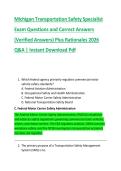
Michigan Transportation Safety Specialist
Exam Questions and Correct Answers
(Verified Answers) Plus Rationales 2026
Q&A | Instant Download Pdf
1. Which federal agency primarily regulates commercial motor
vehicle safety standards?
A. Federal Aviation Administration
B. Occupational Safety and Health Administration
C. Federal Motor Carrier Safety Administration
D. National Transportation Safety Board
C. Federal Motor Carrier Safety Administration
The Federal Motor Carrier Safety Administration (FMCSA) establishes
and enforces safety regulations governing commercial motor vehicles,
drivers, and motor carriers. The FAA regulates aviation, OSHA oversees
workplace safety, and the NTSB investigates transportation accidents
but does not regulate.
2. The primary purpose of a Transportation Safety Management
System (SMS) is to:
, A. Eliminate all workplace incidents
B. Provide a structured process to manage safety risks
C. Increase transportation productivity
D. Reduce equipment costs
B. Provide a structured process to manage safety risks
An SMS is a formal, organization-wide approach to managing safety risk
and assuring the effectiveness of safety risk controls. While it may
reduce incidents and costs, its central focus is systematic risk
management.
3. A leading indicator in transportation safety refers to:
A. Accident reports from the previous year
B. Insurance claim totals
C. Proactive measures predicting future performance
D. Fatal crash statistics
C. Proactive measures predicting future performance
Leading indicators are predictive and preventative measures, such as
training hours or safety audits, that help forecast and reduce future
incidents. Lagging indicators reflect past events.
4. The Michigan Vehicle Code primarily governs:
A. Aviation safety procedures
B. State-level traffic laws and motor vehicle operation
C. Federal railroad compliance
D. Maritime transportation safety
B. State-level traffic laws and motor vehicle operation
,The Michigan Vehicle Code establishes traffic laws, driver licensing
standards, and vehicle regulations within the state.
5. The purpose of a Job Hazard Analysis (JHA) is to:
A. Determine employee salaries
B. Identify and control workplace hazards
C. Evaluate marketing strategies
D. Inspect vehicle registration
B. Identify and control workplace hazards
A JHA systematically examines tasks to identify hazards and implement
controls before incidents occur.
6. Defensive driving techniques are primarily intended to:
A. Reduce fuel consumption
B. Increase travel speed
C. Anticipate and respond safely to hazards
D. Avoid traffic citations
C. Anticipate and respond safely to hazards
Defensive driving focuses on awareness, anticipation, and proactive
responses to reduce crash risk.
7. A Transportation Safety Specialist should prioritize risk controls
using which hierarchy?
A. Training, discipline, termination
B. Elimination, substitution, engineering, administrative, PPE
C. Insurance, inspection, reporting
D. Budget, policy, enforcement
, B. Elimination, substitution, engineering, administrative, PPE
The hierarchy of controls prioritizes removing hazards first, followed by
engineering and administrative controls, with PPE as the last line of
defense.
8. A commercial driver’s Hours of Service regulations are primarily
designed to prevent:
A. Speeding violations
B. Vehicle theft
C. Driver fatigue
D. Equipment malfunction
C. Driver fatigue
Hours of Service (HOS) regulations limit driving time and require rest
breaks to reduce fatigue-related crashes.
9. The primary purpose of a pre-trip vehicle inspection is to:
A. Meet aesthetic standards
B. Ensure mechanical and safety readiness
C. Reduce fuel costs
D. Avoid toll payments
B. Ensure mechanical and safety readiness
Pre-trip inspections identify mechanical or safety deficiencies before
operation, preventing breakdowns and crashes.
10. Root cause analysis is conducted to:
A. Assign blame
Exam Questions and Correct Answers
(Verified Answers) Plus Rationales 2026
Q&A | Instant Download Pdf
1. Which federal agency primarily regulates commercial motor
vehicle safety standards?
A. Federal Aviation Administration
B. Occupational Safety and Health Administration
C. Federal Motor Carrier Safety Administration
D. National Transportation Safety Board
C. Federal Motor Carrier Safety Administration
The Federal Motor Carrier Safety Administration (FMCSA) establishes
and enforces safety regulations governing commercial motor vehicles,
drivers, and motor carriers. The FAA regulates aviation, OSHA oversees
workplace safety, and the NTSB investigates transportation accidents
but does not regulate.
2. The primary purpose of a Transportation Safety Management
System (SMS) is to:
, A. Eliminate all workplace incidents
B. Provide a structured process to manage safety risks
C. Increase transportation productivity
D. Reduce equipment costs
B. Provide a structured process to manage safety risks
An SMS is a formal, organization-wide approach to managing safety risk
and assuring the effectiveness of safety risk controls. While it may
reduce incidents and costs, its central focus is systematic risk
management.
3. A leading indicator in transportation safety refers to:
A. Accident reports from the previous year
B. Insurance claim totals
C. Proactive measures predicting future performance
D. Fatal crash statistics
C. Proactive measures predicting future performance
Leading indicators are predictive and preventative measures, such as
training hours or safety audits, that help forecast and reduce future
incidents. Lagging indicators reflect past events.
4. The Michigan Vehicle Code primarily governs:
A. Aviation safety procedures
B. State-level traffic laws and motor vehicle operation
C. Federal railroad compliance
D. Maritime transportation safety
B. State-level traffic laws and motor vehicle operation
,The Michigan Vehicle Code establishes traffic laws, driver licensing
standards, and vehicle regulations within the state.
5. The purpose of a Job Hazard Analysis (JHA) is to:
A. Determine employee salaries
B. Identify and control workplace hazards
C. Evaluate marketing strategies
D. Inspect vehicle registration
B. Identify and control workplace hazards
A JHA systematically examines tasks to identify hazards and implement
controls before incidents occur.
6. Defensive driving techniques are primarily intended to:
A. Reduce fuel consumption
B. Increase travel speed
C. Anticipate and respond safely to hazards
D. Avoid traffic citations
C. Anticipate and respond safely to hazards
Defensive driving focuses on awareness, anticipation, and proactive
responses to reduce crash risk.
7. A Transportation Safety Specialist should prioritize risk controls
using which hierarchy?
A. Training, discipline, termination
B. Elimination, substitution, engineering, administrative, PPE
C. Insurance, inspection, reporting
D. Budget, policy, enforcement
, B. Elimination, substitution, engineering, administrative, PPE
The hierarchy of controls prioritizes removing hazards first, followed by
engineering and administrative controls, with PPE as the last line of
defense.
8. A commercial driver’s Hours of Service regulations are primarily
designed to prevent:
A. Speeding violations
B. Vehicle theft
C. Driver fatigue
D. Equipment malfunction
C. Driver fatigue
Hours of Service (HOS) regulations limit driving time and require rest
breaks to reduce fatigue-related crashes.
9. The primary purpose of a pre-trip vehicle inspection is to:
A. Meet aesthetic standards
B. Ensure mechanical and safety readiness
C. Reduce fuel costs
D. Avoid toll payments
B. Ensure mechanical and safety readiness
Pre-trip inspections identify mechanical or safety deficiencies before
operation, preventing breakdowns and crashes.
10. Root cause analysis is conducted to:
A. Assign blame