
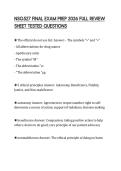
NSG527 FINAL EXAM PREP 2026 FULL REVIEW
SHEET TESTED QUESTIONS
◉ The official do not use list: Answer: - The symbols ">" and "<"
- All abbreviations for drug names
- Apothecary units
- The symbol "@"
- The abbreviation "cc
- "The abbreviation "μg
◉ 5 ethical principles Answer: Autonomy, Beneficence, Fidelity,
Justice, and Non-maleficence
◉ autonomy Answer: Agreement to respect another right to self-
determine a course of action; support of indolence decision making
◉ beneficence Answer: Compassion; taking positive action to help
others; desire to do good; core principle of our patient advocacy
◉ nonmaleficence Answer: The ethical principle of doing no harm
,◉ fidelity Answer: Loyalty, fairness, truthfulness, advocacy, a dn
decision to our patients. It involves an agreement to keep our
promises. Fidelity refers to the concept of keeping a commitment
and is based upon the virtue of caring
◉ justice Answer: individual people and groups with similar
circumstances and conditions should be treated alike; fairness with
equal distribution of goods and services
◉ confidentiality Answer: trusting others with personal and private
information
◉ veracity Answer: truthfulness
◉ ANA Answer: american nurses association; answer to board of the
state for nursing
◉ ANA code of ethics: primary commitment Is to ___ Answer: Patient
(individual, family or community)
◉ ANA code of ethics the applies in course of professional practice:
Answer: - Primary commitment to patient
-Demonstrates compassion and respect for all patients regardless of
patient status
,- Promotes the health and welfare of patients
- Accountable for individual practice.
- Maintains and increases own knowledge base
- Works to improve healthcare environment for providers and
patients
◉ WV BON regulations & rules Answer: - Regulates nursing practice
in WV
- Creates rules and regulations to administer the nurse practice act
NPA
- Describes rules of conduct for nurses
◉ delegation Answer: assigning a task to somebody
◉ what can you not delegate Answer: medicine, shift assessment
- ASSESSMENT AND EVALUATION
◉ Purpose of physical exam Answer: - Gather baseline data
- Supplement, confirm, or refute data in nursing hx
- Confirm and identify nursing diagnosis
- Make clinical judgments about changing status
- Evaluate the physiological outcomes of care
, ◉ nurses role Answer: provider of care - direct / indirect
manager of care - advocacy
member of a profession - research and scholarship
◉ Primary prevention Answer: Prevent the development of the
disease
- Ex: Immunizations, Lifestyle changes (i.e. losing weight, exercise,
modifying high risk sexual behavior), Car seats, Nutrition education,
Fitness activities, and Health Ed in Schools
◉ Secondary prevention Answer: Identify and treat asymptomatic
persons with risk factors or pre-clinical disease.... Also preventing a
worsening health status (ex:)
- Ex: Pap smears, Communicable disease screening, Blood pressure
screening, Early detection/treatment of DM, and Exercise program
for frail older adults
◉ Tertiary prevention Answer: Aims to prevent long-term
consequences of chronic illness of disability and support optimal
functioning (ex:)
- EX: Prevention of pressure ulcers after spinal cord injury and
Promoting independence after traumatic brain injury
SHEET TESTED QUESTIONS
◉ The official do not use list: Answer: - The symbols ">" and "<"
- All abbreviations for drug names
- Apothecary units
- The symbol "@"
- The abbreviation "cc
- "The abbreviation "μg
◉ 5 ethical principles Answer: Autonomy, Beneficence, Fidelity,
Justice, and Non-maleficence
◉ autonomy Answer: Agreement to respect another right to self-
determine a course of action; support of indolence decision making
◉ beneficence Answer: Compassion; taking positive action to help
others; desire to do good; core principle of our patient advocacy
◉ nonmaleficence Answer: The ethical principle of doing no harm
,◉ fidelity Answer: Loyalty, fairness, truthfulness, advocacy, a dn
decision to our patients. It involves an agreement to keep our
promises. Fidelity refers to the concept of keeping a commitment
and is based upon the virtue of caring
◉ justice Answer: individual people and groups with similar
circumstances and conditions should be treated alike; fairness with
equal distribution of goods and services
◉ confidentiality Answer: trusting others with personal and private
information
◉ veracity Answer: truthfulness
◉ ANA Answer: american nurses association; answer to board of the
state for nursing
◉ ANA code of ethics: primary commitment Is to ___ Answer: Patient
(individual, family or community)
◉ ANA code of ethics the applies in course of professional practice:
Answer: - Primary commitment to patient
-Demonstrates compassion and respect for all patients regardless of
patient status
,- Promotes the health and welfare of patients
- Accountable for individual practice.
- Maintains and increases own knowledge base
- Works to improve healthcare environment for providers and
patients
◉ WV BON regulations & rules Answer: - Regulates nursing practice
in WV
- Creates rules and regulations to administer the nurse practice act
NPA
- Describes rules of conduct for nurses
◉ delegation Answer: assigning a task to somebody
◉ what can you not delegate Answer: medicine, shift assessment
- ASSESSMENT AND EVALUATION
◉ Purpose of physical exam Answer: - Gather baseline data
- Supplement, confirm, or refute data in nursing hx
- Confirm and identify nursing diagnosis
- Make clinical judgments about changing status
- Evaluate the physiological outcomes of care
, ◉ nurses role Answer: provider of care - direct / indirect
manager of care - advocacy
member of a profession - research and scholarship
◉ Primary prevention Answer: Prevent the development of the
disease
- Ex: Immunizations, Lifestyle changes (i.e. losing weight, exercise,
modifying high risk sexual behavior), Car seats, Nutrition education,
Fitness activities, and Health Ed in Schools
◉ Secondary prevention Answer: Identify and treat asymptomatic
persons with risk factors or pre-clinical disease.... Also preventing a
worsening health status (ex:)
- Ex: Pap smears, Communicable disease screening, Blood pressure
screening, Early detection/treatment of DM, and Exercise program
for frail older adults
◉ Tertiary prevention Answer: Aims to prevent long-term
consequences of chronic illness of disability and support optimal
functioning (ex:)
- EX: Prevention of pressure ulcers after spinal cord injury and
Promoting independence after traumatic brain injury


