

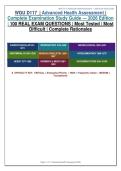
WGU D117 Advanced Health Assessment — 2026 Exam Study Guide
WGU D117 | Advanced Health Assessment |
Complete Examination Study Guide — 2026 Edition
| 100 REAL EXAM QUESTIONS | Most Tested | Most
Difficult | Complete Rationales
CARDIOVASCULAR Q1– RESPIRATORY Q16–Q28 NEUROLOGICAL Q29–Q42
Q15
ABDOMINAL/GI Q43–Q55 MUSCULOSKELETAL Q56– INTEGUMENTARY Q68–Q76
Q67
HEENT Q77–Q86 WOMEN'S & MEN'S Q87– DOCUMENTATION Q94–Q100
Q93
⚡ DIFFICULTY KEY: CRITICAL = Emergency/Priority | HIGH = Frequently Tested | MEDIUM =
Foundational
Page 1 | D117 Advanced Health Assessment 2026
, WGU D117 Advanced Health Assessment — 2026 Exam Study Guide
◆ CARDIOVASCULAR SYSTEM ◆
A nurse practitioner auscultates a low-pitched, rumbling Cardiac
diastolic murmur heard best at the cardiac apex with the ⚡ HIGH
Q1 bell of the stethoscope, in a patient with a history of
rheumatic fever. Which valve lesion is MOST likely?
A Aortic regurgitation
B ✓ CORRECT: Mitral stenosis
C Tricuspid regurgitation
D Pulmonic stenosis
WHY Mitral stenosis produces a low-pitched, rumbling diastolic murmur at the apex heard best with
the bell (low frequency). It results from rheumatic-fever–induced valve scarring and is the
hallmark lesion of rheumatic heart disease in adults.
When assessing for coarctation of the aorta in an adult, Cardiac
Q2 the MOST important comparative assessment the APRN ⚡ HIGH
should perform is:
A Comparing apical and radial pulse rates
B ✓ CORRECT: Comparing upper-extremity and lower-extremity blood pressures
bilaterally
C Auscultating for a systolic bruit over the carotid arteries
D Palpating femoral and radial pulses simultaneously for delay
WHY Coarctation classically produces a ≥20 mmHg systolic BP gradient between the upper and
lower extremities. Both bilateral upper and lower extremity BPs must be compared. Femoral-
radial pulse delay supports but does not quantify the gradient.
A patient with heart failure presents with bilateral Cardiac
Q3 crackles at lung bases, JVD, and a new S3 gallop. The S3 ⚡ HIGH
is BEST heard by:
A Diaphragm at the right sternal border with patient sitting
B ✓ CORRECT: Bell at the apex with patient in left lateral decubitus position
C Diaphragm at the second right intercostal space
D Bell at the second left intercostal space with patient supine
WHY S3 is a low-frequency sound heard best with the bell (which picks up low frequencies) placed
at the cardiac apex, with the patient in the left lateral decubitus position (brings the left
ventricle closer to the chest wall).
A 58-year-old male has a harsh, crescendo-decrescendo Cardiac
systolic murmur that radiates to the carotid arteries. He ⚡ CRITICAL
Q4 reports exertional syncope and angina. Which condition
is MOST consistent?
A Mitral valve prolapse
Page 2 | D117 Advanced Health Assessment 2026
, WGU D117 Advanced Health Assessment — 2026 Exam Study Guide
B Hypertrophic cardiomyopathy (HOCM)
C ✓ CORRECT: Aortic stenosis
D Ventricular septal defect
WHY Aortic stenosis is characterized by a harsh crescendo-decrescendo (ejection) systolic murmur
at the right second ICS (aortic area) radiating to carotids. The classic triad is angina, syncope,
and heart failure — exertional syncope is particularly ominous.
Which finding on physical examination is MOST Cardiac
Q5 consistent with cardiac tamponade (Beck's Triad)? ⚡ CRITICAL
A Wide pulse pressure, bradycardia, and bounding pulses
B ✓ CORRECT: Muffled heart sounds, JVD, and hypotension
C S4 gallop, displaced PMI, and pulsus alternans
D Loud P2, right ventricular heave, and fixed split S2
WHY Beck's Triad of cardiac tamponade: muffled heart sounds (fluid around heart dampens
sounds), elevated JVP/JVD (impaired venous return), and hypotension (reduced cardiac
output). Pulsus paradoxus (>10 mmHg drop in SBP with inspiration) is an additional classic
sign.
A patient has a midsystolic click followed by a late Cardiac
systolic murmur at the cardiac apex. Which maneuver ⚡ HIGH
Q6 will cause the click to move CLOSER to S1 (earlier in
systole)?
A Squatting (increases preload)
B ✓ CORRECT: Standing (decreases preload)
C Sustained handgrip (increases afterload)
D Lying supine with legs elevated
WHY Mitral valve prolapse click moves EARLIER (toward S1) with standing and Valsalva (reduced
preload, smaller LV). It moves LATER (toward S2) with squatting, supine positioning, or
handgrip (increased preload/afterload, larger LV).
During auscultation of a 35-year-old athlete, a Cardiac
Q7 physiologic split of S2 is noted on inspiration that ⚡ MEDIUM
disappears on expiration. This finding is:
A Abnormal and requires immediate cardiac referral
B ✓ CORRECT: Normal variant due to delayed pulmonic valve closure on inspiration
C Indicative of right bundle branch block
D Consistent with atrial septal defect (fixed split)
WHY Physiologic (normal) splitting of S2 occurs because inspiration increases venous return to the
right heart, delaying pulmonic valve closure (P2), while earlier aortic closure (A2) occurs. This
is NORMAL in young adults and athletes.
Page 3 | D117 Advanced Health Assessment 2026
, WGU D117 Advanced Health Assessment — 2026 Exam Study Guide
Which assessment finding is MOST specific for right- Cardiac
Q8 sided heart failure rather than left-sided heart failure? ⚡ HIGH
A Bilateral basilar crackles
B S3 gallop at the apex
C ✓ CORRECT: Hepatojugular reflux (HJR) and dependent edema
D Orthopnea and paroxysmal nocturnal dyspnea
WHY Hepatojugular reflux (HJR), peripheral dependent edema, ascites, and right upper quadrant
tenderness from hepatic congestion are hallmark signs of right-sided HF. Bilateral crackles,
orthopnea, and PND result from pulmonary congestion from left-sided HF.
An APRN notes a patient's JVP is elevated at 10 cm Cardiac
Q9 above the sternal angle with the head of bed at 45°. This ⚡ HIGH
is:
A Normal JVP
B Borderline — re-check with HOB at 30°
C ✓ CORRECT: Elevated JVP, suggesting increased right atrial pressure
D Incorrectly measured — JVP is always measured at 90°
WHY Normal JVP is ≤3–4 cm above the sternal angle (RA) when measured at 45° HOB. A JVP of
10 cm above the sternal angle is significantly elevated, indicating increased right atrial
pressure consistent with right HF, tamponade, or SVC syndrome.
Pulsus paradoxus of >10 mmHg is MOST associated Cardiac
Q10 with: ⚡ HIGH
A Aortic regurgitation
B ✓ CORRECT: Cardiac tamponade and severe asthma/COPD exacerbation
C Hypertensive crisis
D Complete heart block
WHY Pulsus paradoxus >10 mmHg (exaggerated fall in SBP during inspiration) is classic for cardiac
tamponade and severe obstructive lung disease (asthma/COPD). It results from increased
right heart filling during inspiration compressing the left ventricle.
A patient complains of calf pain, warmth, and swelling Vascular
after a 10-hour flight. The Wells score criteria are ⚡ HIGH
Q11 assessed. Which finding MOST increases pretest
probability for DVT?
A Bilateral leg edema
B Varicose veins without prior DVT
C ✓ CORRECT: Active cancer with treatment within 6 months
D Leg pain only with prolonged standing
WHY Active cancer (treatment within 6 months) scores +1 in the Wells DVT criteria. Unilateral
pitting edema (+1), paralysis/plaster cast (+1), entire leg swollen (+1), localized tenderness
Page 4 | D117 Advanced Health Assessment 2026
WGU D117 | Advanced Health Assessment |
Complete Examination Study Guide — 2026 Edition
| 100 REAL EXAM QUESTIONS | Most Tested | Most
Difficult | Complete Rationales
CARDIOVASCULAR Q1– RESPIRATORY Q16–Q28 NEUROLOGICAL Q29–Q42
Q15
ABDOMINAL/GI Q43–Q55 MUSCULOSKELETAL Q56– INTEGUMENTARY Q68–Q76
Q67
HEENT Q77–Q86 WOMEN'S & MEN'S Q87– DOCUMENTATION Q94–Q100
Q93
⚡ DIFFICULTY KEY: CRITICAL = Emergency/Priority | HIGH = Frequently Tested | MEDIUM =
Foundational
Page 1 | D117 Advanced Health Assessment 2026
, WGU D117 Advanced Health Assessment — 2026 Exam Study Guide
◆ CARDIOVASCULAR SYSTEM ◆
A nurse practitioner auscultates a low-pitched, rumbling Cardiac
diastolic murmur heard best at the cardiac apex with the ⚡ HIGH
Q1 bell of the stethoscope, in a patient with a history of
rheumatic fever. Which valve lesion is MOST likely?
A Aortic regurgitation
B ✓ CORRECT: Mitral stenosis
C Tricuspid regurgitation
D Pulmonic stenosis
WHY Mitral stenosis produces a low-pitched, rumbling diastolic murmur at the apex heard best with
the bell (low frequency). It results from rheumatic-fever–induced valve scarring and is the
hallmark lesion of rheumatic heart disease in adults.
When assessing for coarctation of the aorta in an adult, Cardiac
Q2 the MOST important comparative assessment the APRN ⚡ HIGH
should perform is:
A Comparing apical and radial pulse rates
B ✓ CORRECT: Comparing upper-extremity and lower-extremity blood pressures
bilaterally
C Auscultating for a systolic bruit over the carotid arteries
D Palpating femoral and radial pulses simultaneously for delay
WHY Coarctation classically produces a ≥20 mmHg systolic BP gradient between the upper and
lower extremities. Both bilateral upper and lower extremity BPs must be compared. Femoral-
radial pulse delay supports but does not quantify the gradient.
A patient with heart failure presents with bilateral Cardiac
Q3 crackles at lung bases, JVD, and a new S3 gallop. The S3 ⚡ HIGH
is BEST heard by:
A Diaphragm at the right sternal border with patient sitting
B ✓ CORRECT: Bell at the apex with patient in left lateral decubitus position
C Diaphragm at the second right intercostal space
D Bell at the second left intercostal space with patient supine
WHY S3 is a low-frequency sound heard best with the bell (which picks up low frequencies) placed
at the cardiac apex, with the patient in the left lateral decubitus position (brings the left
ventricle closer to the chest wall).
A 58-year-old male has a harsh, crescendo-decrescendo Cardiac
systolic murmur that radiates to the carotid arteries. He ⚡ CRITICAL
Q4 reports exertional syncope and angina. Which condition
is MOST consistent?
A Mitral valve prolapse
Page 2 | D117 Advanced Health Assessment 2026
, WGU D117 Advanced Health Assessment — 2026 Exam Study Guide
B Hypertrophic cardiomyopathy (HOCM)
C ✓ CORRECT: Aortic stenosis
D Ventricular septal defect
WHY Aortic stenosis is characterized by a harsh crescendo-decrescendo (ejection) systolic murmur
at the right second ICS (aortic area) radiating to carotids. The classic triad is angina, syncope,
and heart failure — exertional syncope is particularly ominous.
Which finding on physical examination is MOST Cardiac
Q5 consistent with cardiac tamponade (Beck's Triad)? ⚡ CRITICAL
A Wide pulse pressure, bradycardia, and bounding pulses
B ✓ CORRECT: Muffled heart sounds, JVD, and hypotension
C S4 gallop, displaced PMI, and pulsus alternans
D Loud P2, right ventricular heave, and fixed split S2
WHY Beck's Triad of cardiac tamponade: muffled heart sounds (fluid around heart dampens
sounds), elevated JVP/JVD (impaired venous return), and hypotension (reduced cardiac
output). Pulsus paradoxus (>10 mmHg drop in SBP with inspiration) is an additional classic
sign.
A patient has a midsystolic click followed by a late Cardiac
systolic murmur at the cardiac apex. Which maneuver ⚡ HIGH
Q6 will cause the click to move CLOSER to S1 (earlier in
systole)?
A Squatting (increases preload)
B ✓ CORRECT: Standing (decreases preload)
C Sustained handgrip (increases afterload)
D Lying supine with legs elevated
WHY Mitral valve prolapse click moves EARLIER (toward S1) with standing and Valsalva (reduced
preload, smaller LV). It moves LATER (toward S2) with squatting, supine positioning, or
handgrip (increased preload/afterload, larger LV).
During auscultation of a 35-year-old athlete, a Cardiac
Q7 physiologic split of S2 is noted on inspiration that ⚡ MEDIUM
disappears on expiration. This finding is:
A Abnormal and requires immediate cardiac referral
B ✓ CORRECT: Normal variant due to delayed pulmonic valve closure on inspiration
C Indicative of right bundle branch block
D Consistent with atrial septal defect (fixed split)
WHY Physiologic (normal) splitting of S2 occurs because inspiration increases venous return to the
right heart, delaying pulmonic valve closure (P2), while earlier aortic closure (A2) occurs. This
is NORMAL in young adults and athletes.
Page 3 | D117 Advanced Health Assessment 2026
, WGU D117 Advanced Health Assessment — 2026 Exam Study Guide
Which assessment finding is MOST specific for right- Cardiac
Q8 sided heart failure rather than left-sided heart failure? ⚡ HIGH
A Bilateral basilar crackles
B S3 gallop at the apex
C ✓ CORRECT: Hepatojugular reflux (HJR) and dependent edema
D Orthopnea and paroxysmal nocturnal dyspnea
WHY Hepatojugular reflux (HJR), peripheral dependent edema, ascites, and right upper quadrant
tenderness from hepatic congestion are hallmark signs of right-sided HF. Bilateral crackles,
orthopnea, and PND result from pulmonary congestion from left-sided HF.
An APRN notes a patient's JVP is elevated at 10 cm Cardiac
Q9 above the sternal angle with the head of bed at 45°. This ⚡ HIGH
is:
A Normal JVP
B Borderline — re-check with HOB at 30°
C ✓ CORRECT: Elevated JVP, suggesting increased right atrial pressure
D Incorrectly measured — JVP is always measured at 90°
WHY Normal JVP is ≤3–4 cm above the sternal angle (RA) when measured at 45° HOB. A JVP of
10 cm above the sternal angle is significantly elevated, indicating increased right atrial
pressure consistent with right HF, tamponade, or SVC syndrome.
Pulsus paradoxus of >10 mmHg is MOST associated Cardiac
Q10 with: ⚡ HIGH
A Aortic regurgitation
B ✓ CORRECT: Cardiac tamponade and severe asthma/COPD exacerbation
C Hypertensive crisis
D Complete heart block
WHY Pulsus paradoxus >10 mmHg (exaggerated fall in SBP during inspiration) is classic for cardiac
tamponade and severe obstructive lung disease (asthma/COPD). It results from increased
right heart filling during inspiration compressing the left ventricle.
A patient complains of calf pain, warmth, and swelling Vascular
after a 10-hour flight. The Wells score criteria are ⚡ HIGH
Q11 assessed. Which finding MOST increases pretest
probability for DVT?
A Bilateral leg edema
B Varicose veins without prior DVT
C ✓ CORRECT: Active cancer with treatment within 6 months
D Leg pain only with prolonged standing
WHY Active cancer (treatment within 6 months) scores +1 in the Wells DVT criteria. Unilateral
pitting edema (+1), paralysis/plaster cast (+1), entire leg swollen (+1), localized tenderness
Page 4 | D117 Advanced Health Assessment 2026


