

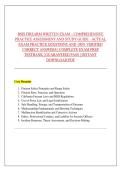
BSIS FIREARM WRITTEN EXAM – COMPREHENSIVE
PRACTICE ASSESSMENT AND STUDY GUIDE - ACTUAL
EXAM PRACTICE QUESTIONS AND 100% VERIFIED
CORRECT ANSWERS | COMPLETE EXAM PREP
TESTBANK | GUARANTEED PASS | INSTANT
DOWNLOAD PDF
Core Domains
1. Firearm Safety Principles and Range Safety
2. Firearm Parts, Function, and Operation
3. California Firearm Laws and BSIS Regulations
4. Use-of-Force Law and Legal Justification
5. Safe Handling, Storage, and Transportation of Firearms
6. Marksmanship Fundamentals and Shooting Techniques
7. Malfunction Identification and Corrective Actions
8. Ethics, Professional Conduct, and Liability for Security Officers
9. Incident Response, Threat Assessment, and Decision-Making
,Table of Contents
Section Topic Page
1 Introduction 1
2 Firearm Safety Principles and Range Safety 2
3 Firearm Parts, Function, and Operation 4
4 California Firearm Laws and BSIS Regulations 6
5 Use-of-Force Law and Legal Justification 8
6 Safe Handling, Storage, and Transportation 10
7 Marksmanship Fundamentals 12
8 Malfunctions and Firearm Maintenance 14
9 Ethics and Professional Conduct 16
10 Incident Response and Threat Assessment 18
11 Answer Key Summary 20
Introduction
The BSIS Firearm Written Exam evaluates the knowledge and professional
judgment required for licensed armed security personnel. The assessment measures
understanding of firearm safety, legal responsibilities, proper firearm handling, and
the justified use of force within professional security operations. Candidates must
demonstrate competency in firearm operation, range safety, California legal
standards, and ethical conduct expected of armed security officers. Questions
include multiple-choice items, scenario-based decision-making situations, and
applied knowledge problems. The exam emphasizes practical application and
critical reasoning to ensure candidates can safely and responsibly carry firearms
while performing security duties.
,Section 1 (Questions 1–35)
1. Which rule of firearm safety requires keeping the muzzle pointed in a safe
direction at all times?
A. Trigger discipline
B. Situational awareness
C. Ammunition control
D. Muzzle control
Rationale: Muzzle control ensures the firearm is always pointed in a safe direction
to prevent accidental injury.
2. Before cleaning a firearm, the first step is to:
A. Remove the magazine
B. Pull the trigger
C. Verify the firearm is unloaded
D. Insert a chamber flag
Rationale: Safety procedures require confirming the firearm is unloaded before
any maintenance.
3. A security officer carrying a firearm must primarily understand use-of-force
laws to:
A. Improve marksmanship
B. Ensure force is legally justified
C. Reduce firearm wear
D. Increase patrol speed
Rationale: Armed officers must ensure force is legally defensible under applicable
law.
, 4. Which part of a semi-automatic pistol houses the firing pin and extractor?
A. Barrel
B. Frame
C. Slide
D. Magazine
Rationale: The slide contains internal firing components responsible for the firing
cycle.
5. Trigger discipline refers to:
A. Maintaining two-hand grip
B. Keeping the finger off the trigger until ready to fire
C. Locking the slide back
D. Checking the magazine
Rationale: Proper trigger discipline prevents negligent discharges.
6. A “failure to fire” malfunction is most commonly caused by:
A. Dirty barrel
B. Defective ammunition or light primer strike
C. Incorrect stance
D. Weak grip
Rationale: Most failures to fire occur when ammunition fails to ignite properly.
7. Which stance provides stability and recoil control in handgun shooting?
A. Standing straight
B. Isosceles stance
C. Kneeling only
D. Leaning backward
PRACTICE ASSESSMENT AND STUDY GUIDE - ACTUAL
EXAM PRACTICE QUESTIONS AND 100% VERIFIED
CORRECT ANSWERS | COMPLETE EXAM PREP
TESTBANK | GUARANTEED PASS | INSTANT
DOWNLOAD PDF
Core Domains
1. Firearm Safety Principles and Range Safety
2. Firearm Parts, Function, and Operation
3. California Firearm Laws and BSIS Regulations
4. Use-of-Force Law and Legal Justification
5. Safe Handling, Storage, and Transportation of Firearms
6. Marksmanship Fundamentals and Shooting Techniques
7. Malfunction Identification and Corrective Actions
8. Ethics, Professional Conduct, and Liability for Security Officers
9. Incident Response, Threat Assessment, and Decision-Making
,Table of Contents
Section Topic Page
1 Introduction 1
2 Firearm Safety Principles and Range Safety 2
3 Firearm Parts, Function, and Operation 4
4 California Firearm Laws and BSIS Regulations 6
5 Use-of-Force Law and Legal Justification 8
6 Safe Handling, Storage, and Transportation 10
7 Marksmanship Fundamentals 12
8 Malfunctions and Firearm Maintenance 14
9 Ethics and Professional Conduct 16
10 Incident Response and Threat Assessment 18
11 Answer Key Summary 20
Introduction
The BSIS Firearm Written Exam evaluates the knowledge and professional
judgment required for licensed armed security personnel. The assessment measures
understanding of firearm safety, legal responsibilities, proper firearm handling, and
the justified use of force within professional security operations. Candidates must
demonstrate competency in firearm operation, range safety, California legal
standards, and ethical conduct expected of armed security officers. Questions
include multiple-choice items, scenario-based decision-making situations, and
applied knowledge problems. The exam emphasizes practical application and
critical reasoning to ensure candidates can safely and responsibly carry firearms
while performing security duties.
,Section 1 (Questions 1–35)
1. Which rule of firearm safety requires keeping the muzzle pointed in a safe
direction at all times?
A. Trigger discipline
B. Situational awareness
C. Ammunition control
D. Muzzle control
Rationale: Muzzle control ensures the firearm is always pointed in a safe direction
to prevent accidental injury.
2. Before cleaning a firearm, the first step is to:
A. Remove the magazine
B. Pull the trigger
C. Verify the firearm is unloaded
D. Insert a chamber flag
Rationale: Safety procedures require confirming the firearm is unloaded before
any maintenance.
3. A security officer carrying a firearm must primarily understand use-of-force
laws to:
A. Improve marksmanship
B. Ensure force is legally justified
C. Reduce firearm wear
D. Increase patrol speed
Rationale: Armed officers must ensure force is legally defensible under applicable
law.
, 4. Which part of a semi-automatic pistol houses the firing pin and extractor?
A. Barrel
B. Frame
C. Slide
D. Magazine
Rationale: The slide contains internal firing components responsible for the firing
cycle.
5. Trigger discipline refers to:
A. Maintaining two-hand grip
B. Keeping the finger off the trigger until ready to fire
C. Locking the slide back
D. Checking the magazine
Rationale: Proper trigger discipline prevents negligent discharges.
6. A “failure to fire” malfunction is most commonly caused by:
A. Dirty barrel
B. Defective ammunition or light primer strike
C. Incorrect stance
D. Weak grip
Rationale: Most failures to fire occur when ammunition fails to ignite properly.
7. Which stance provides stability and recoil control in handgun shooting?
A. Standing straight
B. Isosceles stance
C. Kneeling only
D. Leaning backward


