

Lecture 1A
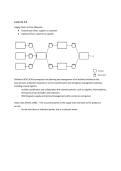
Supply Chains as Flow Networks
● Downstream flows: supplier to customer
● Upstream flow: customer to supplier
Definition SCM: SCM encompasses the planning and management of all activities involved in the
procurement, production of goods or service transformation and all logistics management activities,
including reverse logistics
- includes coordination and collaboration with channel partners, such as suppliers, intermediaries,
third party service providers and customers
- SCM integrates supply and demand management within and across companies
Value Chain (Porter, 1985) → the successive parties in the supply chain add value to the product or
service.
- do not view them as individual parties, but as a coherent whole
,Operations
- Operations function within an organization produces goods and services
- Transformation process: network of activities and buffers to transform inputs in outputs with a
value for the customer
Value proposition: link between strategy and operations
- Strategy: the plan to gain competitive advantage and thus achieve the organization’s goals.
Making choices, taking decision and setting goals.
- Which way, how, which actions, which goal
Porter’s competitive strategy (1980). How do you distinguish yourself from competitors?
● Cost leadership: aim to become the lowest cost producer
● Differentiation: aim to offer unique superior products and services
● Focus: aim to target a specific part of the market with either a focus on cost leadership or
differentiation.
Fishers functional vs innovative products (1997)
● Cost efficient supply chains
● Responsive supply chains
Treacy & Wiersema (1993)
, ● Product leadership: continuos innovation in product/service offered
● Operational Excellence: delivering reliable products/services against cmpeting prices with
minimal inconvenience to the customer
● Customer intimacy: further development of prdoucts/services according to customer wishes in
order to work towards a permanent customer base
SC decision making
- strategic decision making: long-term decision about the design of the supply chain and what
processes will be performed at each node
- examples of strategic SCM decision
- locations and capacities of facilities
- products to be made or stored at various locations
- tactical and operational decision making: decisions about the design, planning and control op SC
operations
- SC design must support the strategy of the organisation.
Value of inventories
● To decouple parts of the production process
○ to prevent standstills
○ compensate for variety in production speeds
● To decouple parts of the supply chain
○ Buffering against variations in delivery times
○ Buffering against variations in demand during delivery times
● To physically present products to customers to choose from
● To benefit from volume discounts and economies of scale in production/transport
○ Cycle stocks: products that are waiting for processing, wait for other products to be
processed together (i.e. batching)
○ Seasonal stocks: anticipating higher demand that cannot be kept up with production
● As a protection against risks, such as inflation, price increases, strikes and natural disasters
Inventory costs
● Costs of storage
○ warehouse, heating, personell, theft, damage
● devaluation of the components
○ if you had bought later, you could have gotten the components cheaper
● price protection costs
○ when the manufacturer lowers the price of a product and then has to pay money back to
the retailer for unsold inventory
● cost for product returns
○ when a retailer returns products to a manufacturer and receives a refund
● costs for obsolescence
, ○ if a product an no longer be sold. Also if a product is reduced in price because soon it
will no longer be able to be sold
Customer order decoupling point (CODP): indicates the point in the production process after which
production occurs only based upon customer demand
- push pull boundary
-
-
Key Performance Indicators (KPIs)
● Variables to monitor performance
● clearly formulated and measurable
● a standard
● important to connect to strategic goals
How to measure the impact of a choice on the whole supply chain? → balanced scorecard
1. How do customers see us? (customer perspective)
2. What must we excel at? (internal perspective)
3. Can we continue to improve and create value? (innovation and learning perspectives)
4. How do we look to shareholders? (financial perspective)
Effectivity and efficiency
Supply Chains as Flow Networks
● Downstream flows: supplier to customer
● Upstream flow: customer to supplier
Definition SCM: SCM encompasses the planning and management of all activities involved in the
procurement, production of goods or service transformation and all logistics management activities,
including reverse logistics
- includes coordination and collaboration with channel partners, such as suppliers, intermediaries,
third party service providers and customers
- SCM integrates supply and demand management within and across companies
Value Chain (Porter, 1985) → the successive parties in the supply chain add value to the product or
service.
- do not view them as individual parties, but as a coherent whole
,Operations
- Operations function within an organization produces goods and services
- Transformation process: network of activities and buffers to transform inputs in outputs with a
value for the customer
Value proposition: link between strategy and operations
- Strategy: the plan to gain competitive advantage and thus achieve the organization’s goals.
Making choices, taking decision and setting goals.
- Which way, how, which actions, which goal
Porter’s competitive strategy (1980). How do you distinguish yourself from competitors?
● Cost leadership: aim to become the lowest cost producer
● Differentiation: aim to offer unique superior products and services
● Focus: aim to target a specific part of the market with either a focus on cost leadership or
differentiation.
Fishers functional vs innovative products (1997)
● Cost efficient supply chains
● Responsive supply chains
Treacy & Wiersema (1993)
, ● Product leadership: continuos innovation in product/service offered
● Operational Excellence: delivering reliable products/services against cmpeting prices with
minimal inconvenience to the customer
● Customer intimacy: further development of prdoucts/services according to customer wishes in
order to work towards a permanent customer base
SC decision making
- strategic decision making: long-term decision about the design of the supply chain and what
processes will be performed at each node
- examples of strategic SCM decision
- locations and capacities of facilities
- products to be made or stored at various locations
- tactical and operational decision making: decisions about the design, planning and control op SC
operations
- SC design must support the strategy of the organisation.
Value of inventories
● To decouple parts of the production process
○ to prevent standstills
○ compensate for variety in production speeds
● To decouple parts of the supply chain
○ Buffering against variations in delivery times
○ Buffering against variations in demand during delivery times
● To physically present products to customers to choose from
● To benefit from volume discounts and economies of scale in production/transport
○ Cycle stocks: products that are waiting for processing, wait for other products to be
processed together (i.e. batching)
○ Seasonal stocks: anticipating higher demand that cannot be kept up with production
● As a protection against risks, such as inflation, price increases, strikes and natural disasters
Inventory costs
● Costs of storage
○ warehouse, heating, personell, theft, damage
● devaluation of the components
○ if you had bought later, you could have gotten the components cheaper
● price protection costs
○ when the manufacturer lowers the price of a product and then has to pay money back to
the retailer for unsold inventory
● cost for product returns
○ when a retailer returns products to a manufacturer and receives a refund
● costs for obsolescence
, ○ if a product an no longer be sold. Also if a product is reduced in price because soon it
will no longer be able to be sold
Customer order decoupling point (CODP): indicates the point in the production process after which
production occurs only based upon customer demand
- push pull boundary
-
-
Key Performance Indicators (KPIs)
● Variables to monitor performance
● clearly formulated and measurable
● a standard
● important to connect to strategic goals
How to measure the impact of a choice on the whole supply chain? → balanced scorecard
1. How do customers see us? (customer perspective)
2. What must we excel at? (internal perspective)
3. Can we continue to improve and create value? (innovation and learning perspectives)
4. How do we look to shareholders? (financial perspective)
Effectivity and efficiency


