Question 1 10/10 pts
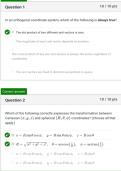
In an orthogonal coordinate system, which of the following is always true?
a The dot product of two different unit vectors is zero.
The magnitude of each unit vector depends on position.
The cross product of any two unit vectors is always the same, regardless of
coordinates.
The unit vectors are fixed in direction everywhere in space.
Question 2 10/10 pts
Which of the following correctly expresses the transformation between
Cartesian (z, y, z) and spherical (R, 8, ¢) coordinates? (Choose all that
apply.)
o z = Rsinfcos¢, y= Rsinfsing, z= Rcosh
a R=\/a? +y? + 2%, 0=arccos(%5), ¢ =arctan(%)
z = Rcosfcos¢p, y= RcosfOsing, z= Rsinf
= Rcosfcos¢, y= Rcosfsing, = Rsin6
, Question 3 20 pts
20/
Let
B=—2+4j
+ 23,
h ]
QL
IS
w
[2
o
Il
Il
+
+
|
<
<
Compute the following and choose the correct answer:
Ax(B+C)
@ s:-25+10:
11& — 74 + 102
78 — 109 + 112
103 + 7j) — 8%
In an orthogonal coordinate system, which of the following is always true?
a The dot product of two different unit vectors is zero.
The magnitude of each unit vector depends on position.
The cross product of any two unit vectors is always the same, regardless of
coordinates.
The unit vectors are fixed in direction everywhere in space.
Question 2 10/10 pts
Which of the following correctly expresses the transformation between
Cartesian (z, y, z) and spherical (R, 8, ¢) coordinates? (Choose all that
apply.)
o z = Rsinfcos¢, y= Rsinfsing, z= Rcosh
a R=\/a? +y? + 2%, 0=arccos(%5), ¢ =arctan(%)
z = Rcosfcos¢p, y= RcosfOsing, z= Rsinf
= Rcosfcos¢, y= Rcosfsing, = Rsin6
, Question 3 20 pts
20/
Let
B=—2+4j
+ 23,
h ]
QL
IS
w
[2
o
Il
Il
+
+
|
<
<
Compute the following and choose the correct answer:
Ax(B+C)
@ s:-25+10:
11& — 74 + 102
78 — 109 + 112
103 + 7j) — 8%