

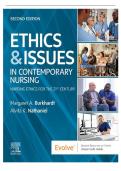
, TESTBANK FOR
Ethics & Issues In Contemporary Nursing, 2nd Edition Burkhardt
Important Notes
The file includes the complete test bank, organized chapter by chapter.
A sample of selected pages has been provided for preview.
All available appendices and Excel files (if included in the original resources) are
provided.
We continuously update our files to ensure you receive the latest and most accurate
editions.
New editions are added regularly – stay connected for updates!
Purchase Guarantee
If you believe you have purchased the wrong file, don’t worry. Contact us anytime and we
will gladly replace it with the correct version.
Contact Email:
, Test Bank - Chapter 01
Q1: Per Peirce, when individuals fail to question their beliefs, they allow their beliefs to be
dictated by what method?
1. A priori
2. Authority
3. Tenacity
4. Reasoning
Q2: The basic principle of critical social theory is that we can only understand each aspect
of a social phenomenon in relation to the ______________ and structure in which it is
found.
1. institution
2. individuals
3. biology
4. history
Q3: The relationship of social ____________ and nurses’ motivation to care for others is
complementary.
1. distrust
2. abundance
3. need
4. sufficiency
Q4: The extent of freedom and respect granted to nurses is tied to whose status in
society?
1. men’s
2. children’s
3. physicians’
4. women’s
Q5: Early cultures viewed the vocation of healer in terms associated with the
_____________.
1. sacred
2. evildoers
3. rulers
4. majority
Q6: The Hebrew religion’s Mosaic health code included principles related to food, rest,
sleep, cleanliness, childbearing, and _________________.
1. ecology
2. work
3. climate
4. hygiene
Q7: The Socratic method is shown when two people present opposing opinions and
_________________.
1. direct each other’s behavior
2. insist on their own viewpoint
3. give each other the answers
4. ask each other questions
,Q8: Monks and women of the Christian era who cared for patients and the needy were
called:
1. deaconesses
2. priests
3. traitors
4. pagans
Q9: During the Middle Ages, monasticism and other religious groups offered the only
opportunities to pursue careers in _________________.
1. agriculture
2. politics
3. nursing
4. feudalism
Q10: Which term relates to knowledge gained through the processes of observation and
experience?
1. faithful
2. religious
3. statistical
4. empirical
Q11: The Crusades led to deplorable sanitary conditions, fatigue, poor nutrition, diarrhea,
and the spread of ___________________.
1. hygienic practices
2. communicable diseases
3. inclusiveness
4. increased tolerance
Q12: During the Middle Ages, Saints Jerome and Thomas of Aquinas set the stage for the
persecution of women that lasted hundreds of years, leaving a persistent legacy of
_________________.
1. freedom
2. humane treatment of the mentally ill
3. misogyny
4. secularism
Q13: Exclusion of women from ___________________ during the Middle Ages meant that
the only women allowed by the church to practice healing arts were in religious nursing
orders.
1. universities
2. agriculture
3. churches
4. courts
Q14: From the 14th to the 17th centuries, the _____________ trials in Europe were carried
out through an organized partnership among the Church, state, and emerging medical
profession.
1. nursing
2. magicians’
3. anatomy
4. witch
,Q15: Which philosophy of the Modern Era resulted in perceived separation between the
acts of caring and curing in the healing arts?
1. Copernican
2. Galilean
3. Cartesian
4. Martin Luther’s
Q16: Florence Nightingale was a ______________________.
1. nurse, farmer, sanitarian, social reformer, and scholar.
2. nurse, statistician, sanitarian, social reformer, and scholar.
3. nurse, farmer, sanitarian, and social reformer.
4. nurse, statistician, sanitarian, social reformer, and farmer.
Q17: In the late 20th and early 21st century, why were many health care services provided
by nurses in the home instead of in hospitals as they had previously?
1. Third-party payers pressured hospitals to release patients quickly.
2. Third-party payers pressured hospitals to not release patients quickly.
3. Hospitals strived for more quality time with patients.
4. Hospitals strived to increase average length of stays.
Q18: The Institute of Medicine report in 2000 changed nursing care in which way:
1. increasing reliance on memory.
2. decreasing involvement of patients in their own care.
3. less focus on work safety.
4. avoiding reliance on memory.
, Test Bank - Chapter 02
Q1: Use of scarce resources and assuring the best outcomes to address mass casualty
incidents is an expression of ________________.
1. Deontology
2. Rationalism
3. Virtue ethics
4. Utilitarianism
Q2: The idea that the virtuous person will naturally choose the morally correct action is
called:
1. character ethics
2. virtue ethics
3. deontology
4. A and B
Q3: Nurse Alayna takes the history of a single mother who has a respiratory infection. The
patient admits she has delayed seeking care because of financial concerns. She wanted
to be sure she had enough saved to pay for her daughter’s asthma medication before
making the appointment for herself. Alayna imagines what it would be like to be the patient
in this situation. Alayna is exhibiting _____________.
1. Discernment
2. Trustworthiness
3. Compassion
4. Integrity
Q4: Nurse Miles works at a skilled nursing facility. Miles told a patient that he will check
back with her in 20-30 minutes to be sure the pain medication just administered has taken
effect. Miles makes sure to return to the patient at the appointed time. Miles is exhibiting
______________.
1. Discernment
2. Trustworthiness
3. Compassion
4. Selfishness
Q5: Nurse Kylee notices that a presurgical patient is licking and biting her lips. Even
though the patient says she is not concerned about the surgery, Kylee decides to spend a
few extra minutes going over what the patient can expect. Kylee sees the patient’s
nonverbal behavior as a reflection of anxiety. Kylee is exhibiting ________________.
1. Discernment
2. Trustworthiness
3. Compassion
4. Intensity
Q6: The moral theory that is sensitive to the specifics of each case, such as the context
and relationships of the case, is called ______________.
1. Deontology
2. Utilitarianism
3. Formalism
4. Moral Particularism
,Q7: Which imperative is the Kantian maxim requiring that no action can be judged as right
that cannot reasonably become a law by which every person should always abide?
1. Utilitarian
2. Triage
3. Practical
4. Categorical
Q8: Which type of utilitarianism allows for times when the overall consequences may be
better if a guideline is not followed?
1. Act-utilitarianism
2. Rule-utilitarianism
3. Neither A nor B
4. Both A and B
Q9: The reasons that professions have an interest in their members’ conduct include:
(Select all that apply.)
1. Protecting people the profession serves
2. Ensuring the competence of members
3. Safeguarding the integrity and trustworthiness of the discipline
4. Keeping them from leaving the profession
Q10: Deontology is the same as Kantian ethics.
1. True
2. False
Q11: According to Kant, a categorical imperative has no exceptions.
1. True
2. False
Q12: When you advocate for a patient, you are using deontic principles.
1. True
2. False
, Test Bank - Chapter 03
Q1: How does noncompliance relate to autonomy?
1. Noncompliance is necessary for autonomy.
2. Autonomy eliminates noncompliance.
3. Autonomy may be misinterpreted as noncompliance.
4. Compliance is necessary for any level of autonomy.
Q2: When competent patients give permission for treatments or research, it is termed:
1. Noncompliance
2. Compliance
3. A code of ethics
4. Informed consent
Q3: Nurse Janine is surprised when a provider instructs her to convince a patient to start
radiation as therapy without explaining other treatment options. Janine recalls that patients
are to be informed of all treatment options and given the benefits and risks of each as a
part of informed consent. To tell the patient which treatment to take without giving
complete information is called _____________________.
1. Nonmaleficence
2. Paternalism
3. Advocacy
4. Compliance
Q4: Nurse James has cared for an elderly resident, Ralph, for years at an assisted living
facility. Recently Ralph had several transient ischemic attacks, or mini-strokes as Ralph
calls them. They resulted in the loss of all verbal ability. Ralph becomes agitated when an
assistant tries to use dry shampoo on him. The assistant reports to James, who explains,
“Ralph prefers to have his hair washed in the shower.” What is the term for James’
speaking on Ralph’s behalf?
1. Informed consent
2. Advocacy
3. Paternalism
4. Compliance
Q5: In addition to the basic meaning of beneficence, the two other meanings it embodies
per the American Nurses Association are that nurses must:
1. prevent or remove harm.
2. notice and report harm.
3. explain and relieve harm.
4. review or summarize harm.
Q6: Nurse Tamry is concerned about connecting an IV port to a new medication. She feels
mostly—but not completely—confident about the skill. She decides to ask her supervisor
for clarification so that she does not harm her patient. Tamry is exhibiting
______________.
1. Veracity
2. Confidentiality
3. Nonmaleficence
4. Informed consent
,Q7: Student nurse Adele has a summer internship in her hometown’s hospital. Some of
the patients for whom she cares are people she has known since childhood. After a shift,
she stops at a grocery store, where she sees a cousin, Todd, of one of her patients. Todd
asks how his cousin is doing. Adele tries changing the subject, but Todd persists with his
question until Adele says firmly, “I can’t say.” Adele is upholding ____________________.
1. Nonmaleficence
2. Beneficence
3. Justice
4. Confidentiality
Q8: Bennie is a nurse caring for Carla, who is recovering from a serious car accident.
Bennie knows that imaging studies of Carla’s broken leg showed an additional concern, a
tumor. Carla asks Bennie about the results of the study. Bennie knows she is supposed to
tell Carla the truth in order to uphold the principle of _________________.
1. Beneficence
2. Veracity
3. Nonmaleficence
4. Confidentiality
Q9: Nurse Bridgee has been having difficulty managing her time. She is concerned about
the pressure to only spend limited time with patients who are on track for physical
recovery, although she feels they may need additional emotional care. Bridgee decides to
talk to her supervisor about her perceptions, and she receives an explanation. Allocation
of time, a scarce resource, is part of _______________.
1. Informed consent
2. Autonomy
3. Distributive justice
4. Noncompliance
Q10: Victoria is a new nurse, eager to understand all her duties on the medical-surgical
floor of the hospital. She knows that because she has passed the NCLEX-RN exam and is
now licensed, she is held to the standards of the professional code of ethics. By keeping
the promises that are part of being a nurse, Victoria will be exhibiting
__________________.
1. Autonomy
2. Noncompliance
3. Nonbeneficence
4. Fidelity
Q11: Errors that can cause violations of patient autonomy include: (Select all that apply.)
1. Assuming patients have the same values as you
2. Making assumptions about a patient’s knowledge
3. Being distracted by work
4. Failing to recognize patients’ thought processes are different from yours
5. Assuming patients have the same goals as you
Q12: The American Nurses Association Code of Ethics for Nurses recognizes that duties
of confidentiality are not absolute. In what instances may these duties be modified?
(Select all that apply.)
1. to enhance hospital marketing
2. for public safety
3. to protect the patient
, 4. for personal gain
Ethics & Issues In Contemporary Nursing, 2nd Edition Burkhardt
Important Notes
The file includes the complete test bank, organized chapter by chapter.
A sample of selected pages has been provided for preview.
All available appendices and Excel files (if included in the original resources) are
provided.
We continuously update our files to ensure you receive the latest and most accurate
editions.
New editions are added regularly – stay connected for updates!
Purchase Guarantee
If you believe you have purchased the wrong file, don’t worry. Contact us anytime and we
will gladly replace it with the correct version.
Contact Email:
, Test Bank - Chapter 01
Q1: Per Peirce, when individuals fail to question their beliefs, they allow their beliefs to be
dictated by what method?
1. A priori
2. Authority
3. Tenacity
4. Reasoning
Q2: The basic principle of critical social theory is that we can only understand each aspect
of a social phenomenon in relation to the ______________ and structure in which it is
found.
1. institution
2. individuals
3. biology
4. history
Q3: The relationship of social ____________ and nurses’ motivation to care for others is
complementary.
1. distrust
2. abundance
3. need
4. sufficiency
Q4: The extent of freedom and respect granted to nurses is tied to whose status in
society?
1. men’s
2. children’s
3. physicians’
4. women’s
Q5: Early cultures viewed the vocation of healer in terms associated with the
_____________.
1. sacred
2. evildoers
3. rulers
4. majority
Q6: The Hebrew religion’s Mosaic health code included principles related to food, rest,
sleep, cleanliness, childbearing, and _________________.
1. ecology
2. work
3. climate
4. hygiene
Q7: The Socratic method is shown when two people present opposing opinions and
_________________.
1. direct each other’s behavior
2. insist on their own viewpoint
3. give each other the answers
4. ask each other questions
,Q8: Monks and women of the Christian era who cared for patients and the needy were
called:
1. deaconesses
2. priests
3. traitors
4. pagans
Q9: During the Middle Ages, monasticism and other religious groups offered the only
opportunities to pursue careers in _________________.
1. agriculture
2. politics
3. nursing
4. feudalism
Q10: Which term relates to knowledge gained through the processes of observation and
experience?
1. faithful
2. religious
3. statistical
4. empirical
Q11: The Crusades led to deplorable sanitary conditions, fatigue, poor nutrition, diarrhea,
and the spread of ___________________.
1. hygienic practices
2. communicable diseases
3. inclusiveness
4. increased tolerance
Q12: During the Middle Ages, Saints Jerome and Thomas of Aquinas set the stage for the
persecution of women that lasted hundreds of years, leaving a persistent legacy of
_________________.
1. freedom
2. humane treatment of the mentally ill
3. misogyny
4. secularism
Q13: Exclusion of women from ___________________ during the Middle Ages meant that
the only women allowed by the church to practice healing arts were in religious nursing
orders.
1. universities
2. agriculture
3. churches
4. courts
Q14: From the 14th to the 17th centuries, the _____________ trials in Europe were carried
out through an organized partnership among the Church, state, and emerging medical
profession.
1. nursing
2. magicians’
3. anatomy
4. witch
,Q15: Which philosophy of the Modern Era resulted in perceived separation between the
acts of caring and curing in the healing arts?
1. Copernican
2. Galilean
3. Cartesian
4. Martin Luther’s
Q16: Florence Nightingale was a ______________________.
1. nurse, farmer, sanitarian, social reformer, and scholar.
2. nurse, statistician, sanitarian, social reformer, and scholar.
3. nurse, farmer, sanitarian, and social reformer.
4. nurse, statistician, sanitarian, social reformer, and farmer.
Q17: In the late 20th and early 21st century, why were many health care services provided
by nurses in the home instead of in hospitals as they had previously?
1. Third-party payers pressured hospitals to release patients quickly.
2. Third-party payers pressured hospitals to not release patients quickly.
3. Hospitals strived for more quality time with patients.
4. Hospitals strived to increase average length of stays.
Q18: The Institute of Medicine report in 2000 changed nursing care in which way:
1. increasing reliance on memory.
2. decreasing involvement of patients in their own care.
3. less focus on work safety.
4. avoiding reliance on memory.
, Test Bank - Chapter 02
Q1: Use of scarce resources and assuring the best outcomes to address mass casualty
incidents is an expression of ________________.
1. Deontology
2. Rationalism
3. Virtue ethics
4. Utilitarianism
Q2: The idea that the virtuous person will naturally choose the morally correct action is
called:
1. character ethics
2. virtue ethics
3. deontology
4. A and B
Q3: Nurse Alayna takes the history of a single mother who has a respiratory infection. The
patient admits she has delayed seeking care because of financial concerns. She wanted
to be sure she had enough saved to pay for her daughter’s asthma medication before
making the appointment for herself. Alayna imagines what it would be like to be the patient
in this situation. Alayna is exhibiting _____________.
1. Discernment
2. Trustworthiness
3. Compassion
4. Integrity
Q4: Nurse Miles works at a skilled nursing facility. Miles told a patient that he will check
back with her in 20-30 minutes to be sure the pain medication just administered has taken
effect. Miles makes sure to return to the patient at the appointed time. Miles is exhibiting
______________.
1. Discernment
2. Trustworthiness
3. Compassion
4. Selfishness
Q5: Nurse Kylee notices that a presurgical patient is licking and biting her lips. Even
though the patient says she is not concerned about the surgery, Kylee decides to spend a
few extra minutes going over what the patient can expect. Kylee sees the patient’s
nonverbal behavior as a reflection of anxiety. Kylee is exhibiting ________________.
1. Discernment
2. Trustworthiness
3. Compassion
4. Intensity
Q6: The moral theory that is sensitive to the specifics of each case, such as the context
and relationships of the case, is called ______________.
1. Deontology
2. Utilitarianism
3. Formalism
4. Moral Particularism
,Q7: Which imperative is the Kantian maxim requiring that no action can be judged as right
that cannot reasonably become a law by which every person should always abide?
1. Utilitarian
2. Triage
3. Practical
4. Categorical
Q8: Which type of utilitarianism allows for times when the overall consequences may be
better if a guideline is not followed?
1. Act-utilitarianism
2. Rule-utilitarianism
3. Neither A nor B
4. Both A and B
Q9: The reasons that professions have an interest in their members’ conduct include:
(Select all that apply.)
1. Protecting people the profession serves
2. Ensuring the competence of members
3. Safeguarding the integrity and trustworthiness of the discipline
4. Keeping them from leaving the profession
Q10: Deontology is the same as Kantian ethics.
1. True
2. False
Q11: According to Kant, a categorical imperative has no exceptions.
1. True
2. False
Q12: When you advocate for a patient, you are using deontic principles.
1. True
2. False
, Test Bank - Chapter 03
Q1: How does noncompliance relate to autonomy?
1. Noncompliance is necessary for autonomy.
2. Autonomy eliminates noncompliance.
3. Autonomy may be misinterpreted as noncompliance.
4. Compliance is necessary for any level of autonomy.
Q2: When competent patients give permission for treatments or research, it is termed:
1. Noncompliance
2. Compliance
3. A code of ethics
4. Informed consent
Q3: Nurse Janine is surprised when a provider instructs her to convince a patient to start
radiation as therapy without explaining other treatment options. Janine recalls that patients
are to be informed of all treatment options and given the benefits and risks of each as a
part of informed consent. To tell the patient which treatment to take without giving
complete information is called _____________________.
1. Nonmaleficence
2. Paternalism
3. Advocacy
4. Compliance
Q4: Nurse James has cared for an elderly resident, Ralph, for years at an assisted living
facility. Recently Ralph had several transient ischemic attacks, or mini-strokes as Ralph
calls them. They resulted in the loss of all verbal ability. Ralph becomes agitated when an
assistant tries to use dry shampoo on him. The assistant reports to James, who explains,
“Ralph prefers to have his hair washed in the shower.” What is the term for James’
speaking on Ralph’s behalf?
1. Informed consent
2. Advocacy
3. Paternalism
4. Compliance
Q5: In addition to the basic meaning of beneficence, the two other meanings it embodies
per the American Nurses Association are that nurses must:
1. prevent or remove harm.
2. notice and report harm.
3. explain and relieve harm.
4. review or summarize harm.
Q6: Nurse Tamry is concerned about connecting an IV port to a new medication. She feels
mostly—but not completely—confident about the skill. She decides to ask her supervisor
for clarification so that she does not harm her patient. Tamry is exhibiting
______________.
1. Veracity
2. Confidentiality
3. Nonmaleficence
4. Informed consent
,Q7: Student nurse Adele has a summer internship in her hometown’s hospital. Some of
the patients for whom she cares are people she has known since childhood. After a shift,
she stops at a grocery store, where she sees a cousin, Todd, of one of her patients. Todd
asks how his cousin is doing. Adele tries changing the subject, but Todd persists with his
question until Adele says firmly, “I can’t say.” Adele is upholding ____________________.
1. Nonmaleficence
2. Beneficence
3. Justice
4. Confidentiality
Q8: Bennie is a nurse caring for Carla, who is recovering from a serious car accident.
Bennie knows that imaging studies of Carla’s broken leg showed an additional concern, a
tumor. Carla asks Bennie about the results of the study. Bennie knows she is supposed to
tell Carla the truth in order to uphold the principle of _________________.
1. Beneficence
2. Veracity
3. Nonmaleficence
4. Confidentiality
Q9: Nurse Bridgee has been having difficulty managing her time. She is concerned about
the pressure to only spend limited time with patients who are on track for physical
recovery, although she feels they may need additional emotional care. Bridgee decides to
talk to her supervisor about her perceptions, and she receives an explanation. Allocation
of time, a scarce resource, is part of _______________.
1. Informed consent
2. Autonomy
3. Distributive justice
4. Noncompliance
Q10: Victoria is a new nurse, eager to understand all her duties on the medical-surgical
floor of the hospital. She knows that because she has passed the NCLEX-RN exam and is
now licensed, she is held to the standards of the professional code of ethics. By keeping
the promises that are part of being a nurse, Victoria will be exhibiting
__________________.
1. Autonomy
2. Noncompliance
3. Nonbeneficence
4. Fidelity
Q11: Errors that can cause violations of patient autonomy include: (Select all that apply.)
1. Assuming patients have the same values as you
2. Making assumptions about a patient’s knowledge
3. Being distracted by work
4. Failing to recognize patients’ thought processes are different from yours
5. Assuming patients have the same goals as you
Q12: The American Nurses Association Code of Ethics for Nurses recognizes that duties
of confidentiality are not absolute. In what instances may these duties be modified?
(Select all that apply.)
1. to enhance hospital marketing
2. for public safety
3. to protect the patient
, 4. for personal gain


