

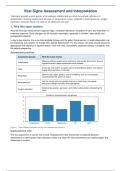
Vital Signs Assessment and Interpretation
Vital signs provide a quick picture of physiologic stability and are often the earliest indicators of
deterioration. Nursing assessment focuses on temperature, pulse, respiration, blood pressure, oxygen
saturation, and pain when it is used as an additional vital sign.
1. Why this topic matters
Accurate vital sign measurement supports triage, medication decisions, escalation of care, and evaluation of
treatment response. Small changes can be clinically meaningful, especially in children, older adults, and
postoperative patients.
In day to day practice, the nurse links bedside findings with the wider clinical picture. A single observation can
be reassuring, but a pattern of change often signals deterioration. For that reason, this topic should always be
approached with attention to baseline status, trend over time, comorbidity, treatment already in progress, and
the patient perspective.
Assessment priorities
Assessment domain What the nurse checks
Measure with the correct device and route, note trends, and confirm fever or
Temperature
hypothermia with repeat assessment when needed.
Count rate and rhythm, compare central and peripheral pulses, and assess
Pulse
quality when perfusion is reduced.
Observe rate, depth, pattern, work of breathing, and use of accessory
Respiration
muscles before the patient is aware.
Use the correct cuff size, position the arm at heart level, and repeat
Blood pressure
abnormal readings manually when appropriate.
Check probe position, perfusion, and motion artifact before interpreting the
Oxygen saturation
value.
Figure 1. Topic related emphasis across core assessment domains.
Quick practice note
The first assessment is not the end of care. Reassessment after intervention is essential because
improvement or deterioration often becomes visible only when the same parameters are checked again and
interpreted in context.
, Vital Signs Assessment and Interpretation
2. Assessment approach and interpretation
Temperature
Measure with the correct device and route, note trends, and confirm fever or hypothermia with repeat
assessment when needed.
When documenting temperature, include the observed value or finding, associated symptoms, and any factor
that might change interpretation such as treatment, activity, anxiety, pain, recent medication, or baseline
variation.
Pulse
Count rate and rhythm, compare central and peripheral pulses, and assess quality when perfusion is reduced.
When documenting pulse, include the observed value or finding, associated symptoms, and any factor that
might change interpretation such as treatment, activity, anxiety, pain, recent medication, or baseline variation.
Respiration
Observe rate, depth, pattern, work of breathing, and use of accessory muscles before the patient is aware.
When documenting respiration, include the observed value or finding, associated symptoms, and any factor
that might change interpretation such as treatment, activity, anxiety, pain, recent medication, or baseline
variation.
Blood pressure
Use the correct cuff size, position the arm at heart level, and repeat abnormal readings manually when
appropriate.
When documenting blood pressure, include the observed value or finding, associated symptoms, and any
factor that might change interpretation such as treatment, activity, anxiety, pain, recent medication, or baseline
variation.
Oxygen saturation
Check probe position, perfusion, and motion artifact before interpreting the value.
When documenting oxygen saturation, include the observed value or finding, associated symptoms, and any
factor that might change interpretation such as treatment, activity, anxiety, pain, recent medication, or baseline
variation.
Figure 2. A practical nursing workflow for this topic.
Interpretation tip
If assessment findings do not match the overall patient picture, the safest response is usually to repeat the
measurement, inspect contributing factors, and look for linked symptoms before deciding that the value is
normal or abnormal.
Vital signs provide a quick picture of physiologic stability and are often the earliest indicators of
deterioration. Nursing assessment focuses on temperature, pulse, respiration, blood pressure, oxygen
saturation, and pain when it is used as an additional vital sign.
1. Why this topic matters
Accurate vital sign measurement supports triage, medication decisions, escalation of care, and evaluation of
treatment response. Small changes can be clinically meaningful, especially in children, older adults, and
postoperative patients.
In day to day practice, the nurse links bedside findings with the wider clinical picture. A single observation can
be reassuring, but a pattern of change often signals deterioration. For that reason, this topic should always be
approached with attention to baseline status, trend over time, comorbidity, treatment already in progress, and
the patient perspective.
Assessment priorities
Assessment domain What the nurse checks
Measure with the correct device and route, note trends, and confirm fever or
Temperature
hypothermia with repeat assessment when needed.
Count rate and rhythm, compare central and peripheral pulses, and assess
Pulse
quality when perfusion is reduced.
Observe rate, depth, pattern, work of breathing, and use of accessory
Respiration
muscles before the patient is aware.
Use the correct cuff size, position the arm at heart level, and repeat
Blood pressure
abnormal readings manually when appropriate.
Check probe position, perfusion, and motion artifact before interpreting the
Oxygen saturation
value.
Figure 1. Topic related emphasis across core assessment domains.
Quick practice note
The first assessment is not the end of care. Reassessment after intervention is essential because
improvement or deterioration often becomes visible only when the same parameters are checked again and
interpreted in context.
, Vital Signs Assessment and Interpretation
2. Assessment approach and interpretation
Temperature
Measure with the correct device and route, note trends, and confirm fever or hypothermia with repeat
assessment when needed.
When documenting temperature, include the observed value or finding, associated symptoms, and any factor
that might change interpretation such as treatment, activity, anxiety, pain, recent medication, or baseline
variation.
Pulse
Count rate and rhythm, compare central and peripheral pulses, and assess quality when perfusion is reduced.
When documenting pulse, include the observed value or finding, associated symptoms, and any factor that
might change interpretation such as treatment, activity, anxiety, pain, recent medication, or baseline variation.
Respiration
Observe rate, depth, pattern, work of breathing, and use of accessory muscles before the patient is aware.
When documenting respiration, include the observed value or finding, associated symptoms, and any factor
that might change interpretation such as treatment, activity, anxiety, pain, recent medication, or baseline
variation.
Blood pressure
Use the correct cuff size, position the arm at heart level, and repeat abnormal readings manually when
appropriate.
When documenting blood pressure, include the observed value or finding, associated symptoms, and any
factor that might change interpretation such as treatment, activity, anxiety, pain, recent medication, or baseline
variation.
Oxygen saturation
Check probe position, perfusion, and motion artifact before interpreting the value.
When documenting oxygen saturation, include the observed value or finding, associated symptoms, and any
factor that might change interpretation such as treatment, activity, anxiety, pain, recent medication, or baseline
variation.
Figure 2. A practical nursing workflow for this topic.
Interpretation tip
If assessment findings do not match the overall patient picture, the safest response is usually to repeat the
measurement, inspect contributing factors, and look for linked symptoms before deciding that the value is
normal or abnormal.


