

1
,PREFACE
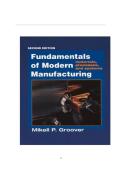
This is the Solutions Manual for the textbook Fundamentals of Modern Manufacturing: Materia
zk zk zk zk zk zk zk zk zk zk zk zk
ls, Processes, and Systems (Second Edition). It contains the answers to the Review Questions and
zk zk zk zk zk zk zk zk zk zk zk zk zk zk zk
Multiple Choice Quizzes at the end of the Chapters 2 through 44, as well as the Problems at the end of
zk zk zk zk zk zk zk zk zk zk zk zk zk zk zk zk zk zk zk zk zk
Chapters 3, 4, 6, 10, 11, 13, 16, 18, 19, 20, 21, 22, 23, 24, 25, 26, 29, 30,
zk zk zk zk zk zk zk zk zk zk zk zk zk zk zk zk zk zk
31, 33, 34, 35, 38, 40, 42, and 43. There are approximately 740 review questions, 500 quiz questions, a
zk zk zk zk zk zk zk zk zk zk zk zk zk zk zk zk zk zk
nd 500 problems (nearly all of them quantitative) in the text.
zk zk zk zk zk zk zk zk zk zk
I have personally answered all of the questions and solved all of the quizzes and problems and have per
zk zk zk zk zk zk zk zk zk zk zk zk zk zk zk zk zk zk
sonally recorded the solutions in this booklet. Many of the problems have been tested in class, thus givi
zk zk zk zk zk zk zk zk zk zk zk zk zk zk zk zk zk
ng me an opportunity to compare my own answers with those developed by the students. Despite my b
zk zk zk zk zk zk zk zk zk zk zk zk zk zk zk zk zk
est efforts to avoid errors in this solutions manual, I am sure that errors are present. I would appreciate
zk zk zk zk zk zk zk zk zk zk zk zk zk zk zk zk zk zk zk
hearing from those of you who discover these errors, so that I can make the necessary corrections in s
zk zk zk zk zk zk zk zk zk zk zk zk zk zk zk zk zk zk
ubsequent editions of the Solutions Manual. Similarly, I would appreciate any suggestions from users
zk zk zk zk zk zk zk zk zk zk zk zk zk zk
of the text itself that might help to make any subsequent editions more accurate, more relevant, and easie
zk zk zk zk zk zk zk zk zk zk zk zk zk zk zk zk zk
r to use. My address is:
zk zk zk zk zk
Dr. Mikell P. Grooverzk zk zk
Department of Industrial and Manufacturing Systems Engineering L zk zk zk zk zk zk zk
ehigh University zk
200 West Packer Avenue Bethlehe
zk zk zk zk
m, PA 18015 zk zk
Office telephone number 610-758- zk zk zk
4030. Fax machine number 610-758- zk zk zk zk
4886.
E-
mail addresses: either Mikell.
zk zk zk
or zk
u
I hope you find the text and this Solutions Manual to be helpful teaching aids in your particular manu
zk zk zk zk zk zk zk zk zk zk zk zk zk zk zk zk zk zk
facturing course. zk
Mikell P. Groover zk zk
2
,TABLE OF CONTENTS:
zk zk
Chapter Chapter Title* zk Page
1. Introduction (No questions or problems) zk zk zk zk
2. The Nature of Materials
zk zk zk 4
3. Mechanical Properties of Materials (P) zk zk zk zk 7
4. Physical Properties of Materials (P)
zk zk zk zk 18
5. Dimensions, Tolerances, and Surfaces zk zk zk 21
6. Metals (P) zk 24
7. Ceramics 29
8. Polymers 32
9. Composite Materials zk 36
10. Fundamentals of Casting (P) zk zk zk 39
11. Metal Casting Processes (P)
zk zk zk 49
12. Glassworking 57
13. Shaping Processes for Plastics (P)
zk zk zk zk 60
14. Rubber Processing Technology
zk zk 70
15. Shaping Processes for Polymer Matrix Composites
zk zk zk zk zk 73
16. Powder Metallurgy (P) zk zk 76
17. Processing of Ceramics and Cermets zk zk zk zk 84
18. Fundamentals of Metal Forming (P) zk zk zk zk 87
19. Bulk Deformation Processes (P)
zk zk zk 92
20. Sheet Metalworking (P)
zk zk 112
21. Theory of Metal Machining (P)
zk zk zk zk 122
22. Machining Operations and Machine Tools (P) zk zk zk zk zk 134
23. Cutting Tool Technology (P)
zk zk zk 142
24. Economic and Product Design Considerations in Machining (P)
zk zk zk zk zk zk zk 153
25. Grinding and Other Abrasive Processes (P)
zk zk zk zk zk 166
26. Nontraditional Machining and Thermal Cutting Processes (P) zk zk zk zk zk zk 173
27. Heat Treatment of Metals
zk zk zk 180
28. Cleaning and Surface Treatments zk zk zk 182
29. Coating and Deposition Processes (P)
zk zk zk zk 184
30. Fundamentals of Welding (P) zk zk zk 190
31. Welding Processes (P) zk zk 197
32. Brazing, Soldering, and Adhesive Bonding
zk zk zk zk 207
33. Mechanical Assembly (P) zk zk 211
34. Rapid Prototyping (P)
zk zk 218
35. Processing of Integrated Circuits (P) zk zk zk zk 222
36. Electronics Assembly and Packaging zk zk zk 230
37. Microfabrication Technologies zk 233
38. Numerical Control and Industrial Robotics (P) zk zk zk zk zk 235
39. Group Technology and Flexible Manufacturing Systems
zk zk zk zk zk 244
40. Production Lines (P) zk zk 246
41. Manufacturing Engineering zk 253
42. Production Planning and Control (P) zk zk zk zk 256
43. Quality Control (P) zk zk 263
44. Measurement and Inspection zk zk 271
*(P) indicates chapters with problem sets.
zk zk zk zk zk
3
, 2 THE NATURE OF MATERIALS zk zk zk
Review Questionszk
2.1 The elements listed in the Periodic Table can be divided into three categories. What are these
zk zk zk zk zk zk zk zk zk zk zk zk z k zk zk
categories and give an example of each?
zk zk zk zk zk zk zk
Answer. The three types of elements are metals (e.g., aluminum), nonmetals (e.g., oxygen), and semim
zk zk zk zk zk zk zk zk zk zk zk zk zk zk
etals (e.g., silicon). zk zk
2.2 Which elements are the noble metals? zk zk zk zk zk
Answer. The noble metals are copper, silver, and gold.
zk zk zk zk zk zk zk zk
2.3 What is the difference between primary and secondary bonding in the structure of materials?
zk zk zk zk zk zk zk zk zk zk zk zk zk
Answer. Primary bonding is strong bonding between atoms in a material, for example to form a mol
zk zk zk zk zk zk zk zk zk zk zk zk zk zk zk zk
ecule; while secondary bonding is not as strong and is associated with attraction between molecule
zk zk zk zk zk zk zk zk zk zk zk zk zk zk
s in the material.
zk zk zk
2.4 Describe how ionic bonding works? zk zk zk zk
Answer. In ionic bonding, atoms of one element give up their outer electron(s) to the atoms of anoth
zk zk zk zk zk zk zk zk zk zk zk zk zk zk zk zk zk
er element to form complete outer shells.
zk zk zk zk zk zk
2.5 What is the difference between crystalline and noncrystalline structures in materials?
zk zk zk zk zk zk zk zk zk zk
Answer. The atoms in a crystalline structure are located at regular and repeating lattice positions in
zk zk zk zk zk zk zk zk zk zk zk zk zk zk zk z
three dimensions; thus, the crystal structure possesses a long-
k zk zk zk zk zk zk zk zk
range order which allows a high packing density. The atoms in a noncrystalline structure are random
zk zk zk zk zk zk zk z k zk zk zk zk zk zk zk
ly positioned in the material, not possessing any repeating, regular pattern.
zk zk zk zk zk zk zk zk zk zk
2.6 What are some common point defects in a crystal lattice structure?
zk zk zk zk zk zk zk zk zk zk
Answer. Some of the common point defects are: (1) vacancy -
zk zk zk zk zk zk zk zk zk zk
a missing atom in the lattice structure; (2) ion-pair vacancy (Schottky defect) -
zk zk zk zk zk zk zk zk zk zk zk zk zk
a missing pair of ions of opposite charge in a compound; (3) interstitialcy -
zk zk zk zk zk zk zk zk zk zk zk zk zk zk
a distortion in the lattice caused by an extra atom present; and (4) Frenkel defect -
zk zk zk zk zk zk zk zk zk zk zk zk zk zk zk zk
an ion is removed from a regular position in the lattice and inserted into an interstitial position not
zk zk zk zk zk zk zk zk zk zk zk zk zk zk zk zk zk zk zk
normally occupied by such an ion. zk zk zk zk zk
2.7 Define the difference between elastic and plastic deformation in terms of the effect on the crystal
zk zk zk zk zk zk zk zk zk zk zk zk zk zk zk zk
lattice structure. zk
Answer. Elastic deformation involves a temporary distortion of the lattice structure that is proporti
zk zk zk zk zk zk zk zk zk zk zk zk zk
onal to the applied stress. Plastic deformation involves a stress of sufficient magnitude to cause a
zk zk zk zk z k zk zk zk zk zk zk zk zk zk zk zk
permanent shift in the relative positions of adjacent atoms in the lattice. Plastic deformation general
zk zk zk zk zk zk zk zk zk zk zk z k zk zk
ly involves the mechanism of slip -
zk zk zk zk zk zk
relative movement of atoms on opposite sides of a plane in the lattice.
zk zk zk zk zk zk zk zk zk zk zk zk zk
2.8 How do grain boundaries contribute to the strain hardening phenomenon in metals?
zk zk zk zk zk zk zk zk zk zk zk
Answer. Grain boundaries block the continued movement of dislocations in the metal during strain
zk zk zk zk zk zk zk zk zk zk zk zk zk
ing. As more dislocations become blocked, the metal becomes more difficult to deform; in effect it b
z k zk zk zk zk zk zk zk zk zk zk zk zk zk zk zk
ecomes stronger. zk
2.9 Identify some materials that have a crystalline structure.
zk zk zk zk zk zk zk
4
,PREFACE
This is the Solutions Manual for the textbook Fundamentals of Modern Manufacturing: Materia
zk zk zk zk zk zk zk zk zk zk zk zk
ls, Processes, and Systems (Second Edition). It contains the answers to the Review Questions and
zk zk zk zk zk zk zk zk zk zk zk zk zk zk zk
Multiple Choice Quizzes at the end of the Chapters 2 through 44, as well as the Problems at the end of
zk zk zk zk zk zk zk zk zk zk zk zk zk zk zk zk zk zk zk zk zk
Chapters 3, 4, 6, 10, 11, 13, 16, 18, 19, 20, 21, 22, 23, 24, 25, 26, 29, 30,
zk zk zk zk zk zk zk zk zk zk zk zk zk zk zk zk zk zk
31, 33, 34, 35, 38, 40, 42, and 43. There are approximately 740 review questions, 500 quiz questions, a
zk zk zk zk zk zk zk zk zk zk zk zk zk zk zk zk zk zk
nd 500 problems (nearly all of them quantitative) in the text.
zk zk zk zk zk zk zk zk zk zk
I have personally answered all of the questions and solved all of the quizzes and problems and have per
zk zk zk zk zk zk zk zk zk zk zk zk zk zk zk zk zk zk
sonally recorded the solutions in this booklet. Many of the problems have been tested in class, thus givi
zk zk zk zk zk zk zk zk zk zk zk zk zk zk zk zk zk
ng me an opportunity to compare my own answers with those developed by the students. Despite my b
zk zk zk zk zk zk zk zk zk zk zk zk zk zk zk zk zk
est efforts to avoid errors in this solutions manual, I am sure that errors are present. I would appreciate
zk zk zk zk zk zk zk zk zk zk zk zk zk zk zk zk zk zk zk
hearing from those of you who discover these errors, so that I can make the necessary corrections in s
zk zk zk zk zk zk zk zk zk zk zk zk zk zk zk zk zk zk
ubsequent editions of the Solutions Manual. Similarly, I would appreciate any suggestions from users
zk zk zk zk zk zk zk zk zk zk zk zk zk zk
of the text itself that might help to make any subsequent editions more accurate, more relevant, and easie
zk zk zk zk zk zk zk zk zk zk zk zk zk zk zk zk zk
r to use. My address is:
zk zk zk zk zk
Dr. Mikell P. Grooverzk zk zk
Department of Industrial and Manufacturing Systems Engineering L zk zk zk zk zk zk zk
ehigh University zk
200 West Packer Avenue Bethlehe
zk zk zk zk
m, PA 18015 zk zk
Office telephone number 610-758- zk zk zk
4030. Fax machine number 610-758- zk zk zk zk
4886.
E-
mail addresses: either Mikell.
zk zk zk
or zk
u
I hope you find the text and this Solutions Manual to be helpful teaching aids in your particular manu
zk zk zk zk zk zk zk zk zk zk zk zk zk zk zk zk zk zk
facturing course. zk
Mikell P. Groover zk zk
2
,TABLE OF CONTENTS:
zk zk
Chapter Chapter Title* zk Page
1. Introduction (No questions or problems) zk zk zk zk
2. The Nature of Materials
zk zk zk 4
3. Mechanical Properties of Materials (P) zk zk zk zk 7
4. Physical Properties of Materials (P)
zk zk zk zk 18
5. Dimensions, Tolerances, and Surfaces zk zk zk 21
6. Metals (P) zk 24
7. Ceramics 29
8. Polymers 32
9. Composite Materials zk 36
10. Fundamentals of Casting (P) zk zk zk 39
11. Metal Casting Processes (P)
zk zk zk 49
12. Glassworking 57
13. Shaping Processes for Plastics (P)
zk zk zk zk 60
14. Rubber Processing Technology
zk zk 70
15. Shaping Processes for Polymer Matrix Composites
zk zk zk zk zk 73
16. Powder Metallurgy (P) zk zk 76
17. Processing of Ceramics and Cermets zk zk zk zk 84
18. Fundamentals of Metal Forming (P) zk zk zk zk 87
19. Bulk Deformation Processes (P)
zk zk zk 92
20. Sheet Metalworking (P)
zk zk 112
21. Theory of Metal Machining (P)
zk zk zk zk 122
22. Machining Operations and Machine Tools (P) zk zk zk zk zk 134
23. Cutting Tool Technology (P)
zk zk zk 142
24. Economic and Product Design Considerations in Machining (P)
zk zk zk zk zk zk zk 153
25. Grinding and Other Abrasive Processes (P)
zk zk zk zk zk 166
26. Nontraditional Machining and Thermal Cutting Processes (P) zk zk zk zk zk zk 173
27. Heat Treatment of Metals
zk zk zk 180
28. Cleaning and Surface Treatments zk zk zk 182
29. Coating and Deposition Processes (P)
zk zk zk zk 184
30. Fundamentals of Welding (P) zk zk zk 190
31. Welding Processes (P) zk zk 197
32. Brazing, Soldering, and Adhesive Bonding
zk zk zk zk 207
33. Mechanical Assembly (P) zk zk 211
34. Rapid Prototyping (P)
zk zk 218
35. Processing of Integrated Circuits (P) zk zk zk zk 222
36. Electronics Assembly and Packaging zk zk zk 230
37. Microfabrication Technologies zk 233
38. Numerical Control and Industrial Robotics (P) zk zk zk zk zk 235
39. Group Technology and Flexible Manufacturing Systems
zk zk zk zk zk 244
40. Production Lines (P) zk zk 246
41. Manufacturing Engineering zk 253
42. Production Planning and Control (P) zk zk zk zk 256
43. Quality Control (P) zk zk 263
44. Measurement and Inspection zk zk 271
*(P) indicates chapters with problem sets.
zk zk zk zk zk
3
, 2 THE NATURE OF MATERIALS zk zk zk
Review Questionszk
2.1 The elements listed in the Periodic Table can be divided into three categories. What are these
zk zk zk zk zk zk zk zk zk zk zk zk z k zk zk
categories and give an example of each?
zk zk zk zk zk zk zk
Answer. The three types of elements are metals (e.g., aluminum), nonmetals (e.g., oxygen), and semim
zk zk zk zk zk zk zk zk zk zk zk zk zk zk
etals (e.g., silicon). zk zk
2.2 Which elements are the noble metals? zk zk zk zk zk
Answer. The noble metals are copper, silver, and gold.
zk zk zk zk zk zk zk zk
2.3 What is the difference between primary and secondary bonding in the structure of materials?
zk zk zk zk zk zk zk zk zk zk zk zk zk
Answer. Primary bonding is strong bonding between atoms in a material, for example to form a mol
zk zk zk zk zk zk zk zk zk zk zk zk zk zk zk zk
ecule; while secondary bonding is not as strong and is associated with attraction between molecule
zk zk zk zk zk zk zk zk zk zk zk zk zk zk
s in the material.
zk zk zk
2.4 Describe how ionic bonding works? zk zk zk zk
Answer. In ionic bonding, atoms of one element give up their outer electron(s) to the atoms of anoth
zk zk zk zk zk zk zk zk zk zk zk zk zk zk zk zk zk
er element to form complete outer shells.
zk zk zk zk zk zk
2.5 What is the difference between crystalline and noncrystalline structures in materials?
zk zk zk zk zk zk zk zk zk zk
Answer. The atoms in a crystalline structure are located at regular and repeating lattice positions in
zk zk zk zk zk zk zk zk zk zk zk zk zk zk zk z
three dimensions; thus, the crystal structure possesses a long-
k zk zk zk zk zk zk zk zk
range order which allows a high packing density. The atoms in a noncrystalline structure are random
zk zk zk zk zk zk zk z k zk zk zk zk zk zk zk
ly positioned in the material, not possessing any repeating, regular pattern.
zk zk zk zk zk zk zk zk zk zk
2.6 What are some common point defects in a crystal lattice structure?
zk zk zk zk zk zk zk zk zk zk
Answer. Some of the common point defects are: (1) vacancy -
zk zk zk zk zk zk zk zk zk zk
a missing atom in the lattice structure; (2) ion-pair vacancy (Schottky defect) -
zk zk zk zk zk zk zk zk zk zk zk zk zk
a missing pair of ions of opposite charge in a compound; (3) interstitialcy -
zk zk zk zk zk zk zk zk zk zk zk zk zk zk
a distortion in the lattice caused by an extra atom present; and (4) Frenkel defect -
zk zk zk zk zk zk zk zk zk zk zk zk zk zk zk zk
an ion is removed from a regular position in the lattice and inserted into an interstitial position not
zk zk zk zk zk zk zk zk zk zk zk zk zk zk zk zk zk zk zk
normally occupied by such an ion. zk zk zk zk zk
2.7 Define the difference between elastic and plastic deformation in terms of the effect on the crystal
zk zk zk zk zk zk zk zk zk zk zk zk zk zk zk zk
lattice structure. zk
Answer. Elastic deformation involves a temporary distortion of the lattice structure that is proporti
zk zk zk zk zk zk zk zk zk zk zk zk zk
onal to the applied stress. Plastic deformation involves a stress of sufficient magnitude to cause a
zk zk zk zk z k zk zk zk zk zk zk zk zk zk zk zk
permanent shift in the relative positions of adjacent atoms in the lattice. Plastic deformation general
zk zk zk zk zk zk zk zk zk zk zk z k zk zk
ly involves the mechanism of slip -
zk zk zk zk zk zk
relative movement of atoms on opposite sides of a plane in the lattice.
zk zk zk zk zk zk zk zk zk zk zk zk zk
2.8 How do grain boundaries contribute to the strain hardening phenomenon in metals?
zk zk zk zk zk zk zk zk zk zk zk
Answer. Grain boundaries block the continued movement of dislocations in the metal during strain
zk zk zk zk zk zk zk zk zk zk zk zk zk
ing. As more dislocations become blocked, the metal becomes more difficult to deform; in effect it b
z k zk zk zk zk zk zk zk zk zk zk zk zk zk zk zk
ecomes stronger. zk
2.9 Identify some materials that have a crystalline structure.
zk zk zk zk zk zk zk
4



