
NC RADAR Operator Course Exam | Latest Update
2026 | Questions & Answers | Exam Prep | Graded
A+
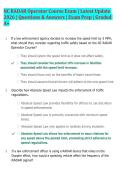
1. If a law enforcement agency decides to increase the speed limit by 5 MPH,
what should they consider regarding traffic safety based on the NC RADAR
Operator Course?
They should ignore the speed limit as it does not affect safety.
They should consider the potential 10% increase in fatalities
associated with the speed limit increase.
They should focus only on the benefits of faster travel times.
They should assume that all drivers will adhere to the new speed limit.
2. Describe how Absolute Speed Law impacts the enforcement of traffic
regulations.
Absolute Speed Law provides flexibility for officers to use discretion
in speed enforcement.
Absolute Speed Law is primarily concerned with minimum speed
limits.
Absolute Speed Law only applies to reckless driving incidents.
Absolute Speed Law allows law enforcement to issue citations for
any speed above the posted limit, promoting strict adherence to
speed regulations.
3. If a law enforcement officer is using a RADAR device that relies on the
Doppler effect, how would a speeding vehicle affect the frequency of the
RADAR signal?
, The frequency would remain constant regardless of the vehicle's
speed.
The frequency would only change if the vehicle is stationary.
The frequency of the RADAR signal would increase as the vehicle
approaches and decrease as it moves away.
The frequency would decrease as the vehicle approaches and
increase as it moves away.
4. What is the frequency range of K-band radar signals used in law
enforcement?
1.0 to 1.5 GHz
10.5 to 10.6 GHz
24.05 to 24.25 GHz
33.4 to 36.0 GHz
5. If a law enforcement officer sets up a radar unit too far from the traveled
portion of the road, what potential issue could arise during speed
enforcement?
Enhanced communication with other officers.
Increased visibility of the radar unit to drivers.
Improved accuracy in speed detection.
Inaccurate speed readings due to increased distance from the
target vehicle.
6. According to the notes, what percentage of fatalities is attributed to
speeding?
41%
25%
, 35%
55%
7. Congress imposed a __ MPH maxium speed limit nationwide in the year ____.
55, 1974
65, 1976
60, 1964
50, 1973
8. What is the recommended action for an officer when uncertain about the
target vehicle being tracked by RADAR?
Consult with another officer for confirmation.
Ignore the uncertainty and proceed with enforcement.
Immediately issue a citation to the nearest vehicle.
Verify the target vehicle's speed before taking enforcement action.
9. If a law enforcement officer is using a K-band radar device that operates at
24.15 GHz, what type of radar signal are they utilizing, and how does it relate
to traffic safety?
They are utilizing a low-frequency radar signal, which cannot measure
speed accurately.
They are utilizing a K-band radar signal, which is effective for
accurately measuring vehicle speeds to enhance traffic safety.
They are utilizing a Ka-band radar signal, which is less effective for
speed detection.
They are utilizing a microwave radar signal, which is not suitable for
speed enforcement.
, 10. What are the original speed limits established for vehicles in urban areas?
30 mph
25 mph
35 mph
20 mph
11. The speed at which a radar pulse travels is:
300,000,000 meters/sec
300,000,000 nm per hour
3 X 10⁸ nm per hour
3 X 10⁷ nm per hour
12. If a law enforcement agency aims to reduce speed-related fatalities by 20%
in the next year, how many fatalities would they need to target based on the
2009 statistics?
150
263
200
300
13. What is the typical width of a radar beam at a distance of 300 feet?
Approximately 6 feet
Approximately 24 feet
Approximately 12 feet
Approximately 18 feet
2026 | Questions & Answers | Exam Prep | Graded
A+
1. If a law enforcement agency decides to increase the speed limit by 5 MPH,
what should they consider regarding traffic safety based on the NC RADAR
Operator Course?
They should ignore the speed limit as it does not affect safety.
They should consider the potential 10% increase in fatalities
associated with the speed limit increase.
They should focus only on the benefits of faster travel times.
They should assume that all drivers will adhere to the new speed limit.
2. Describe how Absolute Speed Law impacts the enforcement of traffic
regulations.
Absolute Speed Law provides flexibility for officers to use discretion
in speed enforcement.
Absolute Speed Law is primarily concerned with minimum speed
limits.
Absolute Speed Law only applies to reckless driving incidents.
Absolute Speed Law allows law enforcement to issue citations for
any speed above the posted limit, promoting strict adherence to
speed regulations.
3. If a law enforcement officer is using a RADAR device that relies on the
Doppler effect, how would a speeding vehicle affect the frequency of the
RADAR signal?
, The frequency would remain constant regardless of the vehicle's
speed.
The frequency would only change if the vehicle is stationary.
The frequency of the RADAR signal would increase as the vehicle
approaches and decrease as it moves away.
The frequency would decrease as the vehicle approaches and
increase as it moves away.
4. What is the frequency range of K-band radar signals used in law
enforcement?
1.0 to 1.5 GHz
10.5 to 10.6 GHz
24.05 to 24.25 GHz
33.4 to 36.0 GHz
5. If a law enforcement officer sets up a radar unit too far from the traveled
portion of the road, what potential issue could arise during speed
enforcement?
Enhanced communication with other officers.
Increased visibility of the radar unit to drivers.
Improved accuracy in speed detection.
Inaccurate speed readings due to increased distance from the
target vehicle.
6. According to the notes, what percentage of fatalities is attributed to
speeding?
41%
25%
, 35%
55%
7. Congress imposed a __ MPH maxium speed limit nationwide in the year ____.
55, 1974
65, 1976
60, 1964
50, 1973
8. What is the recommended action for an officer when uncertain about the
target vehicle being tracked by RADAR?
Consult with another officer for confirmation.
Ignore the uncertainty and proceed with enforcement.
Immediately issue a citation to the nearest vehicle.
Verify the target vehicle's speed before taking enforcement action.
9. If a law enforcement officer is using a K-band radar device that operates at
24.15 GHz, what type of radar signal are they utilizing, and how does it relate
to traffic safety?
They are utilizing a low-frequency radar signal, which cannot measure
speed accurately.
They are utilizing a K-band radar signal, which is effective for
accurately measuring vehicle speeds to enhance traffic safety.
They are utilizing a Ka-band radar signal, which is less effective for
speed detection.
They are utilizing a microwave radar signal, which is not suitable for
speed enforcement.
, 10. What are the original speed limits established for vehicles in urban areas?
30 mph
25 mph
35 mph
20 mph
11. The speed at which a radar pulse travels is:
300,000,000 meters/sec
300,000,000 nm per hour
3 X 10⁸ nm per hour
3 X 10⁷ nm per hour
12. If a law enforcement agency aims to reduce speed-related fatalities by 20%
in the next year, how many fatalities would they need to target based on the
2009 statistics?
150
263
200
300
13. What is the typical width of a radar beam at a distance of 300 feet?
Approximately 6 feet
Approximately 24 feet
Approximately 12 feet
Approximately 18 feet


