
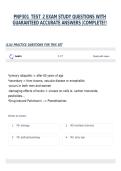
PNP301 TEST 2 EXAM STUDY QUESTIONS WITH
GUARANTEED ACCURATE ANSWERS |COMPLETE!!
(114) PRACTICE QUESTIONS FOR THIS SET
Learn 1/7 Study with Learn
*primary idiopathic = after 60 years of age
*secondary = from trauma, vascular disease or encephalitis
-occurs in both men and women
-damaging effects of toxins + viruses on cells ie. carbon monoxide,
pesticides...
*Drug-induced Parkinson's --> Phenothiazines
Choose an answer
1 PD: etiology 2 MS (multiple sclerosis)
3 PD: pathophysiology 4 MS: early sign
,MS (multiple sclerosis) progressive demyelination of the neurons in the
brain, sc + cranial nerves -- characterized by
remissions and exacerbations.
MS: pathophysiology -Demyelination interrupts the flow of nerve
impulses
-lesions create an inflammatory response + attack
neurons (immune-mediated response on the CNS)
-Plaques appear on demyelinated axons, further
interrupting the transmission of nerve impulses
-Eventually the axons begin to degenerate,
resulting in permanent and irreversible damage
from scarring and plaques
MS: etiology - genetic =affects european pop.,
- immunologic =viral infections + abnormal immune
response
- environmental =temperate climate
*Onset b/w 20-40 years of age (peak 30)
- more common in women (2:1)
MS: S/S Depends on the demyelinated area...
-weakness in legs
-diplopia
-scotoma
-dysarthia
-paresthesia
-sensory deficits
-chronic fatigue
, MS: early sign blurred vision
MS: late sign(s) -depression/ euphoria
-respiratory infections
-decubitus ulcers
-contractures
MS: diagnostic tests No definitive test = often delayed diagnosis
-history of exacerbations + remissions + absence of
other neurologic criteria are used for initial
diagnosis ....
* MRI for detection and monitoring of CNS lesions
* CSF analysis = INCREASED protein, gamma glob.,
lymphocytes
*Tomography = optic + retinal nerves are early
targets in MS
Diplopia double vision
Scotoma dark spot in the visual field
Dysarthia difficulty forming words; articulated speech
paresthesia abnormal tactile sensation often described as
creeping, burning, tingling, or numbness
PD (Parkinson's Disease) affected motor function through loss of
extrapyramidal activity.
GUARANTEED ACCURATE ANSWERS |COMPLETE!!
(114) PRACTICE QUESTIONS FOR THIS SET
Learn 1/7 Study with Learn
*primary idiopathic = after 60 years of age
*secondary = from trauma, vascular disease or encephalitis
-occurs in both men and women
-damaging effects of toxins + viruses on cells ie. carbon monoxide,
pesticides...
*Drug-induced Parkinson's --> Phenothiazines
Choose an answer
1 PD: etiology 2 MS (multiple sclerosis)
3 PD: pathophysiology 4 MS: early sign
,MS (multiple sclerosis) progressive demyelination of the neurons in the
brain, sc + cranial nerves -- characterized by
remissions and exacerbations.
MS: pathophysiology -Demyelination interrupts the flow of nerve
impulses
-lesions create an inflammatory response + attack
neurons (immune-mediated response on the CNS)
-Plaques appear on demyelinated axons, further
interrupting the transmission of nerve impulses
-Eventually the axons begin to degenerate,
resulting in permanent and irreversible damage
from scarring and plaques
MS: etiology - genetic =affects european pop.,
- immunologic =viral infections + abnormal immune
response
- environmental =temperate climate
*Onset b/w 20-40 years of age (peak 30)
- more common in women (2:1)
MS: S/S Depends on the demyelinated area...
-weakness in legs
-diplopia
-scotoma
-dysarthia
-paresthesia
-sensory deficits
-chronic fatigue
, MS: early sign blurred vision
MS: late sign(s) -depression/ euphoria
-respiratory infections
-decubitus ulcers
-contractures
MS: diagnostic tests No definitive test = often delayed diagnosis
-history of exacerbations + remissions + absence of
other neurologic criteria are used for initial
diagnosis ....
* MRI for detection and monitoring of CNS lesions
* CSF analysis = INCREASED protein, gamma glob.,
lymphocytes
*Tomography = optic + retinal nerves are early
targets in MS
Diplopia double vision
Scotoma dark spot in the visual field
Dysarthia difficulty forming words; articulated speech
paresthesia abnormal tactile sensation often described as
creeping, burning, tingling, or numbness
PD (Parkinson's Disease) affected motor function through loss of
extrapyramidal activity.


