
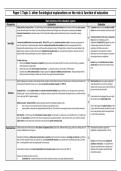
Paper 1 Topic 1: other Sociological explanations on the role & function of education
Main functions of the education system
Perspective Explanation Evaluation
Chubb and Moe: Consumer Choice – New Right believe that the role of the state should be limited and that schools should have more autonomy Competition between schools benefits the middle
to meet the local needs of their intake. Too much spending on education leads to higher taxes, which prevents economic growth. Parents classes who use their economic and cultural capital
(consumers) should shape the education system. Private schools deliver higher quality education because they are answerable to paying
consumers Vocational education is often seen as having lower
status than more traditional academic
New Right A trained and qualified labour force (human capital) – Shultz (1971) argues that vocational education is useful as it prepares young people for qualifications. Birdwell (2011) suggests that school
work. The main focus of vocational education should be to improve the basic skills of the workforce (particularly young people) and to be routinely neglect students with vocational
integrated with academic learning in order to meet the needs of employers/economy. This helps Britain to maintain its successful position in the aspirations, offer little carers advice or
global economy. Measures to achieve this have been integrated into education policy e.g. work experience programmes, expansion of post-16 opportunities for work experience. Students
education (BTEC, NVQs, apprenticeships etc.) and an emphasis on key skills. themselves may view work experience as pointless
and vocational courses as exploitative.
The Role of the State –
1. State should establish a framework for competition that gives parents information with which to make an informed choice e.g. publishing Marxists argue that education does not impose
Ofsted inspections & league tables shared culture, but the that of a dominant ruling
2. State should ensure that schools transmit a shared culture – e.g. National Curriculum, the inclusion of ‘British Values’ class
3. Education should affirm national identity to integrate pupils into a single set of traditions and cultural values – through teaching of British
History & Literature and having a Christian act of worship. They oppose multi-cultural education.
Despite making gains in education, mainly through changes to policy, Feminists believe that some of the processes in schools prevent females from Liberal Feminists gain some support arguing that
achieving their full potential. Schools serve to reproduce patriarchy and gender inequality (see TOPIC 6) males still do better in some of the ‘prestigious’
subjects (such as physics) and are still more likely to
Socialisation Role – schools socialise students into masculine and feminine identities though verbal abuse, the male gaze and the way teachers gain entry into the top universities.
Feminism discipline pupils. They also socialise students, e.g. through peer pressure, teacher bias to follow gender stereotyped courses e.g. Health and Social
Care for girls (see TOPIC 6 Student Identities). Many feminists tend to disregard the way in which
the education system disadvantages males
Hidden Curriculum –Stanworth (1983) found that education transmits the following messages to girls:
• Boys’ careers are more important than girls’ (teachers encourages boys more) There is little support for Radical Feminists as there
• Senior positions in education are disproportionately held by men. This reinforces the message that males are and should be dominant. is clear evidence that females do better than males
due to many education policies favouring females
Role Allocation – Feminists argue that role allocation is based on gender and not based on a meritocracy as Functionalists claim. For example, they e.g. GIST, WISE, marketisation.
point to the ‘glass ceiling’ that prevents many women occupying senior occupational positions. They also point to the way in which boys and girls
subject choices at school leads males and females to be allocated into gender stereotypical jobs
Postmodernism Schools function to meet the needs of a more diverse or fragmented society (social classes, different ethnic groups, genders etc), offering choice to Postmodernists attempt to explain how
a range of individuals and social groups. globalisation is shaping education in the UK
Postmodernist thinking has influenced government policy on education, both Conservative and Labour by a) creating more diversity e.g. different
types of schools, specialist schools, city academies etc. and b) creating flexible education (e.g. modular exams) and lifelong learning (e.g. the New Marxists claim Postmodernists underplay the
Deal – retraining adults) to meet the changing needs of the economy. significance of social class. It is argued that the
education system still serves to reproduce and
Postmodernists emphasis on the impact of globalisation on the education system and the economy (see TOPIC 12) legitimate class inequality, especially through
marketisation policies.
Education and training has three main roles:
• Socialisation role - socialises individuals into a diverse multicultural society e.g. through citizenship education.


