
NUR 257 | Concepts of Aging & Chronic Illness | Exam 4 Practice | Page 1
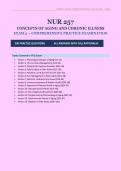
NUR 257
CONCEPTS OF AGING AND CHRONIC ILLNESS
EXAM 4 — COMPREHENSIVE PRACTICE EXAMINATION
100 PRACTICE QUESTIONS ALL ANSWERS WITH FULL RATIONALES
Topics Covered in This Exam
• Section 1: Physiological Changes of Aging (Q1–12)
• Section 2: Chronic Illness Management (Q13–24)
• Section 3: Dementia & Cognitive Disorders (Q25–34)
• Section 4: Falls & Safety in Older Adults (Q35–40)
• Section 5: Palliative Care & End-of-Life Care (Q41–50)
• Section 6: Pain Management in Older Adults (Q51–58)
• Section 7: Nutrition, Hydration & GI Issues (Q59–64)
• Section 8: Urinary Incontinence & Bladder Health (Q65–68)
• Section 9: Depression & Mental Health in Aging (Q69–74)
• Section 10: Osteoporosis & Arthritis (Q75–80)
• Section 11: Skin Integrity & Wound Care (Q81–86)
• Section 12: Polypharmacy & Pharmacology in Aging (Q87–92)
• Section 13: Cardiovascular Disease in Aging (Q93–97)
• Section 14: Diabetes in Older Adults (Q98–100)
, NUR 257 | Concepts of Aging & Chronic Illness | Exam 4 Practice | Page 2
ANSWER KEY — QUICK REFERENCE
Use the table below to quickly check your answers. Full rationale for each question follows in the exam section.
Q# Q# Q# Q# Q# Q# Q# Q# Q# Q#
Q1 Q2 Q3 Q4 Q5 Q6 Q7 Q8 Q9 Q10
B C B C B B C B C B
Q11 Q12 Q13 Q14 Q15 Q16 Q17 Q18 Q19 Q20
C C B B B B B B B B
Q21 Q22 Q23 Q24 Q25 Q26 Q27 Q28 Q29 Q30
C B B B B B B B C B
Q31 Q32 Q33 Q34 Q35 Q36 Q37 Q38 Q39 Q40
C B B B B B B B D B
Q41 Q42 Q43 Q44 Q45 Q46 Q47 Q48 Q49 Q50
B B B B B B B B B C
Q51 Q52 Q53 Q54 Q55 Q56 Q57 Q58 Q59 Q60
C C B C B C B C B B
Q61 Q62 Q63 Q64 Q65 Q66 Q67 Q68 Q69 Q70
B C B B C C B C B B
Q71 Q72 Q73 Q74 Q75 Q76 Q77 Q78 Q79 Q80
B C B C B C B B B B
Q81 Q82 Q83 Q84 Q85 Q86 Q87 Q88 Q89 Q90
B B B B B C B B A C
Q91 Q92 Q93 Q94 Q95 Q96 Q97 Q98 Q99 Q100
C B C C B B C C C B
, NUR 257 | Concepts of Aging & Chronic Illness | Exam 4 Practice | Page 3
PHYSIOLOGICAL CHANGES OF AGING
Question 1 | Topic: Physiological Changes of Aging
An 80-year-old patient's renal function lab results show a creatinine level of 1.1 mg/dL. The nurse
correctly interprets this result as:
A. Normal renal function — no intervention needed
B. Potentially significant renal impairment despite normal-appearing value ✓ CORRECT
C. Indicative of acute kidney injury requiring immediate dialysis
D. A result expected only in patients with documented kidney disease
Correct Answer: B | Rationale & Explanation:
Due to the normal loss of muscle mass (sarcopenia) associated with aging, older adults produce less
creatinine as a byproduct of muscle metabolism. This means that a serum creatinine value that appears
'normal' in a younger adult may actually reflect significant underlying renal impairment in an older
patient. The nurse must use age-adjusted GFR calculations (eGFR) rather than relying on creatinine alone.
A: Incorrect — what appears normal may mask decreased GFR in older adults due to reduced muscle
mass.
B: Correct — age-related muscle loss reduces creatinine production, masking true renal decline.
C: Incorrect — this value does not indicate a crisis, but subtle impairment requires further evaluation.
D: Incorrect — sarcopenia-related low creatinine occurs in all older adults, not just those with disease.
Question 2 | Topic: Physiological Changes of Aging
Which of the following cardiovascular changes is considered a NORMAL physiological change
associated with aging?
A. Decreased stroke volume at rest
B. Increased cardiac output at rest
C. Decreased arterial compliance leading to increased systolic blood pressure ✓ CORRECT
D. Tachycardia as the primary compensatory mechanism to stress
Correct Answer: C | Rationale & Explanation:
A normal age-related cardiovascular change is decreased arterial compliance (stiffening of blood vessel
walls), which results in increased peripheral vascular resistance and a rise in systolic blood pressure —
contributing to isolated systolic hypertension common in older adults. Resting stroke volume and cardiac
output are relatively preserved, and the heart relies less on heart rate and more on the Frank-Starling
mechanism as it ages.
A: Incorrect — resting stroke volume is generally preserved in healthy older adults.
B: Incorrect — resting cardiac output is typically maintained; it declines under exertion.
, NUR 257 | Concepts of Aging & Chronic Illness | Exam 4 Practice | Page 4
C: Correct — arterial stiffening with aging increases SBP and pulse pressure — a hallmark cardiovascular
change.
D: Incorrect — the aging heart has a blunted HR response; chronotropic response to stress is reduced.
Question 3 | Topic: Physiological Changes of Aging
An older adult patient reports increasing difficulty seeing at night and needing brighter light to read.
The nurse attributes these changes to:
A. Cataracts requiring immediate surgical referral
B. Normal age-related changes in the lens and pupillary response ✓ CORRECT
C. Early-onset macular degeneration requiring urgent treatment
D. Glaucoma presenting as decreased night vision
Correct Answer: B | Rationale & Explanation:
Normal aging of the eye includes lens thickening and yellowing (which filters blue light and reduces
contrast sensitivity), decreased pupillary size and speed of dilation (miosis), and reduced adaptation to
changes in light. These changes collectively impair night vision and require more light for close work.
While cataracts, macular degeneration, and glaucoma are diseases common in older adults, the
symptoms described here align with expected normal age-related visual changes.
A: Incorrect — cataracts cause cloudy/blurred vision at all times, not only night difficulty.
B: Correct — miosis, lens yellowing, and reduced light-dark adaptation are normal age-related changes.
C: Incorrect — macular degeneration causes central vision loss, not primarily night vision difficulty.
D: Incorrect — glaucoma causes peripheral vision loss; a more targeted assessment is needed to diagnose.
Question 4 | Topic: Physiological Changes of Aging
Which statement BEST explains why older adults are at increased risk for dehydration?
A. They consume excessive amounts of caffeine and alcohol
B. The kidneys over-compensate by retaining too much fluid
C. The sensation of thirst diminishes significantly with aging ✓ CORRECT
D. Older adults have increased antidiuretic hormone (ADH) secretion
Correct Answer: C | Rationale & Explanation:
The thirst mechanism becomes blunted with age — older adults do not perceive thirst as readily as
younger adults even when they are clinically dehydrated. Additionally, the kidneys' ability to concentrate
urine and conserve water is reduced. Total body water decreases with age. These factors collectively
make older adults highly susceptible to dehydration, especially during illness, hot weather, or after
diuretic therapy.
A: Incorrect — while caffeine/alcohol contribute, the primary physiological reason is blunted thirst
sensation.
NUR 257
CONCEPTS OF AGING AND CHRONIC ILLNESS
EXAM 4 — COMPREHENSIVE PRACTICE EXAMINATION
100 PRACTICE QUESTIONS ALL ANSWERS WITH FULL RATIONALES
Topics Covered in This Exam
• Section 1: Physiological Changes of Aging (Q1–12)
• Section 2: Chronic Illness Management (Q13–24)
• Section 3: Dementia & Cognitive Disorders (Q25–34)
• Section 4: Falls & Safety in Older Adults (Q35–40)
• Section 5: Palliative Care & End-of-Life Care (Q41–50)
• Section 6: Pain Management in Older Adults (Q51–58)
• Section 7: Nutrition, Hydration & GI Issues (Q59–64)
• Section 8: Urinary Incontinence & Bladder Health (Q65–68)
• Section 9: Depression & Mental Health in Aging (Q69–74)
• Section 10: Osteoporosis & Arthritis (Q75–80)
• Section 11: Skin Integrity & Wound Care (Q81–86)
• Section 12: Polypharmacy & Pharmacology in Aging (Q87–92)
• Section 13: Cardiovascular Disease in Aging (Q93–97)
• Section 14: Diabetes in Older Adults (Q98–100)
, NUR 257 | Concepts of Aging & Chronic Illness | Exam 4 Practice | Page 2
ANSWER KEY — QUICK REFERENCE
Use the table below to quickly check your answers. Full rationale for each question follows in the exam section.
Q# Q# Q# Q# Q# Q# Q# Q# Q# Q#
Q1 Q2 Q3 Q4 Q5 Q6 Q7 Q8 Q9 Q10
B C B C B B C B C B
Q11 Q12 Q13 Q14 Q15 Q16 Q17 Q18 Q19 Q20
C C B B B B B B B B
Q21 Q22 Q23 Q24 Q25 Q26 Q27 Q28 Q29 Q30
C B B B B B B B C B
Q31 Q32 Q33 Q34 Q35 Q36 Q37 Q38 Q39 Q40
C B B B B B B B D B
Q41 Q42 Q43 Q44 Q45 Q46 Q47 Q48 Q49 Q50
B B B B B B B B B C
Q51 Q52 Q53 Q54 Q55 Q56 Q57 Q58 Q59 Q60
C C B C B C B C B B
Q61 Q62 Q63 Q64 Q65 Q66 Q67 Q68 Q69 Q70
B C B B C C B C B B
Q71 Q72 Q73 Q74 Q75 Q76 Q77 Q78 Q79 Q80
B C B C B C B B B B
Q81 Q82 Q83 Q84 Q85 Q86 Q87 Q88 Q89 Q90
B B B B B C B B A C
Q91 Q92 Q93 Q94 Q95 Q96 Q97 Q98 Q99 Q100
C B C C B B C C C B
, NUR 257 | Concepts of Aging & Chronic Illness | Exam 4 Practice | Page 3
PHYSIOLOGICAL CHANGES OF AGING
Question 1 | Topic: Physiological Changes of Aging
An 80-year-old patient's renal function lab results show a creatinine level of 1.1 mg/dL. The nurse
correctly interprets this result as:
A. Normal renal function — no intervention needed
B. Potentially significant renal impairment despite normal-appearing value ✓ CORRECT
C. Indicative of acute kidney injury requiring immediate dialysis
D. A result expected only in patients with documented kidney disease
Correct Answer: B | Rationale & Explanation:
Due to the normal loss of muscle mass (sarcopenia) associated with aging, older adults produce less
creatinine as a byproduct of muscle metabolism. This means that a serum creatinine value that appears
'normal' in a younger adult may actually reflect significant underlying renal impairment in an older
patient. The nurse must use age-adjusted GFR calculations (eGFR) rather than relying on creatinine alone.
A: Incorrect — what appears normal may mask decreased GFR in older adults due to reduced muscle
mass.
B: Correct — age-related muscle loss reduces creatinine production, masking true renal decline.
C: Incorrect — this value does not indicate a crisis, but subtle impairment requires further evaluation.
D: Incorrect — sarcopenia-related low creatinine occurs in all older adults, not just those with disease.
Question 2 | Topic: Physiological Changes of Aging
Which of the following cardiovascular changes is considered a NORMAL physiological change
associated with aging?
A. Decreased stroke volume at rest
B. Increased cardiac output at rest
C. Decreased arterial compliance leading to increased systolic blood pressure ✓ CORRECT
D. Tachycardia as the primary compensatory mechanism to stress
Correct Answer: C | Rationale & Explanation:
A normal age-related cardiovascular change is decreased arterial compliance (stiffening of blood vessel
walls), which results in increased peripheral vascular resistance and a rise in systolic blood pressure —
contributing to isolated systolic hypertension common in older adults. Resting stroke volume and cardiac
output are relatively preserved, and the heart relies less on heart rate and more on the Frank-Starling
mechanism as it ages.
A: Incorrect — resting stroke volume is generally preserved in healthy older adults.
B: Incorrect — resting cardiac output is typically maintained; it declines under exertion.
, NUR 257 | Concepts of Aging & Chronic Illness | Exam 4 Practice | Page 4
C: Correct — arterial stiffening with aging increases SBP and pulse pressure — a hallmark cardiovascular
change.
D: Incorrect — the aging heart has a blunted HR response; chronotropic response to stress is reduced.
Question 3 | Topic: Physiological Changes of Aging
An older adult patient reports increasing difficulty seeing at night and needing brighter light to read.
The nurse attributes these changes to:
A. Cataracts requiring immediate surgical referral
B. Normal age-related changes in the lens and pupillary response ✓ CORRECT
C. Early-onset macular degeneration requiring urgent treatment
D. Glaucoma presenting as decreased night vision
Correct Answer: B | Rationale & Explanation:
Normal aging of the eye includes lens thickening and yellowing (which filters blue light and reduces
contrast sensitivity), decreased pupillary size and speed of dilation (miosis), and reduced adaptation to
changes in light. These changes collectively impair night vision and require more light for close work.
While cataracts, macular degeneration, and glaucoma are diseases common in older adults, the
symptoms described here align with expected normal age-related visual changes.
A: Incorrect — cataracts cause cloudy/blurred vision at all times, not only night difficulty.
B: Correct — miosis, lens yellowing, and reduced light-dark adaptation are normal age-related changes.
C: Incorrect — macular degeneration causes central vision loss, not primarily night vision difficulty.
D: Incorrect — glaucoma causes peripheral vision loss; a more targeted assessment is needed to diagnose.
Question 4 | Topic: Physiological Changes of Aging
Which statement BEST explains why older adults are at increased risk for dehydration?
A. They consume excessive amounts of caffeine and alcohol
B. The kidneys over-compensate by retaining too much fluid
C. The sensation of thirst diminishes significantly with aging ✓ CORRECT
D. Older adults have increased antidiuretic hormone (ADH) secretion
Correct Answer: C | Rationale & Explanation:
The thirst mechanism becomes blunted with age — older adults do not perceive thirst as readily as
younger adults even when they are clinically dehydrated. Additionally, the kidneys' ability to concentrate
urine and conserve water is reduced. Total body water decreases with age. These factors collectively
make older adults highly susceptible to dehydration, especially during illness, hot weather, or after
diuretic therapy.
A: Incorrect — while caffeine/alcohol contribute, the primary physiological reason is blunted thirst
sensation.


