

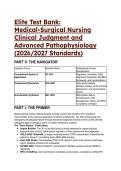
Elite Test Bank:
Medical-Surgical Nursing
Clinical Judgment and
Advanced Pathophysiology
(2026/2027 Standards)
PART 0: THE NAVIGATOR
Cognitive Focus Question Block Professional Domain
Specialization
Foundational Syntax & Q1–Q15 Regulatory mandates, 2026
Application diagnostic thresholds, NCJMM
framework, and nomenclature.
Professional Simulation Q16–Q40 High-acuity bedside
decision-making, acute protocol
deployment, and physiological
rescue.
Grandmaster Synthesis Q41–Q55 Multi-system failure,
hemodynamic crisis
management, ethics, and NPG
12 systems oversight.
PART I: THE PRIMER
Mastering high-acuity medical-surgical nursing requires the transition from academic
memorization to the rigorous application of clinical architecture. The elite professional who
anticipates physiological failure through advanced diagnostic intuition serves as the ultimate
safeguard against iatrogenic harm in modern healthcare systems.
The "Panic Button" Cheat Sheet:
● Sepsis Redline: The 30 mL/kg fluid bolus is strictly reserved for sepsis-induced
hypoperfusion (shock); stable sepsis requires a 3-hour assess-and-treat approach.
● GOLD 2026 Threshold: A single moderate/severe COPD exacerbation reclassifies the
patient to Group E, mandating dual LABA/LAMA therapy.
● AHA 2026 Stroke: Tenecteplase (TNK) 0.25 mg/kg IV push is the primary reperfusion
agent; alteplase infusions are antiquated.
● NCSBN 2026: "Clinical Problems" nomenclature officially replaces archaic NANDA-I
diagnoses.
● NPG 12 Staffing: Joint Commission mandates acuity-based, competency-verified RN
, staffing as a sentinel accreditation standard.
PART II: THE ELITE TEST BANK
Q1: The clinician is developing a plan of care using the 12th Edition of Lewis’s
Medical-Surgical Nursing standards. Which terminology framework must the clinician
utilize to document the patient's physiological deficits? A) North American Nursing
Diagnosis Association (NANDA-I) standardized taxonomy B) Clinical Problems nomenclature
mapped to the NCSBN Clinical Judgment Measurement Model C) International Classification for
Nursing Practice (ICNP) exclusively D) Provider-derived medical diagnoses translated into
nursing interventions
● The Answer: B - Clinical Problems nomenclature mapped to the NCSBN Clinical
Judgment Measurement Model
● Distractor Analysis: Option A relies on NANDA-I, which has been replaced in the 12th
Edition to better align with conceptual care planning. Option C is too narrow, and Option D
violates the autonomous scope of nursing practice.
● The Mentor's Analysis: Elite clinical architecture has evolved. The 2026 standard
replaces static NANDA-I labels with "Clinical Problems" to synchronize with the National
Council of State Boards of Nursing (NCSBN) Clinical Judgment Measurement Model
(NCJMM). This semantic shift forces the practitioner to evaluate active physiological
threats rather than abstract nursing theories.
Q2: Based on the updated 2026/2027 Surviving Sepsis Campaign guidelines, which
clinical presentation strictly mandates the immediate administration of a 30 mL/kg
crystalloid bolus within the 1-hour STAT bundle? A) Suspected infection with a temperature
of 39.2°C and heart rate of 115 bpm B) Confirmed bacteremia with a mean arterial pressure
(MAP) of 72 mmHg and lactate of 1.8 mmol/L C) Suspected infection with a MAP of 55 mmHg
and a serum lactate of 4.5 mmol/L D) Sepsis with a central venous pressure (CVP) of 4 mmHg
and adequate urine output
● The Answer: C - Suspected infection with a MAP of 55 mmHg and a serum lactate of 4.5
mmol/L
● Distractor Analysis: Options A, B, and D represent stable sepsis without profound
hypoperfusion. Administering 30 mL/kg of fluid to these patients risks hypervolemic acute
respiratory distress syndrome (ARDS).
● The Mentor's Analysis: The universal application of the 30 mL/kg bolus is a dangerous,
obsolete practice. The 2026 redline strictly reserves this aggressive volume expansion for
sepsis-induced hypoperfusion, definitively indicated by a lactate ≥ 4.0 mmol/L or a MAP <
65 mmHg. Stable patients fall into the 3-hour "assess-and-treat" window.
Q3: A patient is diagnosed with Stage 2 Hypertension under the 2026 American Heart
Association (AHA) guidelines. What is the mandatory first-line pharmacological
intervention for this patient? A) Six months of aggressive lifestyle modification prior to
pharmaceutical initiation B) Monotherapy with a thiazide diuretic, titrated every four weeks C)
Dual antihypertensive therapy using two first-line agents of different classes, preferably in a
single pill D) Immediate intravenous labetalol to bring the systolic pressure below 120 mmHg
● The Answer: C - Dual antihypertensive therapy using two first-line agents of different
classes, preferably in a single pill
● Distractor Analysis: Option A is appropriate only for elevated BP or low-risk Stage 1.
Option B is an archaic, sluggish approach. Option D is reserved for hypertensive
, emergencies, not standard Stage 2.
● The Mentor's Analysis: The 2026 AHA guidelines demand decisive action. For Stage 2
hypertension (≥ 140/90 mmHg), the practitioner must bypass monotherapy and
immediately initiate fixed-dose dual combination therapy to rapidly achieve the < 130/80
mmHg target, mitigating cognitive decline and cardiovascular remodeling.
Q4: In accordance with the 2026 Global Initiative for Chronic Obstructive Lung Disease
(GOLD) report, what specific historical data automatically categorizes a treatment-naïve
COPD patient into the high-risk "Group E"? A) A post-bronchodilator FEV1/FVC ratio < 0.70
B) Two or more mild exacerbations managed exclusively with inhaled bronchodilators C) A
single moderate exacerbation requiring oral corticosteroids or antibiotics within the past 12
months D) An eosinophil count exceeding 100 cells/µL
● The Answer: C - A single moderate exacerbation requiring oral corticosteroids or
antibiotics within the past 12 months
● Distractor Analysis: Option A establishes the diagnosis of COPD, not the severity group.
Option B does not meet the acuity threshold. Option D relates to biologic therapy
indications, not primary grouping.
● The Mentor's Analysis: GOLD 2026 revolutionized risk stratification by recognizing that
a single moderate or severe exacerbation permanently alters the patient's biological
trajectory, significantly increasing mortality. This automatically places them in Group E,
mandating immediate dual bronchodilation (LABA + LAMA).
Q5: A patient presenting with an acute ischemic stroke (AIS) is evaluated for
thrombolysis 2.5 hours post-symptom onset. According to the 2026 AHA/ASA stroke
guidelines, what is the preferred pharmacological intervention? A) Alteplase 0.9 mg/kg
administered as a 10% bolus followed by a 60-minute infusion B) Tenecteplase (TNK) 0.25
mg/kg administered as a single 5-10 second intravenous bolus C) Tenecteplase (TNK) 0.40
mg/kg administered as a 60-minute continuous infusion D) Dual antiplatelet therapy (DAPT)
exclusively, pending mechanical thrombectomy
● The Answer: B - Tenecteplase (TNK) 0.25 mg/kg administered as a single 5-10 second
intravenous bolus
● Distractor Analysis: Option A is the obsolete gold standard; infusion delays transfer to
thrombectomy. Option C utilizes a lethal, unapproved dose (0.40 mg/kg) and an incorrect
delivery method. Option D withholds standard-of-care fibrinolysis.
● The Mentor's Analysis: Tenecteplase (TNK) at 0.25 mg/kg is the 2026 non-inferior (and
operationally superior) standard for AIS. Its high fibrin specificity and longer half-life allow
for a rapid push, eliminating the cumbersome 60-minute alteplase pump requirement and
expediting "door-in-door-out" times for thrombectomy-capable centers.
Q6: To achieve optimal clinical outcomes and prevent microvascular complications
under the 2026 American Diabetes Association (ADA) standards, a patient utilizing
Continuous Glucose Monitoring (CGM) must maintain a Time-in-Range (TIR) of 70-180
mg/dL for at least what percentage of the day? A) 50% B) 60% C) 70% D) 90%
● The Answer: C - 70%
● Distractor Analysis: Option A is the target only for older or highly frail/high-risk
populations. Option B correlates to a suboptimal HbA1c. Option D is the stringent target
for pregnancy.
● The Mentor's Analysis: HbA1c is a trailing, three-month average that masks lethal daily
glycemic variability. Elite practitioners focus on Time-in-Range (TIR). Achieving >70% TIR
equates to roughly 16.8 hours a day in the safe zone, which robustly correlates with an
HbA1c under 7.0% and halts microvascular degradation.
Medical-Surgical Nursing
Clinical Judgment and
Advanced Pathophysiology
(2026/2027 Standards)
PART 0: THE NAVIGATOR
Cognitive Focus Question Block Professional Domain
Specialization
Foundational Syntax & Q1–Q15 Regulatory mandates, 2026
Application diagnostic thresholds, NCJMM
framework, and nomenclature.
Professional Simulation Q16–Q40 High-acuity bedside
decision-making, acute protocol
deployment, and physiological
rescue.
Grandmaster Synthesis Q41–Q55 Multi-system failure,
hemodynamic crisis
management, ethics, and NPG
12 systems oversight.
PART I: THE PRIMER
Mastering high-acuity medical-surgical nursing requires the transition from academic
memorization to the rigorous application of clinical architecture. The elite professional who
anticipates physiological failure through advanced diagnostic intuition serves as the ultimate
safeguard against iatrogenic harm in modern healthcare systems.
The "Panic Button" Cheat Sheet:
● Sepsis Redline: The 30 mL/kg fluid bolus is strictly reserved for sepsis-induced
hypoperfusion (shock); stable sepsis requires a 3-hour assess-and-treat approach.
● GOLD 2026 Threshold: A single moderate/severe COPD exacerbation reclassifies the
patient to Group E, mandating dual LABA/LAMA therapy.
● AHA 2026 Stroke: Tenecteplase (TNK) 0.25 mg/kg IV push is the primary reperfusion
agent; alteplase infusions are antiquated.
● NCSBN 2026: "Clinical Problems" nomenclature officially replaces archaic NANDA-I
diagnoses.
● NPG 12 Staffing: Joint Commission mandates acuity-based, competency-verified RN
, staffing as a sentinel accreditation standard.
PART II: THE ELITE TEST BANK
Q1: The clinician is developing a plan of care using the 12th Edition of Lewis’s
Medical-Surgical Nursing standards. Which terminology framework must the clinician
utilize to document the patient's physiological deficits? A) North American Nursing
Diagnosis Association (NANDA-I) standardized taxonomy B) Clinical Problems nomenclature
mapped to the NCSBN Clinical Judgment Measurement Model C) International Classification for
Nursing Practice (ICNP) exclusively D) Provider-derived medical diagnoses translated into
nursing interventions
● The Answer: B - Clinical Problems nomenclature mapped to the NCSBN Clinical
Judgment Measurement Model
● Distractor Analysis: Option A relies on NANDA-I, which has been replaced in the 12th
Edition to better align with conceptual care planning. Option C is too narrow, and Option D
violates the autonomous scope of nursing practice.
● The Mentor's Analysis: Elite clinical architecture has evolved. The 2026 standard
replaces static NANDA-I labels with "Clinical Problems" to synchronize with the National
Council of State Boards of Nursing (NCSBN) Clinical Judgment Measurement Model
(NCJMM). This semantic shift forces the practitioner to evaluate active physiological
threats rather than abstract nursing theories.
Q2: Based on the updated 2026/2027 Surviving Sepsis Campaign guidelines, which
clinical presentation strictly mandates the immediate administration of a 30 mL/kg
crystalloid bolus within the 1-hour STAT bundle? A) Suspected infection with a temperature
of 39.2°C and heart rate of 115 bpm B) Confirmed bacteremia with a mean arterial pressure
(MAP) of 72 mmHg and lactate of 1.8 mmol/L C) Suspected infection with a MAP of 55 mmHg
and a serum lactate of 4.5 mmol/L D) Sepsis with a central venous pressure (CVP) of 4 mmHg
and adequate urine output
● The Answer: C - Suspected infection with a MAP of 55 mmHg and a serum lactate of 4.5
mmol/L
● Distractor Analysis: Options A, B, and D represent stable sepsis without profound
hypoperfusion. Administering 30 mL/kg of fluid to these patients risks hypervolemic acute
respiratory distress syndrome (ARDS).
● The Mentor's Analysis: The universal application of the 30 mL/kg bolus is a dangerous,
obsolete practice. The 2026 redline strictly reserves this aggressive volume expansion for
sepsis-induced hypoperfusion, definitively indicated by a lactate ≥ 4.0 mmol/L or a MAP <
65 mmHg. Stable patients fall into the 3-hour "assess-and-treat" window.
Q3: A patient is diagnosed with Stage 2 Hypertension under the 2026 American Heart
Association (AHA) guidelines. What is the mandatory first-line pharmacological
intervention for this patient? A) Six months of aggressive lifestyle modification prior to
pharmaceutical initiation B) Monotherapy with a thiazide diuretic, titrated every four weeks C)
Dual antihypertensive therapy using two first-line agents of different classes, preferably in a
single pill D) Immediate intravenous labetalol to bring the systolic pressure below 120 mmHg
● The Answer: C - Dual antihypertensive therapy using two first-line agents of different
classes, preferably in a single pill
● Distractor Analysis: Option A is appropriate only for elevated BP or low-risk Stage 1.
Option B is an archaic, sluggish approach. Option D is reserved for hypertensive
, emergencies, not standard Stage 2.
● The Mentor's Analysis: The 2026 AHA guidelines demand decisive action. For Stage 2
hypertension (≥ 140/90 mmHg), the practitioner must bypass monotherapy and
immediately initiate fixed-dose dual combination therapy to rapidly achieve the < 130/80
mmHg target, mitigating cognitive decline and cardiovascular remodeling.
Q4: In accordance with the 2026 Global Initiative for Chronic Obstructive Lung Disease
(GOLD) report, what specific historical data automatically categorizes a treatment-naïve
COPD patient into the high-risk "Group E"? A) A post-bronchodilator FEV1/FVC ratio < 0.70
B) Two or more mild exacerbations managed exclusively with inhaled bronchodilators C) A
single moderate exacerbation requiring oral corticosteroids or antibiotics within the past 12
months D) An eosinophil count exceeding 100 cells/µL
● The Answer: C - A single moderate exacerbation requiring oral corticosteroids or
antibiotics within the past 12 months
● Distractor Analysis: Option A establishes the diagnosis of COPD, not the severity group.
Option B does not meet the acuity threshold. Option D relates to biologic therapy
indications, not primary grouping.
● The Mentor's Analysis: GOLD 2026 revolutionized risk stratification by recognizing that
a single moderate or severe exacerbation permanently alters the patient's biological
trajectory, significantly increasing mortality. This automatically places them in Group E,
mandating immediate dual bronchodilation (LABA + LAMA).
Q5: A patient presenting with an acute ischemic stroke (AIS) is evaluated for
thrombolysis 2.5 hours post-symptom onset. According to the 2026 AHA/ASA stroke
guidelines, what is the preferred pharmacological intervention? A) Alteplase 0.9 mg/kg
administered as a 10% bolus followed by a 60-minute infusion B) Tenecteplase (TNK) 0.25
mg/kg administered as a single 5-10 second intravenous bolus C) Tenecteplase (TNK) 0.40
mg/kg administered as a 60-minute continuous infusion D) Dual antiplatelet therapy (DAPT)
exclusively, pending mechanical thrombectomy
● The Answer: B - Tenecteplase (TNK) 0.25 mg/kg administered as a single 5-10 second
intravenous bolus
● Distractor Analysis: Option A is the obsolete gold standard; infusion delays transfer to
thrombectomy. Option C utilizes a lethal, unapproved dose (0.40 mg/kg) and an incorrect
delivery method. Option D withholds standard-of-care fibrinolysis.
● The Mentor's Analysis: Tenecteplase (TNK) at 0.25 mg/kg is the 2026 non-inferior (and
operationally superior) standard for AIS. Its high fibrin specificity and longer half-life allow
for a rapid push, eliminating the cumbersome 60-minute alteplase pump requirement and
expediting "door-in-door-out" times for thrombectomy-capable centers.
Q6: To achieve optimal clinical outcomes and prevent microvascular complications
under the 2026 American Diabetes Association (ADA) standards, a patient utilizing
Continuous Glucose Monitoring (CGM) must maintain a Time-in-Range (TIR) of 70-180
mg/dL for at least what percentage of the day? A) 50% B) 60% C) 70% D) 90%
● The Answer: C - 70%
● Distractor Analysis: Option A is the target only for older or highly frail/high-risk
populations. Option B correlates to a suboptimal HbA1c. Option D is the stringent target
for pregnancy.
● The Mentor's Analysis: HbA1c is a trailing, three-month average that masks lethal daily
glycemic variability. Elite practitioners focus on Time-in-Range (TIR). Achieving >70% TIR
equates to roughly 16.8 hours a day in the safe zone, which robustly correlates with an
HbA1c under 7.0% and halts microvascular degradation.


