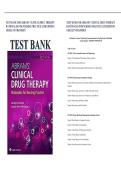
TEST BANK FOR ABRAMS’ CLINICAL DRUG THERAPY TEST BANK FOR ABRAMS’ CLINICAL DRUG THERAPY
RATIONALES FOR NURSING PRACTICE 12TH EDITION RATIONALES FOR NURSING PRACTICE 12TH EDITION
GERALYN FRANDSEN GERALYN FRANDSEN
Test Bank For Abrams’ Clinical Drug Therapy Rationales for Nursing Practice 12th Edition
Geralyn Frandsen - ISBN/ISSN 9781975136130
Table of Content
SECTION 1 The Conceptual Framework of Pharmacology
Chapter 1 The Foundation of Pharmacology: Quality and Safety
Chapter 2 Basic Concepts and Processes
Chapter 3 Medication Administration and the Nursing Process of Drug Therapy
SECTION 2 Drug Therapy Throughout the Lifespan
Chapter 4 Pharmacology and the Care of Infants and Pediatric Patients Medication Administration in
Pediatrics
Chapter 5 Pharmacology and the Care of Adults and Geriatric Patients
Chapter 6 Pharmacology and the Care of Pregnant or Lactating Woman
Chapter 7 Pharmacology and Women’s Health
Chapter 8 Pharmacology and Men’s Health
SECTION 3 Drugs Affecting the Hematopoietic and Immune Systems
Chapter 9 Drug Therapy for Coagulation Disorders
Chapter 10 Drug Therapy for Dyslipidemia
Chapter 11 Drug Therapy for Hematopoietic Disorders
Chapter 12 Drug Therapy: Immunizations
Chapter 13 Drug Therapy to Decrease Immunity
Chapter 14 Drug Therapy for the Treatment of Cancer
,TEST BANK FOR ABRAMS’ CLINICAL DRUG THERAPY TEST BANK FOR ABRAMS’ CLINICAL DRUG THERAPY
RATIONALES FOR NURSING PRACTICE 12TH EDITION RATIONALES FOR NURSING PRACTICE 12TH EDITION
GERALYN FRANDSEN GERALYN FRANDSEN
SECTION 4 Drugs Affecting Inflammation and Infection
SECTION 7 Drugs Affecting the Renal and Digestive Systems
Chapter 15 Inflammation, Infection, and the Use of Antimicrobial Agents
Chapter 34 Drug Therapy for Fluid Volume Excess
Chapter 16 Drug Therapy to Decrease Pain, Fever, and Inflammation
Chapter 35 Nutritional Support Products, Vitamins, and Mineral Supplements
Chapter 17 Drug Therapy With Corticosteroids
Chapter 36 Drug Therapy for Weight Management
Chapter 18 Drug Therapy With Beta-Lactam Antibacterial Agents
Chapter 37 Drug Therapy for Peptic Ulcer Disease and Hyperacidity
Chapter 19 Drug Therapy With Aminoglycosides and Fluoroquinolones
Chapter 38 Drug Therapy for Nausea and Vomiting
Chapter 20 Drug Therapy With Tetracyclines, Sulfonamides, and Urinary Antiseptics
Chapter 39 Drug Therapy for Constipation and Elimination Problems
Chapter 21 Drug Therapy With Macrolides and Miscellaneous Anti-infective Agents
Chapter 40 Drug Therapy for Diarrhea
Chapter 22 Drug Therapy for Tuberculosis and Mycobacterium avium Complex Disease
Chapter 23 Drug Therapy for Viral Infections
SECTION 8 Drugs Affecting the Endocrine System
Chapter 24 Drug Therapy for Fungal Infections
Chapter 41 Drug Therapy for Diabetes Mellitus
Chapter 25 Drug Therapy for Parasitic Infections
Chapter 42 Drug Therapy for Hyperthyroidism and Hypothyroidism
Chapter 43 Drug Therapy for Pituitary and Hypothalamic Dysfunction
SECTION 5 Drugs Affecting the Cardiovascular System
Chapter 44 Drug Therapy to Regulate Calcium and Bone Metabolism
Chapter 26 Drug Therapy for Hypertension
Chapter 45 Drug Therapy for Addison’s Disease and Cushing’s Disease
Chapter 27 Drug Therapy for Dysrhythmias
Chapter 28 Drug Therapy for Coronary Heart Disease
Section 9 Drugs Affecting the Autonomic and Central Nervous System
Chapter 29 Drug Therapy for Shock and Hypotension
Chapter 46 Physiology of the Autonomic and Central Nervous Systems and Indications for the Use of
Chapter 30 Drug Therapy for Heart Failure
Drug Therapy
Chapter 47 Drug Therapy for Myasthenia Gravis, Alzheimer’s Disease, and Urinary Retention
SECTION 6 Drugs Affecting the Respiratory System
Chapter 48 Drug Therapy for Parkinson’s Disease, Urinary Spasticity, and Disorders Requiring
Chapter 31 Drug Therapy for Nasal Congestion and Cough Anticholinergic Drug Therapy
Chapter 32 Drug Therapy to Decrease Histamine Effects and Allergic Response Chapter 49 Drug Therapy With Opioids
Chapter 33 Drug Therapy for Asthma and Bronchoconstriction Chapter 50 Drug Therapy With Local Anesthetics
, TEST BANK FOR ABRAMS’ CLINICAL DRUG THERAPY
RATIONALES FOR NURSING PRACTICE 12TH EDITION
TEST BANK FOR ABRAMS’ CLINICAL DRUG THERAPY GERALYN FRANDSEN
RATIONALES FOR NURSING PRACTICE 12TH EDITION
GERALYN FRANDSEN GRADESBOOST.COM
Chapter 1, The Foundation of Pharmacology: Quality and Safety
Chapter 51 Drug Therapy With General Anesthetics
Chapter 52 Drug Therapy for Migraines and Other Headaches 1. A woman diagnosed with obsessive–compulsive disorder has been prescribed oral
paroxetine hydrochloride. What is the expected effect for this prescription?
Chapter 53 Drug Therapy for Seizure Disorders and Spasticity A. Curative effect on symptoms
B. Systemic effect on symptoms
Chapter 54 Drug Therapy for Anxiety and Insomnia C. Local effect on symptoms
D. Parenteral effect on symptoms
Chapter 55 Drug Therapy for Depression and Mood Stabilization
ANS: B
Chapter 56 Drug Therapy for Psychotic Disorders Rationale: Drugs that produce systemic effects are taken into the body, circulated through
G R A D E S B O O S T . C O M
the bloodstream to their sites of action in various body tissues, and eventually eliminated
Chapter 57 Drug Therapy for Attention Deficit Hyperactivity Disorder and Narcolepsy from the body. Curative agents are given to cure a disease process. In this case, paroxetine
hydrochloride will control the symptoms but not cure the disorder. Drugs with local effects,
Chapter 58 Drug Therapy for Substance Abuse Disorders such as sunscreen and local anesthetics, act mainly at the site of application. Paroxetine
hydrochloride is not administered parenterally. Parenteral agents are administered
subcutaneously, intramuscularly, or intravenously.
Section 10 Drugs Affecting the Eye, Ear, and Skin PTS: 1 REF: p. 3, Introduction OBJ: 1
NAT: Client Needs: Physiological Integrity: Pharmacological and Parenteral Therapies
Chapter 59 Drug Therapy for Disorders of the Eye TOP: Chapter: 1: The Foundation of Pharmacology: Quality and Safety
KEY: Integrated Process: Nursing Process
Chapter 60 Drug Therapy for Disorders of the Ear BLM: Cognitive Level: Understand NOT: Multiple Choice
Chapter 61 Drug Therapy for Disorders of the Skin 2. A client has been prescribed an antibiotic. This medication is a naturally occurring
substance that has been cheG
mRicAalDlyEm
SoBdOifOieSd.TW
.hCaOt Mi s another name for this type of
medication?
A. Synthetic drug
B. Semisynthetic drug
C. Biotechnology drug
D. Prototype drug
ANS: B
Rationale: Semisynthetic drugs (e.g., many antibiotics) are naturally occurring substances
that have been chemically modified. Synthetic drugs are more standardized in their chemical
characteristics, more consistent in their effects, and less likely to produce allergic reactions.
Biotechnology drugs involve manipulating DNA and RNA and recombining genes into
hybrid molecules that can be inserted into living organisms. Prototype drugs are the first
drug of a particular group to be developed.
PTS: 1 REF: p. 3, Drug Sources OBJ: 1
NAT: Client Needs: Physiological Integrity: Pharmacological and Parenteral Therapies
TOP: Chapter: 1: The Foundation of Pharmacology: Quality and Safety
KEY: Integrated Process: Nursing Process
BLM: Cognitive Level: Understand NOT: Multiple Choice
3. Which classification applies to morphine?
GRADESBOOST.COM #1 TEST BANKS WEBSITE
, TEST BANK FOR ABRAMS’ CLINICAL DRUG THERAPY TEST BANK FOR ABRAMS’ CLINICAL DRUG THERAPY
RATIONALES FOR NURSING PRACTICE 12TH EDITION RATIONALES FOR NURSING PRACTICE 12TH EDITION
GERALYN FRANDSEN GERALYN FRANDSEN
A. Central nervous system depressant GRADESBOOST.COM
B. Central nervous system stimulant
C. Anti-inflammatory
D. Antihypertensive
ANS: A
Rationale: Drugs are classified according to their effects on particular body systems, their
therapeutic uses, and their chemical characteristics. Morphine is classified as a central
nervous system depressant and will produce this effect in the client. A central nervous
system stimulant increases attention and raises mood. An anti-inflammatory agent decreases
inflammation at the site of tissue or joint inflammation. An antihypertensive agent reduces
blood pressure.
PTS: 1 REF: p. 3, Drug Classifications and Prototypes
G R A D E S B O O S T . C O M
OBJ: 1
NAT: Client Needs: Physiological Integrity: Pharmacological and Parenteral Therapies
TOP: Chapter: 1: The Foundation of Pharmacology: Quality and Safety
KEY: Integrated Process: Nursing Process
BLM: Cognitive Level: Remember NOT: Multiple Choice
4. A client is administered amoxicillin. The generic name of this medication belongs to which
drug group?
A. Selective serotonin reuptake inhibitors
B. Diuretics
C. Penicillins
D. ACE inhibitors
ANS: C
Rationale: The generic namGe RoAfteDnEiS
ndBicOaO
teS
sTth.
e Cd rOu g group (e.g., drugs with generic names
ending in “cillin” are penicillins). Selective serotonin reuptake inhibitors are medications
that have antidepressant effects; SSRI is a broad classification, not a generic name. Diuretics
are medications that increase urine output; diuretic is a broad classification, not a generic
name. ACE inhibitor is the broad classification for the angiotensin receptor blockers, not the
generic name.
PTS: 1 REF: p. 3, Drug Names OBJ: 2
NAT: Client Needs: Physiological Integrity: Pharmacological and Parenteral Therapies
TOP: Chapter: 1: The Foundation of Pharmacology: Quality and Safety
KEY: Integrated Process: Nursing Process
BLM: Cognitive Level: Understand NOT: Multiple Choice
ANS: D
GRADESBOOST.COM #1 TEST BANKS WEBSITE GRADESBOOST.COM #1 TEST BANKS WEBSITE
RATIONALES FOR NURSING PRACTICE 12TH EDITION RATIONALES FOR NURSING PRACTICE 12TH EDITION
GERALYN FRANDSEN GERALYN FRANDSEN
Test Bank For Abrams’ Clinical Drug Therapy Rationales for Nursing Practice 12th Edition
Geralyn Frandsen - ISBN/ISSN 9781975136130
Table of Content
SECTION 1 The Conceptual Framework of Pharmacology
Chapter 1 The Foundation of Pharmacology: Quality and Safety
Chapter 2 Basic Concepts and Processes
Chapter 3 Medication Administration and the Nursing Process of Drug Therapy
SECTION 2 Drug Therapy Throughout the Lifespan
Chapter 4 Pharmacology and the Care of Infants and Pediatric Patients Medication Administration in
Pediatrics
Chapter 5 Pharmacology and the Care of Adults and Geriatric Patients
Chapter 6 Pharmacology and the Care of Pregnant or Lactating Woman
Chapter 7 Pharmacology and Women’s Health
Chapter 8 Pharmacology and Men’s Health
SECTION 3 Drugs Affecting the Hematopoietic and Immune Systems
Chapter 9 Drug Therapy for Coagulation Disorders
Chapter 10 Drug Therapy for Dyslipidemia
Chapter 11 Drug Therapy for Hematopoietic Disorders
Chapter 12 Drug Therapy: Immunizations
Chapter 13 Drug Therapy to Decrease Immunity
Chapter 14 Drug Therapy for the Treatment of Cancer
,TEST BANK FOR ABRAMS’ CLINICAL DRUG THERAPY TEST BANK FOR ABRAMS’ CLINICAL DRUG THERAPY
RATIONALES FOR NURSING PRACTICE 12TH EDITION RATIONALES FOR NURSING PRACTICE 12TH EDITION
GERALYN FRANDSEN GERALYN FRANDSEN
SECTION 4 Drugs Affecting Inflammation and Infection
SECTION 7 Drugs Affecting the Renal and Digestive Systems
Chapter 15 Inflammation, Infection, and the Use of Antimicrobial Agents
Chapter 34 Drug Therapy for Fluid Volume Excess
Chapter 16 Drug Therapy to Decrease Pain, Fever, and Inflammation
Chapter 35 Nutritional Support Products, Vitamins, and Mineral Supplements
Chapter 17 Drug Therapy With Corticosteroids
Chapter 36 Drug Therapy for Weight Management
Chapter 18 Drug Therapy With Beta-Lactam Antibacterial Agents
Chapter 37 Drug Therapy for Peptic Ulcer Disease and Hyperacidity
Chapter 19 Drug Therapy With Aminoglycosides and Fluoroquinolones
Chapter 38 Drug Therapy for Nausea and Vomiting
Chapter 20 Drug Therapy With Tetracyclines, Sulfonamides, and Urinary Antiseptics
Chapter 39 Drug Therapy for Constipation and Elimination Problems
Chapter 21 Drug Therapy With Macrolides and Miscellaneous Anti-infective Agents
Chapter 40 Drug Therapy for Diarrhea
Chapter 22 Drug Therapy for Tuberculosis and Mycobacterium avium Complex Disease
Chapter 23 Drug Therapy for Viral Infections
SECTION 8 Drugs Affecting the Endocrine System
Chapter 24 Drug Therapy for Fungal Infections
Chapter 41 Drug Therapy for Diabetes Mellitus
Chapter 25 Drug Therapy for Parasitic Infections
Chapter 42 Drug Therapy for Hyperthyroidism and Hypothyroidism
Chapter 43 Drug Therapy for Pituitary and Hypothalamic Dysfunction
SECTION 5 Drugs Affecting the Cardiovascular System
Chapter 44 Drug Therapy to Regulate Calcium and Bone Metabolism
Chapter 26 Drug Therapy for Hypertension
Chapter 45 Drug Therapy for Addison’s Disease and Cushing’s Disease
Chapter 27 Drug Therapy for Dysrhythmias
Chapter 28 Drug Therapy for Coronary Heart Disease
Section 9 Drugs Affecting the Autonomic and Central Nervous System
Chapter 29 Drug Therapy for Shock and Hypotension
Chapter 46 Physiology of the Autonomic and Central Nervous Systems and Indications for the Use of
Chapter 30 Drug Therapy for Heart Failure
Drug Therapy
Chapter 47 Drug Therapy for Myasthenia Gravis, Alzheimer’s Disease, and Urinary Retention
SECTION 6 Drugs Affecting the Respiratory System
Chapter 48 Drug Therapy for Parkinson’s Disease, Urinary Spasticity, and Disorders Requiring
Chapter 31 Drug Therapy for Nasal Congestion and Cough Anticholinergic Drug Therapy
Chapter 32 Drug Therapy to Decrease Histamine Effects and Allergic Response Chapter 49 Drug Therapy With Opioids
Chapter 33 Drug Therapy for Asthma and Bronchoconstriction Chapter 50 Drug Therapy With Local Anesthetics
, TEST BANK FOR ABRAMS’ CLINICAL DRUG THERAPY
RATIONALES FOR NURSING PRACTICE 12TH EDITION
TEST BANK FOR ABRAMS’ CLINICAL DRUG THERAPY GERALYN FRANDSEN
RATIONALES FOR NURSING PRACTICE 12TH EDITION
GERALYN FRANDSEN GRADESBOOST.COM
Chapter 1, The Foundation of Pharmacology: Quality and Safety
Chapter 51 Drug Therapy With General Anesthetics
Chapter 52 Drug Therapy for Migraines and Other Headaches 1. A woman diagnosed with obsessive–compulsive disorder has been prescribed oral
paroxetine hydrochloride. What is the expected effect for this prescription?
Chapter 53 Drug Therapy for Seizure Disorders and Spasticity A. Curative effect on symptoms
B. Systemic effect on symptoms
Chapter 54 Drug Therapy for Anxiety and Insomnia C. Local effect on symptoms
D. Parenteral effect on symptoms
Chapter 55 Drug Therapy for Depression and Mood Stabilization
ANS: B
Chapter 56 Drug Therapy for Psychotic Disorders Rationale: Drugs that produce systemic effects are taken into the body, circulated through
G R A D E S B O O S T . C O M
the bloodstream to their sites of action in various body tissues, and eventually eliminated
Chapter 57 Drug Therapy for Attention Deficit Hyperactivity Disorder and Narcolepsy from the body. Curative agents are given to cure a disease process. In this case, paroxetine
hydrochloride will control the symptoms but not cure the disorder. Drugs with local effects,
Chapter 58 Drug Therapy for Substance Abuse Disorders such as sunscreen and local anesthetics, act mainly at the site of application. Paroxetine
hydrochloride is not administered parenterally. Parenteral agents are administered
subcutaneously, intramuscularly, or intravenously.
Section 10 Drugs Affecting the Eye, Ear, and Skin PTS: 1 REF: p. 3, Introduction OBJ: 1
NAT: Client Needs: Physiological Integrity: Pharmacological and Parenteral Therapies
Chapter 59 Drug Therapy for Disorders of the Eye TOP: Chapter: 1: The Foundation of Pharmacology: Quality and Safety
KEY: Integrated Process: Nursing Process
Chapter 60 Drug Therapy for Disorders of the Ear BLM: Cognitive Level: Understand NOT: Multiple Choice
Chapter 61 Drug Therapy for Disorders of the Skin 2. A client has been prescribed an antibiotic. This medication is a naturally occurring
substance that has been cheG
mRicAalDlyEm
SoBdOifOieSd.TW
.hCaOt Mi s another name for this type of
medication?
A. Synthetic drug
B. Semisynthetic drug
C. Biotechnology drug
D. Prototype drug
ANS: B
Rationale: Semisynthetic drugs (e.g., many antibiotics) are naturally occurring substances
that have been chemically modified. Synthetic drugs are more standardized in their chemical
characteristics, more consistent in their effects, and less likely to produce allergic reactions.
Biotechnology drugs involve manipulating DNA and RNA and recombining genes into
hybrid molecules that can be inserted into living organisms. Prototype drugs are the first
drug of a particular group to be developed.
PTS: 1 REF: p. 3, Drug Sources OBJ: 1
NAT: Client Needs: Physiological Integrity: Pharmacological and Parenteral Therapies
TOP: Chapter: 1: The Foundation of Pharmacology: Quality and Safety
KEY: Integrated Process: Nursing Process
BLM: Cognitive Level: Understand NOT: Multiple Choice
3. Which classification applies to morphine?
GRADESBOOST.COM #1 TEST BANKS WEBSITE
, TEST BANK FOR ABRAMS’ CLINICAL DRUG THERAPY TEST BANK FOR ABRAMS’ CLINICAL DRUG THERAPY
RATIONALES FOR NURSING PRACTICE 12TH EDITION RATIONALES FOR NURSING PRACTICE 12TH EDITION
GERALYN FRANDSEN GERALYN FRANDSEN
A. Central nervous system depressant GRADESBOOST.COM
B. Central nervous system stimulant
C. Anti-inflammatory
D. Antihypertensive
ANS: A
Rationale: Drugs are classified according to their effects on particular body systems, their
therapeutic uses, and their chemical characteristics. Morphine is classified as a central
nervous system depressant and will produce this effect in the client. A central nervous
system stimulant increases attention and raises mood. An anti-inflammatory agent decreases
inflammation at the site of tissue or joint inflammation. An antihypertensive agent reduces
blood pressure.
PTS: 1 REF: p. 3, Drug Classifications and Prototypes
G R A D E S B O O S T . C O M
OBJ: 1
NAT: Client Needs: Physiological Integrity: Pharmacological and Parenteral Therapies
TOP: Chapter: 1: The Foundation of Pharmacology: Quality and Safety
KEY: Integrated Process: Nursing Process
BLM: Cognitive Level: Remember NOT: Multiple Choice
4. A client is administered amoxicillin. The generic name of this medication belongs to which
drug group?
A. Selective serotonin reuptake inhibitors
B. Diuretics
C. Penicillins
D. ACE inhibitors
ANS: C
Rationale: The generic namGe RoAfteDnEiS
ndBicOaO
teS
sTth.
e Cd rOu g group (e.g., drugs with generic names
ending in “cillin” are penicillins). Selective serotonin reuptake inhibitors are medications
that have antidepressant effects; SSRI is a broad classification, not a generic name. Diuretics
are medications that increase urine output; diuretic is a broad classification, not a generic
name. ACE inhibitor is the broad classification for the angiotensin receptor blockers, not the
generic name.
PTS: 1 REF: p. 3, Drug Names OBJ: 2
NAT: Client Needs: Physiological Integrity: Pharmacological and Parenteral Therapies
TOP: Chapter: 1: The Foundation of Pharmacology: Quality and Safety
KEY: Integrated Process: Nursing Process
BLM: Cognitive Level: Understand NOT: Multiple Choice
ANS: D
GRADESBOOST.COM #1 TEST BANKS WEBSITE GRADESBOOST.COM #1 TEST BANKS WEBSITE