MN 502 Unit 2 FINAL QUESTIONS & ANSWERS
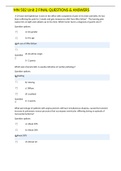
A 29-year-old Englishman is seen in the office with complaints of pain in his chest and belly. He has been suffering the pain for 2 weeks and gets temporary relief from Alka-Seltzer®. The burning pain wakes him at night and radiates up to his chest. Which factor favors a diagnosis of gastric ulcer? Question options: a) His gender b) His age Question 2 d) His ethnic origin 0 / 2 points Which pain characteristic is usually indicative of cardiac pathology? Question options: Question 3 b) Moving c) Diffuse d) Localized 0 / 2 points What percentage of patients with angina pectoris will have simultaneous dyspnea, caused by transient increase in pulmonary venous pressures that accompany ventricular stiffening during an episode of myocardial ischemia? Question options: a) About 20% b) About 30% d) Almost all Question 4 2 / 2 points Jamie, age 55, has just started on a statin after having his liver function tests (LFTs) come back normal. He now asks you how often he has to have the LFTs repeated. What do you tell him? Question options: a) Initially in 6 weeks b) Every 3 months c) Every 6 months Question 5 2 / 2 points George, age 64, has cardiovascular disease (CVD), a total cholesterol of 280 mg/dL, and a systolic BP of 158. He is being treated for hypertension. You are doing a Framingham Risk Assessment on him. Which assessment factor would give him the highest number of points on the scale? Question options: a) His age Question 6 c) His systolic BP d) The fact that he is on antihypertensive medication 2 / 2 points A patient is seen with dark-colored urine, and the urine dipstick reveals a high level of bilirubin. Which of the following could be a cause of this problem? Question options: a) Increased breakdown of red blood cells b) Inadequate hepatocyte function c) Biliary obstruction Question 7 2 / 2 points Which heart sound may be heard with poorly controlled hypertension, angina, and ischemic heart disease? Question options: a) A physiologic split S2 b) A fixed split S2 c) S3 Question 8 0 / 2 points A patient is seen in the office with complaints of six to seven liquid bowel movements per day. Which of the following assessment findings would lead the NP to a diagnosis of inflammatory bowel disease? Question options: Question 9 b) Wakens at night with diarrhea c) History of international travel d) All of the above 2 / 2 points Mary has hypertension and previously had a stroke. Which hypertensive drug would you order for her? Question options: b) Calcium channel blocker c) Angiotensin II receptor blocker Question 10 d) Beta blocker 0 / 2 points Which type of angina do you suspect in Harvey, who complains of chest pain that occurs during sleep and most often in the early morning hours? Question options: a) Stable angina Question 11 c) Variant (Prinzmetal’s angina) d) Probably not angina but hiatal hernia 2 / 2 points You just started Martha on HTN therapy. The Eighth Joint National Committee recommends that if her goal BP is not reached in what length of time, you should increase the initial drug or add a second drug to it? Question options: Question 12 b) 3 months c) 6 months d) 1 year 0 / 2 points Mr. J. K., 38 years old, is 5 feet 8 inches tall and weighs 189 pounds. He reports that he has had intermittent heartburn for several months and takes Tums® with temporary relief. He has been waking during the night with a burning sensation in his chest. Which additional information would lead you to believe that gastroesophageal reflux disease (GERD) is the cause of his pain? Question options: a) The pain seems better when he smokes to relieve his nerves. b) Coffee and fried foods don’t bother him, c) He wakes at night coughing with a bad taste in his mouth. Question 13 0 / 2 points Which test has long been considered the gold standard for a diagnosis of venous thromboembolism? Question options: Question 14 b) Magnetic resonance imaging (MRI) c) Ascending venogram d) D-dimer 2 / 2 points A 45-year-old patient presents with a chief complaint of generalized abdominal pain. Her physical examination is remarkable for left lower quadrant tenderness. At this time, which of the following should be considered in the differential diagnosis? Question options: a) Endometriosis b) Colon cancer c) Diverticulitis Question 15 2 / 2 points A 28-year-old patient is seen in the clinic with colicky abdominal pain particular with meals. She has frequent constipation, flatulence, and abdominal distension. Which of the data make a diagnosis of diverticulitis unlikely? Question options: Question 16 b) Frequent constipation c) Flatulence d) Colicky abdominal pain 0 / 2 points A 28-year-old patient is seen with complaints of diarrhea. Which of the following responses to the history questions would help the primary care physician (PCP) establish the diagnosis of irritable bowel syndrome? Question options: Question 17 b) Sometimes is constipated c) Does not defecate in the middle of the night d) All of the above 2 / 2 points Nitroglycerine (NTG) is given for a patient having ischemic chest pain. One tablet or one spray should be used under the tongue every 5 minutes for three doses. What should be done if the pain has not been relieved after three doses? Question options: Question 18 b) One more dose of NTG may be tried. c) The person should be given two aspirin to chew. d) A portable defibrillator should be located to ascertain the cardiac rhythm.
Document information
- Uploaded on
- April 14, 2021
- Number of pages
- 18
- Written in
- 2020/2021
- Type
- Exam (elaborations)
- Contains
- Questions & answers