

Written by students who passed Immediately available after payment Read online or as PDF Wrong document? Swap it for free 4.6 TrustPilot
logo-home
Exam (elaborations)

NHA CCMA Certification Exam Prep – Vital Signs, ECG Interpretation, Infection Control, Phlebotomy & Medical Law (450 Questions and Answers) – National Healthcareer Association (NHA)

Rating
-
Sold
-
Pages
126
Grade
A+
Uploaded on
04-03-2026
Written in
2025/2026

This document is a comprehensive NHA CCMA (Certified Clinical Medical Assistant) certification exam preparation guide containing approximately 450 exam-style questions with verified answers designed to support students preparing for the National Healthcareer Association certification exam. The study material covers essential medical assisting competencies including patient assessment, vital signs measurement, infection control procedures, ECG interpretation, phlebotomy techniques, laboratory testing, cardiovascular anatomy, clinical documentation, and medical law and ethics. On the opening page of the document, key clinical documentation concepts are introduced, such as the chief complaint (CC)—the primary reason a patient visits a physician—and history of present illness (HPI), which expands on the patient’s symptoms and onset of illness. The study guide begins with medical history and patient documentation procedures, explaining components such as past medical history, family history, and social history. These sections highlight how healthcare professionals collect patient information about previous illnesses, medications, allergies, lifestyle factors, and hereditary conditions that may influence diagnosis and treatment planning. A major section focuses on vital signs and patient assessment, which are critical clinical responsibilities of medical assistants. The guide explains the four primary vital signs—temperature, pulse, respiration, and blood pressure—and describes normal physiological ranges used during clinical evaluation. For instance, a normal adult pulse typically ranges from 60 to 100 beats per minute, while normal respiration rates range between 12 and 20 breaths per minute. The material also explains methods for measuring temperature at various anatomical sites such as oral, rectal, axillary, and tympanic locations. Another section explores physical examination techniques, including the four foundational assessment methods used in clinical medicine: inspection, palpation, percussion, and auscultation. The guide also describes patient positioning techniques used during examinations, including horizontal recumbent, Fowler’s position, dorsal lithotomy position, Sims’ position, knee-chest position, and Trendelenburg position, each of which allows healthcare professionals to properly examine specific body systems. The document also includes detailed coverage of infection control procedures and workplace safety regulations. It explains the chain of infection model and strategies used to interrupt disease transmission, including standard precautions, personal protective equipment (PPE), hand hygiene, and sterilization procedures. Various sterilization methods are described, including steam sterilization using autoclaves at temperatures of approximately 250–254°F for 20–40 minutes, chemical sterilization, dry heat sterilization, and gas sterilization. Another major topic covered in the study guide is clinical laboratory testing and specimen collection. The material explains proper specimen handling procedures for urine samples, throat cultures, sputum specimens, and blood collection. It also reviews laboratory diagnostic methods such as urinalysis, microscopic examination of urine sediment, and chemical testing for substances like glucose, protein, bilirubin, and leukocyte esterase. The guide further explores phlebotomy procedures and blood collection techniques, including the correct order of draw for blood tubes to prevent cross-contamination of additives. For example, blood culture bottles are typically drawn first, followed by light blue tubes, red or serum tubes, green tubes, lavender tubes, and gray tubes. These procedures are essential for accurate laboratory analysis and patient diagnosis. A large portion of the material focuses on cardiovascular anatomy and electrocardiography (ECG/EKG). The guide explains the structure of the heart, including its four chambers—the right atrium, left atrium, right ventricle, and left ventricle—as well as the function of heart valves such as the tricuspid, mitral, pulmonic, and aortic valves. It also discusses the electrical conduction system of the heart, including the sinoatrial (SA) node, atrioventricular (AV) node, Bundle of His, bundle branches, and Purkinje fibers, which coordinate cardiac contractions and regulate heart rhythm. The study guide also explains electrocardiogram waveform interpretation, including the P wave, QRS complex, and T wave that represent atrial depolarization, ventricular depolarization, and ventricular repolarization. ECG intervals such as the PR interval, QT interval, and RR interval are described, along with heart rhythm analysis methods such as the 6-second method, large box method, and small box method used to determine heart rate from ECG tracings. In addition to clinical procedures, the document reviews medical law and patient rights, including HIPAA privacy protections, negligence laws, informed consent, patient confidentiality, and the Good Samaritan law. The four legal elements of negligence—duty, dereliction, direct cause, and damages—are also explained to help healthcare professionals understand their legal responsibilities in patient care. The content aligns with the Certified Clinical Medical Assistant (CCMA) certification exam administered by the National Healthcareer Association (NHA) and corresponds with widely used training materials such as the NHA Certified Clinical Medical Assistant (CCMA) Study Guide, a commonly used textbook in medical assisting and allied health programs. This document may be useful for students enrolled in courses such as: Clinical Medical Assisting Programs Certified Clinical Medical Assistant (CCMA) Certification Preparation Allied Health Clinical Skills Training Medical Terminology and Clinical Procedures Healthcare Administration and Patient Care Programs It may also benefit learners and professionals including: Medical assistant students preparing for the NHA CCMA certification exam Allied health trainees studying clinical procedures and patient assessment Phlebotomy students learning blood collection and specimen handling Healthcare administration students reviewing medical documentation and billing concepts Clinical instructors reviewing CCMA certification curriculum materials Overall, this study guide provides a structured and detailed review of medical assisting knowledge, covering patient care procedures, vital signs measurement, infection control standards, laboratory diagnostics, ECG interpretation, cardiovascular anatomy, and healthcare legal principles, making it a valuable resource for candidates preparing for the NHA Certified Clinical Medical Assistant certification examination. Keywords NHA CCMA certification exam questions, certified clinical medical assistant exam prep, vital signs temperature pulse respiration blood pressure, ECG interpretation heart conduction system, phlebotomy venipuncture order of draw tubes, infection control chain of infection PPE healthcare, cardiovascular anatomy heart chambers valves, urinalysis laboratory specimen collection, medical law HIPAA negligence informed consent, patient assessment physical examination techniques

Show more Read less

Content preview

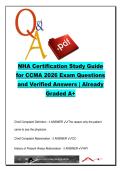
NHA Certification Study Guide
for CCMA 2026 Exam Questions
and Verified Answers | Already
Graded A+


Chief Complaint Definition - 🧠 ANSWER ✔✔The reason why the patient

came to see the physician.


Chief Complaint Abbreviation - 🧠 ANSWER ✔✔CC


History of Present Illness Abbreviation - 🧠 ANSWER ✔✔HPI

,History of Present Illness Definition - 🧠 ANSWER ✔✔This is an explanation

of the CC to determine the onset of the illness; associated symptoms; what

the patient has done to treat the condition, etc.


Past, Family and Social History Abbreviation - 🧠 ANSWER ✔✔PFSH


Past Medical History Definition - 🧠 ANSWER ✔✔Includes all health

problems, major illnesses, surgeries the patient has had, current

medications complete with reasons for taking them, and allergies.


Family History Definition - 🧠 ANSWER ✔✔Summary of health problems of

siblings, parents, and other blood relatives that could alert the physician to

hereditary and/or familial disease.


Social History Definition - 🧠 ANSWER ✔✔Includes marital status,

occupation, educational attainment, hobbies, use of alcohol, tobacco,

drugs, and lifestyles.


Review of Systems Abbreviation - 🧠 ANSWER ✔✔ROS


Review of Systems Definition - 🧠 ANSWER ✔✔This is an orderly and

systematic check of each organ and system of the body by questions. Both

positive and pertinent negative findings are documented.

,3 Body Processes Necessary for life are: - 🧠 ANSWER ✔✔Body

Temperature, Respiration, Heart Function


4 Vital Signs of Body Function are: - 🧠 ANSWER ✔✔Temperature, Pulse,

Respiration, Blood Pressure


Define Body Temperature - 🧠 ANSWER ✔✔Is a balance between heart

production and heart loss in conjunction with each other, maintained and

regulated by the hypothalamus.


Thermometers - 🧠 ANSWER ✔✔Are used to measure temperature using

the Fahrenheit and Centigrade or Celsius scale.


Temperature Sites - 🧠 ANSWER ✔✔Mouth, Rectum, Ear (Tympanic

Membrane), and the axilla (underarm).


Normal Temperature Range for Rectal - 🧠 ANSWER ✔✔98.6F to 100.6F


37.0C to 38.1C


Normal Temperature Range for Oral - 🧠 ANSWER ✔✔97.6F to 99.6F


36.5C to 37.5C


Normal Temperature Range for Axillary - 🧠 ANSWER ✔✔96.6F to 98.6F


COPYRIGHT©NINJANERD 2025/2026. YEAR PUBLISHED 2025. COMPANY REGISTRATION NUMBER: 619652435. TERMS OF USE. PRIVACY
STATEMENT. ALL RIGHTS RESERVED
3

, 35.9C to 37.0C

Normal Temperature Range for Tympanic Membrane - 🧠 ANSWER

✔✔98.6 F


37 C


Define Febrile - 🧠 ANSWER ✔✔Presence of Fever


Define Afebrile - 🧠 ANSWER ✔✔Absence of Fever


Define Fever - 🧠 ANSWER ✔✔Elevated body temperature beyond normal

range.


Intermittent Fever - 🧠 ANSWER ✔✔Fluctuating fever that returns to or

below baseline then rises again.


Remittent Fever - 🧠 ANSWER ✔✔Fluctuating fever that remains elevated; it

does not return to baseline temperature.


Continuous Fever - 🧠 ANSWER ✔✔A fever that remains constant above

the baseline; it does not fluctuate.


Oral Temperature - 🧠 ANSWER ✔✔Is the most common method of

measurement.

Written for

Document information

Uploaded on
March 4, 2026
Number of pages
126
Written in
2025/2026
Type
Exam (elaborations)
Contains
Questions & answers

Subjects

$15.99
Get access to the full document:

Wrong document? Swap it for free Within 14 days of purchase and before downloading, you can choose a different document. You can simply spend the amount again.
Written by students who passed
Immediately available after payment
Read online or as PDF


Also available in package deal

Thumbnail
Package deal
NHA CCMA EXAM COMPLETE PACKAGE DEAL
-
4 2026
$ 26.57 More info

Get to know the seller

Seller avatar
Reputation scores are based on the amount of documents a seller has sold for a fee and the reviews they have received for those documents. There are three levels: Bronze, Silver and Gold. The better the reputation, the more your can rely on the quality of the sellers work.
NinjaNerd Liberty University
View profile
Follow You need to be logged in order to follow users or courses
Sold
376
Member since
2 year
Number of followers
6
Documents
14742
Last sold
1 day ago
NinjaNerd

Here You will All Documents and Package Deals Offered by Seller NinjaNerd.

3.5

74 reviews

5
26
4
14
3
16
2
4
1
14

Why students choose Stuvia

Created by fellow students, verified by reviews

Quality you can trust: written by students who passed their tests and reviewed by others who've used these notes.

Didn't get what you expected? Choose another document

No worries! You can instantly pick a different document that better fits what you're looking for.

Pay as you like, start learning right away

No subscription, no commitments. Pay the way you're used to via credit card and download your PDF document instantly.

Student with book image

“Bought, downloaded, and aced it. It really can be that simple.”

Alisha Student

Working on your references?

Create accurate citations in APA, MLA and Harvard with our free citation generator.

Working on your references?

Frequently asked questions

