
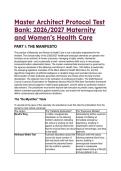
Master Architect Protocol Test
Bank: 2026/2027 Maternity
and Women’s Health Care
PART I: THE MANIFESTO
The practice of Maternity and Women’s Health Care is not a discipline engineered for the
hesitant. The clinical reality of the 2026/2027 healthcare landscape demands an operator who
functions as an architect of human outcomes, managing a highly volatile, intertwined
physiological dyad—and occasionally a triad—where baseline shifts occur in microscopic
increments before catastrophic failure. The modern maternal-fetal environment is governed by
the rigorous standards of the Maternity and Women's Health Care, 13th Edition (Lowdermilk),
the sweeping legislative mandates of the Black Maternal Health Momnibus Act, and the
algorithmic integration of artificial intelligence in obstetric triage and neonatal intensive care.
Memorization of static textbooks generates technicians who freeze when the fetal monitor
decelerates. The objective here is the cultivation of professional intuition. The 2026 National
Council Licensure Examination for Registered Nurses (NCLEX-RN) Next Generation framework
explicitly tests clinical judgment, health equity application, and the ability to synthesize massive
data streams. The practitioner must evolve beyond task execution to predict crises, aggressively
defend vulnerable populations against systemic bias, and master the technological adjuncts that
define contemporary high-performance obstetrics.
The "De-Mystifier" Table
To operate at the apex of this specialty, the practitioner must first strip the intimidation from the
domain's most critical vernacular.
The Jargon The "Cafeteria Explanation" The "Expensive Mistake"
Bandl's Ring A visible, hourglass-like Administering further oxytocics
indentation on the laboring instead of initiating an
mother's abdomen indicating immediate emergency
the uterus is working so hard laparotomy, resulting in
against a physical obstruction catastrophic uterine rupture,
that the muscle fibers are about massive hemorrhage, and fetal
to tear apart. asphyxia.
Kleihauer-Betke Test A precise laboratory assay that Failing to order this assay
counts the exact number of following maternal blunt force
fetal red blood cells that have trauma, leading to
crossed the placental barrier unrecognized massive fetal
into the mother's systemic anemia or inadequate
circulation. weight-based dosing of Rho(D)
immune globulin in an
,The Jargon The "Cafeteria Explanation" The "Expensive Mistake"
Rh-negative mother.
HELLP Syndrome A severe, life-threatening Misdiagnosing the patient's
permutation of preeclampsia severe right upper quadrant or
where red blood cells are epigastric pain as "acid reflux,"
destroyed, the liver becomes resulting in spontaneous
dangerously engorged, and the hepatic rupture, disseminated
blood loses its fundamental intravascular coagulation (DIC),
ability to clot. and maternal mortality.
Category III FHR Tracing The fetal heart rate pattern Engaging in passive "watchful
indicates the baby’s brain is waiting" instead of executing
actively being deprived of immediate intrauterine
oxygen, and neurological tissue resuscitation sequences and
damage is currently underway. calling for a STAT operative
delivery.
Uterine Atony The uterine myometrium acts Assuming a steady trickle of
like a flaccid, wet sponge vaginal blood is "normal lochia"
instead of a tightly clamped fist without aggressively palpating
after delivery, allowing the the fundus, missing a
placental implantation site to concealed hemorrhage until the
hemorrhage freely. patient enters Class III
hypovolemic shock.
PART II: THE DEEP DIVE
Module 1: Intrapartum Fetal Surveillance & Algorithmic Adjudication
1. The Professional Analogy: Interpreting electronic fetal monitoring (EFM) is equivalent to
acting as an air traffic controller during a Category 5 hurricane. The controller cannot manipulate
the storm (uterine contractions), but must continuously analyze the radar (the tracing) to ensure
the aircraft (the fetus) possesses sufficient fuel (oxygen) to survive the landing.
2. The "Hard Deck" (Technical Deep Work): The Association of Women’s Health, Obstetric
and Neonatal Nurses (AWHONN) 2026 guidelines mandate strict adherence to National Institute
of Child Health and Human Development (NICHD) nomenclature. Baseline Fetal Heart Rate
represents the average rate over a 10-minute window, excluding periodic changes, serving as
the fundamental metric of fetal metabolic demand (Normal: 110-160 bpm). Baseline Variability
denotes the beat-to-beat amplitude fluctuations and serves as the primary indicator of an intact,
oxygenated fetal autonomic nervous system. Tracings are rigidly classified: Category I (normal,
predictive of normal acid-base status), Category II (indeterminate, requiring continuous
evaluation), and Category III (abnormal, featuring absent variability combined with recurrent
late decelerations, recurrent variable decelerations, or bradycardia, mandating immediate
intervention).
3. The 2027 Redline: The integration of Cardiotocography (CTG) artificial intelligence now
allows systems to analyze morphological patterns and predict fetal acidemia prior to visual
human detection. However, AWHONN standards explicitly state that fetal heart monitoring
requires advanced clinical judgment and cannot be entirely delegated to AI algorithms; the
technology is an adjunct, not a replacement for the practitioner's physiological synthesis.
4. The "Trap" Alert: Amateurs think late decelerations are acceptable if the baseline heart rate
,remains within the normal range. Professionals know that recurrent late decelerations represent
uteroplacental insufficiency; without immediate intrauterine resuscitation (maternal repositioning,
fluid bolus, supplemental oxygen, cessation of uterotonics), fetal myocardial depression and
severe hypoxic-ischemic encephalopathy are imminent.
Module 2: Hypertensive Crises & Neuroprotection
1. The Professional Analogy: Severe preeclampsia functions as a physiological pressure
cooker with a compromised release valve. The maternal endothelial lining leaks and spasms,
causing systemic organ pressure to escalate rapidly. Magnesium Sulfate is the chemical
mechanism utilized to prevent the central nervous system from short-circuiting (seizing) while
the surgical team prepares to remove the heat source (delivery of the placenta).
2. The "Hard Deck" (Technical Deep Work): Preeclampsia with severe features is diagnosed
by a systolic blood pressure \ge 160 mm Hg or diastolic \ge 110 mm Hg, combined with
end-organ dysfunction (thrombocytopenia < 100,000, impaired liver transaminases, pulmonary
edema, or new-onset visual/cerebral disturbances). The definitive therapeutic intervention is
Magnesium Sulfate (MgSO4), a central nervous system depressant administered to raise the
seizure threshold. The evidence-based protocol dictates a 4-6 gram IV loading dose over
20-30 minutes, followed by a 1-2 gram/hour maintenance infusion.
3. The 2027 Redline: The 2026 Joint Commission National Performance Goals (NPGs) enacted
stringent requirements for maternal safety, mandating standardized, evidence-based protocols
for severe maternal hypertension. This includes the immediate availability of emergency
response medications (IV Labetalol, Hydralazine) and rigorous continuous monitoring
parameters to avert maternal cerebrovascular accidents.
4. The "Trap" Alert: Amateurs think Magnesium Sulfate is administered primarily as an
antihypertensive medication. Professionals know it is a targeted neuroprotectant. If the clinical
objective is to rapidly lower blood pressure to prevent a hemorrhagic stroke, the practitioner
must push specific antihypertensives while maintaining the MgSO4 infusion for seizure
prophylaxis.
Module 3: Obstetric Hemorrhage & Uterine Myometrial Tone
1. The Professional Analogy: Postpartum hemorrhage (PPH) is akin to an open floodgate in a
submerged vessel. The practitioner must manually clamp the infrastructure (bimanual fundal
massage) while simultaneously deploying chemical coagulants into the system to force the
vascular networks to constrict.
2. The "Hard Deck" (Technical Deep Work): PPH is objectively defined as a cumulative blood
loss \ge 1000 mL or bleeding accompanied by signs of hypovolemia within 24 hours of birth,
fundamentally driven by Uterine Atony. The immediate mechanical intervention is Bimanual
Uterine Massage to induce myometrial contraction. First-line pharmacological management
utilizes Oxytocin (Pitocin). Escalation pathways include Methylergonovine (Methergine),
Carboprost (Hemabate), and Misoprostol (Cytotec), with strict contraindications: Methergine
is absolutely contraindicated in hypertensive patients, and Hemabate is contraindicated in
asthmatics due to severe bronchospasm risk.
3. The 2027 Redline: Machine learning models, specifically Random Forest and Extreme
Gradient Boosting (XGBoost), are now deployed upon labor admission to predict PPH risk by
analyzing over 55 clinical variables, including the Social Vulnerability Index, admission
hemoglobin, and real-time intrapartum hemodynamics. Quantitative Blood Loss (QBL) has
,entirely replaced Estimated Blood Loss (EBL) in standard practice to eliminate human error in
visual estimation.
4. The "Trap" Alert: Amateurs think waiting for maternal tachycardia and hypotension is the
appropriate methodology to diagnose hemorrhage. Professionals know that pregnant patients
possess a 40-50% expanded blood volume; by the time vital signs visibly crash, the patient has
already lost over 1500 mL of blood, exhausted their compensatory reserve, and entered Class
III hemorrhagic shock.
Module 4: Health Equity & The Momnibus Directives
1. The Professional Analogy: Delivering identical treatment to every patient is analogous to
issuing the exact same optical prescription to an entire population. Equality is providing the
glasses; equity is meticulously grinding the lenses to correct each patient's specific deficits.
2. The "Hard Deck" (Technical Deep Work): Systemic disparities dictate that Black women
are three times more likely to experience maternal mortality than white women, a crisis driven by
structural racism, implicit bias, and unaddressed Social Determinants of Health (SDOH).
Implicit Bias represents unconscious attitudes affecting clinical decisions, such as the
dangerous cognitive error of dismissing a minority patient's objective pain or dyspnea as
subjective "anxiety". Culturally congruent care is a clinical mandate, not a theoretical framework.
3. The 2027 Redline: The Black Maternal Health Momnibus Act, supported by extensive federal
appropriations, aggressively forces systemic changes. It mandates the diversification of the
perinatal workforce, enforces implicit bias training across hospital systems, and invests heavily
in digital tools to eradicate maternal care deserts. Concurrently, the April 2026 NCLEX-RN
blueprint explicitly tests candidates on health equity, assessing the recognition of language
barriers, cultural competent communication, and the mitigation of SDOH.
4. The "Trap" Alert: Amateurs think biological race is an independent risk factor for maternal
mortality. Professionals know that racism and chronic systemic stress (allostatic load)—not
genetic racial biology—are the primary drivers of these disparate morbidity outcomes.
Module 5: The Neonatal Transition & NICU Predictive Analytics
1. The Professional Analogy: Neonatal birth is a complex biological system reboot. The
organism transitions from a fluid-filled, passively oxygenated aquatic environment to an
air-breathing, self-regulating terrestrial state. If the physiological software hangs during this
reboot, the practitioner has only seconds to intervene before irreversible hypoxic damage
occurs.
2. The "Hard Deck" (Technical Deep Work): The APGAR score evaluates Appearance,
Pulse, Grimace, Activity, and Respiration at 1 and 5 minutes post-delivery to quantify the
transition. A 5-minute score < 7 necessitates continued assessment and intervention. If the
neonate exhibits apnea, gasping, or a heart rate < 100 bpm, the Neonatal Resuscitation
Program (NRP) algorithms dictate the immediate initiation of Positive Pressure Ventilation (PPV)
within the first 60 seconds of life.
3. The 2027 Redline: Artificial Intelligence ecosystems within the Neonatal Intensive Care Unit
(NICU) utilize Convolutional Neural Networks (CNNs) and Long Short-Term Memory (LSTM)
models to analyze high-frequency vital sign streams. These systems can predict the onset of
life-threatening neonatal sepsis 6 to 12 hours before clinical symptoms manifest by detecting
micro-fluctuations in heart rate variability and respiratory dynamics.
4. The "Trap" Alert: Amateurs think peripheral cyanosis (blue hands and feet) at 1 minute of
,life requires aggressive oxygenation and CPR. Professionals know that acrocyanosis is an
expected, normal finding during early transition; it is the heart rate and respiratory effort that
dictate the resuscitation cascade, not peripheral color.
PART III: THE 55-POINT GAUNTLET
The following assessment rigorously evaluates clinical judgment, pathophysiological
comprehension, and algorithmic synthesis based on the 2026 NCLEX-RN and advanced
practice standards.
Q1: A fetal heart rate tracing exhibits a baseline of 145 bpm, moderate variability, and the
absence of decelerations. How is this tracing classified under AWHONN standards? The
Answer: Category I. The Mentor's Insight: Category I tracings are strongly predictive of
normal fetal acid-base status. The practitioner must document the findings and continue routine
monitoring. Intervening on a Category I tracing introduces unnecessary risk.
Q2: A continuous fetal heart rate baseline is recorded at 170 bpm for 15 minutes. What is the
clinical terminology for this finding? The Answer: Fetal Tachycardia. The Mentor's Insight:
Tachycardia (baseline > 160 bpm for > 10 minutes) is an early, critical indicator of fetal hypoxia,
maternal fever, or impending chorioamnionitis. It demands immediate clinical investigation, not
merely observational charting.
Q3: The tracing reveals a gradual decrease in the fetal heart rate, with the onset to nadir taking
greater than 30 seconds, precisely mirroring the peak of the maternal contraction. What is the
physiological cause? The Answer: Fetal head compression (Early Deceleration). The Mentor's
Insight: Early decelerations are benign vagal responses to head compression during fetal
descent. The appropriate action is maternal evaluation for labor progression; no intrauterine
resuscitation is required.
Q4: A patient at 36 weeks gestation reports a severe, unrelenting frontal headache and
scotomata (visual blind spots). Her blood pressure is 165/112. What specific pathophysiological
event is occurring? The Answer: Severe cerebral vasospasm indicating preeclampsia with
severe features. The Mentor's Insight: The maternal brain is edematous and highly irritable.
Dismissing these symptoms as "normal pregnancy discomfort" will result in an eclamptic seizure
or hemorrhagic stroke. Immediate MgSO4 and antihypertensive therapy are warranted.
Q5: A patient receiving an intravenous Magnesium Sulfate infusion exhibits a respiratory rate of
8 breaths per minute and absent deep tendon reflexes. What is the precise pharmacological
antidote? The Answer: Intravenous Calcium Gluconate. The Mentor's Insight: Magnesium
toxicity induces severe central nervous system and respiratory depression. The infusion must be
stopped immediately, and Calcium Gluconate administered to competitively bind and restore
diaphragmatic function.
Q6: A laboratory report for a preeclamptic patient reveals significant hemolysis, an AST of 350
U/L, and a platelet count of 65,000/mm³. What is the definitive diagnosis? The Answer: HELLP
Syndrome. The Mentor's Insight: Hemolysis, Elevated Liver enzymes, and Low Platelets
characterize this catastrophic variant of preeclampsia. Epidural anesthesia is strictly
contraindicated due to the severe risk of spinal epidural hematoma from thrombocytopenia.
Q7: Under 2026 Joint Commission standards, how must obstetric hemorrhage volume be
measured? The Answer: Quantitative Blood Loss (QBL), utilizing the gravimetric measurement
of all blood-soaked materials. The Mentor's Insight: Estimated Blood Loss (EBL) is a
subjective visual assessment that routinely underestimates severe hemorrhage by up to 50%.
QBL provides the precise data required to trigger massive transfusion protocols objectively.
, Q8: What clinical parameters are evaluated using the BUBBLE-HE mnemonic during a
postpartum assessment? The Answer: Breasts, Uterus, Bowel, Bladder, Lochia,
Episiotomy/Perineum, Homan's sign (DVT assessment), and Emotional status. The Mentor's
Insight: This framework ensures an exhaustive, systematic evaluation. Omitting the
assessment of the uterus or lochia can result in failure to detect an insidious postpartum
hemorrhage.
Q9: At 1 minute of life, a neonate exhibits a heart rate of 115 bpm, a weak cry, some extremity
flexion, a grimace upon stimulation, and a pink body with blue extremities. Calculate the exact
APGAR score. The Answer: 6. (Heart Rate = 2, Respiratory Effort = 1, Muscle Tone = 1, Reflex
Irritability = 1, Color = 1). The Mentor's Insight: An APGAR of 6 indicates moderate difficulty
transitioning. The neonate requires aggressive drying, stimulation, and clearing of the airway,
but does not yet require positive pressure ventilation.
Q10: The fetal heart rate tracing demonstrates visually apparent, abrupt decreases of 20 bpm
lasting 40 seconds, varying in timing relative to uterine contractions. What is the physiological
etiology? The Answer: Umbilical cord compression (Variable Decelerations). The Mentor's
Insight: Cord compression acutely spikes fetal systemic vascular resistance. Baroreceptors
detect the pressure surge and trigger an abrupt, vagally mediated drop in heart rate. The
primary intervention is immediate maternal repositioning to alleviate cord pressure.
Q11: A laboring patient's intrauterine pressure catheter records 7 contractions within a
10-minute window, averaged over 30 minutes. What is the clinical diagnosis? The Answer:
Tachysystole. The Mentor's Insight: Excessive uterine activity restricts the critical relaxation
phase needed for the intervillous space to refill with oxygenated maternal blood. If induced by
oxytocin, the infusion must be immediately decreased or discontinued to prevent fetal asphyxia.
Q12: In the context of the 2026 NCLEX health equity framework, define the distinction between
equality and equity in maternal care. The Answer: Equality provides identical resources to all
patients; equity involves tailoring interventions and resources to overcome a specific patient's
unique social, cultural, or economic barriers. The Mentor's Insight: A rigid "one-size-fits-all"
approach fails marginalized populations. Providing written English discharge instructions to a
non-English speaking patient is equality without equity, leading directly to preventable
readmissions.
Q13: In the standardized obstetric history mnemonic GTPAL, what does the "T" represent? The
Answer: Term births (pregnancies delivered at 37 weeks gestation or later). The Mentor's
Insight: Gravida, Term, Preterm, Abortions, Living children. Precision in this history alerts the
practitioner to specific structural or physiological risks, such as a history of recurrent preterm
labor requiring early prophylactic interventions.
Q14: An Rh-negative mother delivers an Rh-positive neonate. What specific pharmacological
intervention is mandated, and what is the temporal deadline? The Answer: Administration of
Rho(D) immune globulin (RhoGAM) within 72 hours of delivery. The Mentor's Insight:
RhoGAM prevents maternal alloimmunization. Failure to administer this within the 72-hour
window allows the maternal immune system to generate permanent antibodies that will attack
and destroy the erythrocytes of future Rh-positive fetuses.
Q15: According to the provisions of the Black Maternal Health Momnibus Act, what is the
strategic objective of expanding the perinatal workforce? The Answer: To systematically
diversify the workforce by funding the education of providers of color, including midwives and
doulas, to deliver culturally congruent care. The Mentor's Insight: Empirical data demonstrates
that marginalized populations experience significantly lower morbidity rates when treated by
practitioners who share cultural paradigms and proactively mitigate institutional bias.
Q16: You assess a fetal monitor and observe a smooth, undulating, sine-wave-like pattern with
Bank: 2026/2027 Maternity
and Women’s Health Care
PART I: THE MANIFESTO
The practice of Maternity and Women’s Health Care is not a discipline engineered for the
hesitant. The clinical reality of the 2026/2027 healthcare landscape demands an operator who
functions as an architect of human outcomes, managing a highly volatile, intertwined
physiological dyad—and occasionally a triad—where baseline shifts occur in microscopic
increments before catastrophic failure. The modern maternal-fetal environment is governed by
the rigorous standards of the Maternity and Women's Health Care, 13th Edition (Lowdermilk),
the sweeping legislative mandates of the Black Maternal Health Momnibus Act, and the
algorithmic integration of artificial intelligence in obstetric triage and neonatal intensive care.
Memorization of static textbooks generates technicians who freeze when the fetal monitor
decelerates. The objective here is the cultivation of professional intuition. The 2026 National
Council Licensure Examination for Registered Nurses (NCLEX-RN) Next Generation framework
explicitly tests clinical judgment, health equity application, and the ability to synthesize massive
data streams. The practitioner must evolve beyond task execution to predict crises, aggressively
defend vulnerable populations against systemic bias, and master the technological adjuncts that
define contemporary high-performance obstetrics.
The "De-Mystifier" Table
To operate at the apex of this specialty, the practitioner must first strip the intimidation from the
domain's most critical vernacular.
The Jargon The "Cafeteria Explanation" The "Expensive Mistake"
Bandl's Ring A visible, hourglass-like Administering further oxytocics
indentation on the laboring instead of initiating an
mother's abdomen indicating immediate emergency
the uterus is working so hard laparotomy, resulting in
against a physical obstruction catastrophic uterine rupture,
that the muscle fibers are about massive hemorrhage, and fetal
to tear apart. asphyxia.
Kleihauer-Betke Test A precise laboratory assay that Failing to order this assay
counts the exact number of following maternal blunt force
fetal red blood cells that have trauma, leading to
crossed the placental barrier unrecognized massive fetal
into the mother's systemic anemia or inadequate
circulation. weight-based dosing of Rho(D)
immune globulin in an
,The Jargon The "Cafeteria Explanation" The "Expensive Mistake"
Rh-negative mother.
HELLP Syndrome A severe, life-threatening Misdiagnosing the patient's
permutation of preeclampsia severe right upper quadrant or
where red blood cells are epigastric pain as "acid reflux,"
destroyed, the liver becomes resulting in spontaneous
dangerously engorged, and the hepatic rupture, disseminated
blood loses its fundamental intravascular coagulation (DIC),
ability to clot. and maternal mortality.
Category III FHR Tracing The fetal heart rate pattern Engaging in passive "watchful
indicates the baby’s brain is waiting" instead of executing
actively being deprived of immediate intrauterine
oxygen, and neurological tissue resuscitation sequences and
damage is currently underway. calling for a STAT operative
delivery.
Uterine Atony The uterine myometrium acts Assuming a steady trickle of
like a flaccid, wet sponge vaginal blood is "normal lochia"
instead of a tightly clamped fist without aggressively palpating
after delivery, allowing the the fundus, missing a
placental implantation site to concealed hemorrhage until the
hemorrhage freely. patient enters Class III
hypovolemic shock.
PART II: THE DEEP DIVE
Module 1: Intrapartum Fetal Surveillance & Algorithmic Adjudication
1. The Professional Analogy: Interpreting electronic fetal monitoring (EFM) is equivalent to
acting as an air traffic controller during a Category 5 hurricane. The controller cannot manipulate
the storm (uterine contractions), but must continuously analyze the radar (the tracing) to ensure
the aircraft (the fetus) possesses sufficient fuel (oxygen) to survive the landing.
2. The "Hard Deck" (Technical Deep Work): The Association of Women’s Health, Obstetric
and Neonatal Nurses (AWHONN) 2026 guidelines mandate strict adherence to National Institute
of Child Health and Human Development (NICHD) nomenclature. Baseline Fetal Heart Rate
represents the average rate over a 10-minute window, excluding periodic changes, serving as
the fundamental metric of fetal metabolic demand (Normal: 110-160 bpm). Baseline Variability
denotes the beat-to-beat amplitude fluctuations and serves as the primary indicator of an intact,
oxygenated fetal autonomic nervous system. Tracings are rigidly classified: Category I (normal,
predictive of normal acid-base status), Category II (indeterminate, requiring continuous
evaluation), and Category III (abnormal, featuring absent variability combined with recurrent
late decelerations, recurrent variable decelerations, or bradycardia, mandating immediate
intervention).
3. The 2027 Redline: The integration of Cardiotocography (CTG) artificial intelligence now
allows systems to analyze morphological patterns and predict fetal acidemia prior to visual
human detection. However, AWHONN standards explicitly state that fetal heart monitoring
requires advanced clinical judgment and cannot be entirely delegated to AI algorithms; the
technology is an adjunct, not a replacement for the practitioner's physiological synthesis.
4. The "Trap" Alert: Amateurs think late decelerations are acceptable if the baseline heart rate
,remains within the normal range. Professionals know that recurrent late decelerations represent
uteroplacental insufficiency; without immediate intrauterine resuscitation (maternal repositioning,
fluid bolus, supplemental oxygen, cessation of uterotonics), fetal myocardial depression and
severe hypoxic-ischemic encephalopathy are imminent.
Module 2: Hypertensive Crises & Neuroprotection
1. The Professional Analogy: Severe preeclampsia functions as a physiological pressure
cooker with a compromised release valve. The maternal endothelial lining leaks and spasms,
causing systemic organ pressure to escalate rapidly. Magnesium Sulfate is the chemical
mechanism utilized to prevent the central nervous system from short-circuiting (seizing) while
the surgical team prepares to remove the heat source (delivery of the placenta).
2. The "Hard Deck" (Technical Deep Work): Preeclampsia with severe features is diagnosed
by a systolic blood pressure \ge 160 mm Hg or diastolic \ge 110 mm Hg, combined with
end-organ dysfunction (thrombocytopenia < 100,000, impaired liver transaminases, pulmonary
edema, or new-onset visual/cerebral disturbances). The definitive therapeutic intervention is
Magnesium Sulfate (MgSO4), a central nervous system depressant administered to raise the
seizure threshold. The evidence-based protocol dictates a 4-6 gram IV loading dose over
20-30 minutes, followed by a 1-2 gram/hour maintenance infusion.
3. The 2027 Redline: The 2026 Joint Commission National Performance Goals (NPGs) enacted
stringent requirements for maternal safety, mandating standardized, evidence-based protocols
for severe maternal hypertension. This includes the immediate availability of emergency
response medications (IV Labetalol, Hydralazine) and rigorous continuous monitoring
parameters to avert maternal cerebrovascular accidents.
4. The "Trap" Alert: Amateurs think Magnesium Sulfate is administered primarily as an
antihypertensive medication. Professionals know it is a targeted neuroprotectant. If the clinical
objective is to rapidly lower blood pressure to prevent a hemorrhagic stroke, the practitioner
must push specific antihypertensives while maintaining the MgSO4 infusion for seizure
prophylaxis.
Module 3: Obstetric Hemorrhage & Uterine Myometrial Tone
1. The Professional Analogy: Postpartum hemorrhage (PPH) is akin to an open floodgate in a
submerged vessel. The practitioner must manually clamp the infrastructure (bimanual fundal
massage) while simultaneously deploying chemical coagulants into the system to force the
vascular networks to constrict.
2. The "Hard Deck" (Technical Deep Work): PPH is objectively defined as a cumulative blood
loss \ge 1000 mL or bleeding accompanied by signs of hypovolemia within 24 hours of birth,
fundamentally driven by Uterine Atony. The immediate mechanical intervention is Bimanual
Uterine Massage to induce myometrial contraction. First-line pharmacological management
utilizes Oxytocin (Pitocin). Escalation pathways include Methylergonovine (Methergine),
Carboprost (Hemabate), and Misoprostol (Cytotec), with strict contraindications: Methergine
is absolutely contraindicated in hypertensive patients, and Hemabate is contraindicated in
asthmatics due to severe bronchospasm risk.
3. The 2027 Redline: Machine learning models, specifically Random Forest and Extreme
Gradient Boosting (XGBoost), are now deployed upon labor admission to predict PPH risk by
analyzing over 55 clinical variables, including the Social Vulnerability Index, admission
hemoglobin, and real-time intrapartum hemodynamics. Quantitative Blood Loss (QBL) has
,entirely replaced Estimated Blood Loss (EBL) in standard practice to eliminate human error in
visual estimation.
4. The "Trap" Alert: Amateurs think waiting for maternal tachycardia and hypotension is the
appropriate methodology to diagnose hemorrhage. Professionals know that pregnant patients
possess a 40-50% expanded blood volume; by the time vital signs visibly crash, the patient has
already lost over 1500 mL of blood, exhausted their compensatory reserve, and entered Class
III hemorrhagic shock.
Module 4: Health Equity & The Momnibus Directives
1. The Professional Analogy: Delivering identical treatment to every patient is analogous to
issuing the exact same optical prescription to an entire population. Equality is providing the
glasses; equity is meticulously grinding the lenses to correct each patient's specific deficits.
2. The "Hard Deck" (Technical Deep Work): Systemic disparities dictate that Black women
are three times more likely to experience maternal mortality than white women, a crisis driven by
structural racism, implicit bias, and unaddressed Social Determinants of Health (SDOH).
Implicit Bias represents unconscious attitudes affecting clinical decisions, such as the
dangerous cognitive error of dismissing a minority patient's objective pain or dyspnea as
subjective "anxiety". Culturally congruent care is a clinical mandate, not a theoretical framework.
3. The 2027 Redline: The Black Maternal Health Momnibus Act, supported by extensive federal
appropriations, aggressively forces systemic changes. It mandates the diversification of the
perinatal workforce, enforces implicit bias training across hospital systems, and invests heavily
in digital tools to eradicate maternal care deserts. Concurrently, the April 2026 NCLEX-RN
blueprint explicitly tests candidates on health equity, assessing the recognition of language
barriers, cultural competent communication, and the mitigation of SDOH.
4. The "Trap" Alert: Amateurs think biological race is an independent risk factor for maternal
mortality. Professionals know that racism and chronic systemic stress (allostatic load)—not
genetic racial biology—are the primary drivers of these disparate morbidity outcomes.
Module 5: The Neonatal Transition & NICU Predictive Analytics
1. The Professional Analogy: Neonatal birth is a complex biological system reboot. The
organism transitions from a fluid-filled, passively oxygenated aquatic environment to an
air-breathing, self-regulating terrestrial state. If the physiological software hangs during this
reboot, the practitioner has only seconds to intervene before irreversible hypoxic damage
occurs.
2. The "Hard Deck" (Technical Deep Work): The APGAR score evaluates Appearance,
Pulse, Grimace, Activity, and Respiration at 1 and 5 minutes post-delivery to quantify the
transition. A 5-minute score < 7 necessitates continued assessment and intervention. If the
neonate exhibits apnea, gasping, or a heart rate < 100 bpm, the Neonatal Resuscitation
Program (NRP) algorithms dictate the immediate initiation of Positive Pressure Ventilation (PPV)
within the first 60 seconds of life.
3. The 2027 Redline: Artificial Intelligence ecosystems within the Neonatal Intensive Care Unit
(NICU) utilize Convolutional Neural Networks (CNNs) and Long Short-Term Memory (LSTM)
models to analyze high-frequency vital sign streams. These systems can predict the onset of
life-threatening neonatal sepsis 6 to 12 hours before clinical symptoms manifest by detecting
micro-fluctuations in heart rate variability and respiratory dynamics.
4. The "Trap" Alert: Amateurs think peripheral cyanosis (blue hands and feet) at 1 minute of
,life requires aggressive oxygenation and CPR. Professionals know that acrocyanosis is an
expected, normal finding during early transition; it is the heart rate and respiratory effort that
dictate the resuscitation cascade, not peripheral color.
PART III: THE 55-POINT GAUNTLET
The following assessment rigorously evaluates clinical judgment, pathophysiological
comprehension, and algorithmic synthesis based on the 2026 NCLEX-RN and advanced
practice standards.
Q1: A fetal heart rate tracing exhibits a baseline of 145 bpm, moderate variability, and the
absence of decelerations. How is this tracing classified under AWHONN standards? The
Answer: Category I. The Mentor's Insight: Category I tracings are strongly predictive of
normal fetal acid-base status. The practitioner must document the findings and continue routine
monitoring. Intervening on a Category I tracing introduces unnecessary risk.
Q2: A continuous fetal heart rate baseline is recorded at 170 bpm for 15 minutes. What is the
clinical terminology for this finding? The Answer: Fetal Tachycardia. The Mentor's Insight:
Tachycardia (baseline > 160 bpm for > 10 minutes) is an early, critical indicator of fetal hypoxia,
maternal fever, or impending chorioamnionitis. It demands immediate clinical investigation, not
merely observational charting.
Q3: The tracing reveals a gradual decrease in the fetal heart rate, with the onset to nadir taking
greater than 30 seconds, precisely mirroring the peak of the maternal contraction. What is the
physiological cause? The Answer: Fetal head compression (Early Deceleration). The Mentor's
Insight: Early decelerations are benign vagal responses to head compression during fetal
descent. The appropriate action is maternal evaluation for labor progression; no intrauterine
resuscitation is required.
Q4: A patient at 36 weeks gestation reports a severe, unrelenting frontal headache and
scotomata (visual blind spots). Her blood pressure is 165/112. What specific pathophysiological
event is occurring? The Answer: Severe cerebral vasospasm indicating preeclampsia with
severe features. The Mentor's Insight: The maternal brain is edematous and highly irritable.
Dismissing these symptoms as "normal pregnancy discomfort" will result in an eclamptic seizure
or hemorrhagic stroke. Immediate MgSO4 and antihypertensive therapy are warranted.
Q5: A patient receiving an intravenous Magnesium Sulfate infusion exhibits a respiratory rate of
8 breaths per minute and absent deep tendon reflexes. What is the precise pharmacological
antidote? The Answer: Intravenous Calcium Gluconate. The Mentor's Insight: Magnesium
toxicity induces severe central nervous system and respiratory depression. The infusion must be
stopped immediately, and Calcium Gluconate administered to competitively bind and restore
diaphragmatic function.
Q6: A laboratory report for a preeclamptic patient reveals significant hemolysis, an AST of 350
U/L, and a platelet count of 65,000/mm³. What is the definitive diagnosis? The Answer: HELLP
Syndrome. The Mentor's Insight: Hemolysis, Elevated Liver enzymes, and Low Platelets
characterize this catastrophic variant of preeclampsia. Epidural anesthesia is strictly
contraindicated due to the severe risk of spinal epidural hematoma from thrombocytopenia.
Q7: Under 2026 Joint Commission standards, how must obstetric hemorrhage volume be
measured? The Answer: Quantitative Blood Loss (QBL), utilizing the gravimetric measurement
of all blood-soaked materials. The Mentor's Insight: Estimated Blood Loss (EBL) is a
subjective visual assessment that routinely underestimates severe hemorrhage by up to 50%.
QBL provides the precise data required to trigger massive transfusion protocols objectively.
, Q8: What clinical parameters are evaluated using the BUBBLE-HE mnemonic during a
postpartum assessment? The Answer: Breasts, Uterus, Bowel, Bladder, Lochia,
Episiotomy/Perineum, Homan's sign (DVT assessment), and Emotional status. The Mentor's
Insight: This framework ensures an exhaustive, systematic evaluation. Omitting the
assessment of the uterus or lochia can result in failure to detect an insidious postpartum
hemorrhage.
Q9: At 1 minute of life, a neonate exhibits a heart rate of 115 bpm, a weak cry, some extremity
flexion, a grimace upon stimulation, and a pink body with blue extremities. Calculate the exact
APGAR score. The Answer: 6. (Heart Rate = 2, Respiratory Effort = 1, Muscle Tone = 1, Reflex
Irritability = 1, Color = 1). The Mentor's Insight: An APGAR of 6 indicates moderate difficulty
transitioning. The neonate requires aggressive drying, stimulation, and clearing of the airway,
but does not yet require positive pressure ventilation.
Q10: The fetal heart rate tracing demonstrates visually apparent, abrupt decreases of 20 bpm
lasting 40 seconds, varying in timing relative to uterine contractions. What is the physiological
etiology? The Answer: Umbilical cord compression (Variable Decelerations). The Mentor's
Insight: Cord compression acutely spikes fetal systemic vascular resistance. Baroreceptors
detect the pressure surge and trigger an abrupt, vagally mediated drop in heart rate. The
primary intervention is immediate maternal repositioning to alleviate cord pressure.
Q11: A laboring patient's intrauterine pressure catheter records 7 contractions within a
10-minute window, averaged over 30 minutes. What is the clinical diagnosis? The Answer:
Tachysystole. The Mentor's Insight: Excessive uterine activity restricts the critical relaxation
phase needed for the intervillous space to refill with oxygenated maternal blood. If induced by
oxytocin, the infusion must be immediately decreased or discontinued to prevent fetal asphyxia.
Q12: In the context of the 2026 NCLEX health equity framework, define the distinction between
equality and equity in maternal care. The Answer: Equality provides identical resources to all
patients; equity involves tailoring interventions and resources to overcome a specific patient's
unique social, cultural, or economic barriers. The Mentor's Insight: A rigid "one-size-fits-all"
approach fails marginalized populations. Providing written English discharge instructions to a
non-English speaking patient is equality without equity, leading directly to preventable
readmissions.
Q13: In the standardized obstetric history mnemonic GTPAL, what does the "T" represent? The
Answer: Term births (pregnancies delivered at 37 weeks gestation or later). The Mentor's
Insight: Gravida, Term, Preterm, Abortions, Living children. Precision in this history alerts the
practitioner to specific structural or physiological risks, such as a history of recurrent preterm
labor requiring early prophylactic interventions.
Q14: An Rh-negative mother delivers an Rh-positive neonate. What specific pharmacological
intervention is mandated, and what is the temporal deadline? The Answer: Administration of
Rho(D) immune globulin (RhoGAM) within 72 hours of delivery. The Mentor's Insight:
RhoGAM prevents maternal alloimmunization. Failure to administer this within the 72-hour
window allows the maternal immune system to generate permanent antibodies that will attack
and destroy the erythrocytes of future Rh-positive fetuses.
Q15: According to the provisions of the Black Maternal Health Momnibus Act, what is the
strategic objective of expanding the perinatal workforce? The Answer: To systematically
diversify the workforce by funding the education of providers of color, including midwives and
doulas, to deliver culturally congruent care. The Mentor's Insight: Empirical data demonstrates
that marginalized populations experience significantly lower morbidity rates when treated by
practitioners who share cultural paradigms and proactively mitigate institutional bias.
Q16: You assess a fetal monitor and observe a smooth, undulating, sine-wave-like pattern with


