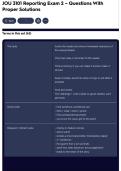
JOU 3101 Reporting Exam 2 – Questions With
Proper Solutions
Save
Terms in this set (63)
The lede hooks the reader and shows immediate relevance of
the issue/problem
One main idea, a "promise" to the reader
Think economy, if you can make it shorter, make it
shorter
Keep it simple, avoid full name of orgs or job titles if
possible
Must be honest.
The challenge = write a lede so good readers can't
get away
Direct lede - One sentence, sometimes two
- Who / what / when / where
- Not a prepositional phrase
- you know the issue, get to the point
Delayed / Indirect Lede - mostly on feature stories
- sets a scene
- evokes a mood (anecdote, foreshadow, tease)
- 2 + sentences
- Nut graf in first 4 (or so) Grafs
- same two roles (essence, encouragement)
- leads to the heart of the story
, Nut Graf paragraph that explains the focus of the story; should
come no later than the fifth paragraph with a delayed
lead
- Tells readers what the writer is up to
- Delivers a promise of the story's content & message
- Justifies the story by telling readers why they should
care
- Provides a transition from the lede & explains the
lede and its connection to the rest of the story
- Often tells readers why the story is timely
- Often includes supporting material that helps
readers see why the story is important
Hard News Lead must answer the questions of who, what, when,
where, why and how.
summarizes the story and cuts to the bottom line
Little person big picture Lead Take someone involved in a big story/issue & use an
example/anecdote of a person involved
No news ledes are dangerous
Basic summary lede a brief, inclusive statement of what story is about, 5
W's & H
Three variations (naming, delayed ID, blind)
Naming lede Summary, names and identities in the same Graf
(people, organizations, concepts)
problem: can get too long
Delayed ID lead summary lede without the details... subject/concept
named in the first sentence.... ID is in the 2nd/3rd
sentence
Proper Solutions
Save
Terms in this set (63)
The lede hooks the reader and shows immediate relevance of
the issue/problem
One main idea, a "promise" to the reader
Think economy, if you can make it shorter, make it
shorter
Keep it simple, avoid full name of orgs or job titles if
possible
Must be honest.
The challenge = write a lede so good readers can't
get away
Direct lede - One sentence, sometimes two
- Who / what / when / where
- Not a prepositional phrase
- you know the issue, get to the point
Delayed / Indirect Lede - mostly on feature stories
- sets a scene
- evokes a mood (anecdote, foreshadow, tease)
- 2 + sentences
- Nut graf in first 4 (or so) Grafs
- same two roles (essence, encouragement)
- leads to the heart of the story
, Nut Graf paragraph that explains the focus of the story; should
come no later than the fifth paragraph with a delayed
lead
- Tells readers what the writer is up to
- Delivers a promise of the story's content & message
- Justifies the story by telling readers why they should
care
- Provides a transition from the lede & explains the
lede and its connection to the rest of the story
- Often tells readers why the story is timely
- Often includes supporting material that helps
readers see why the story is important
Hard News Lead must answer the questions of who, what, when,
where, why and how.
summarizes the story and cuts to the bottom line
Little person big picture Lead Take someone involved in a big story/issue & use an
example/anecdote of a person involved
No news ledes are dangerous
Basic summary lede a brief, inclusive statement of what story is about, 5
W's & H
Three variations (naming, delayed ID, blind)
Naming lede Summary, names and identities in the same Graf
(people, organizations, concepts)
problem: can get too long
Delayed ID lead summary lede without the details... subject/concept
named in the first sentence.... ID is in the 2nd/3rd
sentence