
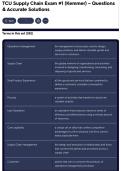
TCU Supply Chain Exam #1 (Kemmer) – Questions
& Accurate Solutions
Save
Terms in this set (282)
Operations Management the management of processes used to design,
supply, produce, and deliver valuable goods and
services to customers.
Supply Chain the global network of organizations and activities
involved in designing, transforming, consuming, and
disposing of goods and services.
Total Product Experience all the goods and services that are combined to
define a customer's complete consumption
experience.
Process a system of activities that transforms inputs into
valuable outputs.
Lean Operation an operation that produces maximum levels of
efficiency and effectiveness using a minimal amount
of resources.
Core capibilitiy a unique set of skills that confers competitive
advantages to a firm, because rival firms cannot
easily duplicate them.
Supply Chain Management the design and execution of relationships and flows
that connect the parties and processes across a
supply chain.
Customers parties that use or consume the products of
operations management processes.
,Suppliers parties that provide inputs to operational processes.
Stakeholders groups of people who have a financial or other
interest in the well-being of an operation.
Customer Management the management of the customer interface, including
all aspects of order processing and fulfillment.
Supply Management the management of processes used to identify,
acquire, and administer inputs to the firm.
Logistics Management the management of the movement of materials and
information within, into, and out of the firm.
Tier an upstream stage of supply.
Echelon a downstream stage of supply or consumption.
Strategic Planning a type of planning that addresses long-term
decisions that define the operations objectives and
capabilities for the firm and its partners.
Tactical Planning a type of planning that addresses intermediate-term
decisions to target aggregate product demands and
to establish how operational capacities will be used
to meet them.
Operational Planning a type of planning that establishes short-term
priorities and schedules to guide operational
resource allocations.
Operations Strategy a set of competitive priorities coupled with supply
chain structural and infrastructural design choices
intended to create capabilities that support a set of
value propositions targeted to address the needs of
critical customers.
,Corporate Strategy determines the overall mission of the firm and the
types of businesses that the firm wants to be in.
Strategic Business Unit (SBU) the semi-independent organizations used to manage
different product and market segments.
Business Unit Strategy determines how a strategic business unite will
compete.
Business Model the combination of the choices determining the
customers an SBU will target, the value propositions
it will offer, and the supply chain/operations
management capabilities it will employ.
SWOT a strategic planning technique to help firms identify
opportunities where they can develop a sustainable
competitive advantage and areas where the firm is
significantly at risk.
Functional Strategy determines how the function will support the overall
business unit strategy.
Critical Customers a customer that the firm has targeted as being
important to its future success.
Order Winners product traits that cause a customer to select one
product over its competitors.
Order Qualifiers product traits that must be met at a certain level for
the product to be considered by the customer.
Order Losers product traits that, if not satisfied, cause the loss of
either the current order or future orders.
Value Proposition a collection of product and service features that is
both attractive to customers and different than
competitors' offerings.
, Qualitiy a product's fitness for consumption in terms of
meeting customer's needs and desires.
Timeliness the degree to which a product is delivered or
available when the customer wants it.
Lead Time the amount of time that passes between the
beginning and ending of a set of activities.
Time to Market the total time that a firm takes to conceive, design,
test, produce, and deliver a new or revised product
for the marketplace.
Order-to-Delivery Lead Time the time that passes from the instant the customer
places an order for a product until the instant that the
customer receives the product.
Cost the expenses incurred in acquiring and using a
product.
Innovation both radical and incremental changes in process and
products.
Flexibility an operation's ability to respond efficiently to
changes in products, processes (including supply
chain relationships), and competitive environments.
Sustainability maintaining operations that are both profitable and
nondamanging to society or the environment.
Risk Management developing operations that anticipate and deal with
problems resulting from natural events, social factors,
economic issues, or technological issues.
& Accurate Solutions
Save
Terms in this set (282)
Operations Management the management of processes used to design,
supply, produce, and deliver valuable goods and
services to customers.
Supply Chain the global network of organizations and activities
involved in designing, transforming, consuming, and
disposing of goods and services.
Total Product Experience all the goods and services that are combined to
define a customer's complete consumption
experience.
Process a system of activities that transforms inputs into
valuable outputs.
Lean Operation an operation that produces maximum levels of
efficiency and effectiveness using a minimal amount
of resources.
Core capibilitiy a unique set of skills that confers competitive
advantages to a firm, because rival firms cannot
easily duplicate them.
Supply Chain Management the design and execution of relationships and flows
that connect the parties and processes across a
supply chain.
Customers parties that use or consume the products of
operations management processes.
,Suppliers parties that provide inputs to operational processes.
Stakeholders groups of people who have a financial or other
interest in the well-being of an operation.
Customer Management the management of the customer interface, including
all aspects of order processing and fulfillment.
Supply Management the management of processes used to identify,
acquire, and administer inputs to the firm.
Logistics Management the management of the movement of materials and
information within, into, and out of the firm.
Tier an upstream stage of supply.
Echelon a downstream stage of supply or consumption.
Strategic Planning a type of planning that addresses long-term
decisions that define the operations objectives and
capabilities for the firm and its partners.
Tactical Planning a type of planning that addresses intermediate-term
decisions to target aggregate product demands and
to establish how operational capacities will be used
to meet them.
Operational Planning a type of planning that establishes short-term
priorities and schedules to guide operational
resource allocations.
Operations Strategy a set of competitive priorities coupled with supply
chain structural and infrastructural design choices
intended to create capabilities that support a set of
value propositions targeted to address the needs of
critical customers.
,Corporate Strategy determines the overall mission of the firm and the
types of businesses that the firm wants to be in.
Strategic Business Unit (SBU) the semi-independent organizations used to manage
different product and market segments.
Business Unit Strategy determines how a strategic business unite will
compete.
Business Model the combination of the choices determining the
customers an SBU will target, the value propositions
it will offer, and the supply chain/operations
management capabilities it will employ.
SWOT a strategic planning technique to help firms identify
opportunities where they can develop a sustainable
competitive advantage and areas where the firm is
significantly at risk.
Functional Strategy determines how the function will support the overall
business unit strategy.
Critical Customers a customer that the firm has targeted as being
important to its future success.
Order Winners product traits that cause a customer to select one
product over its competitors.
Order Qualifiers product traits that must be met at a certain level for
the product to be considered by the customer.
Order Losers product traits that, if not satisfied, cause the loss of
either the current order or future orders.
Value Proposition a collection of product and service features that is
both attractive to customers and different than
competitors' offerings.
, Qualitiy a product's fitness for consumption in terms of
meeting customer's needs and desires.
Timeliness the degree to which a product is delivered or
available when the customer wants it.
Lead Time the amount of time that passes between the
beginning and ending of a set of activities.
Time to Market the total time that a firm takes to conceive, design,
test, produce, and deliver a new or revised product
for the marketplace.
Order-to-Delivery Lead Time the time that passes from the instant the customer
places an order for a product until the instant that the
customer receives the product.
Cost the expenses incurred in acquiring and using a
product.
Innovation both radical and incremental changes in process and
products.
Flexibility an operation's ability to respond efficiently to
changes in products, processes (including supply
chain relationships), and competitive environments.
Sustainability maintaining operations that are both profitable and
nondamanging to society or the environment.
Risk Management developing operations that anticipate and deal with
problems resulting from natural events, social factors,
economic issues, or technological issues.


