
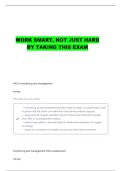
PACU monitoring and management
airway
Give this one a try later!
-- an artifical airway (endotracheal tube, nasal trumpet, or oral airway) is left
in place until the client can maintin an ioen airway without support
-- assess blood oxygen saturation levels continously (should be greater
than 95% or at preoperative status)
-- assess resp pattern, rate and depth to determine adequate of oxygen
exchange
-- assess for symmetry of brerath sounds and chest wall movement
Monitoring and management PACU assessment
Airway
,Give this one a try later!
~ an artificial airway (endotracheal tube, nasal trumpet, or oral airway) is left
in place until a client can maintain an open airway without support
~ assess blood oxygen saturation levels continuously (should be greater
than 95% or at postoperative status)
~ assess respiratory pattern, rate, and death to determine adequacy or
oxygen exchange
~ assess for symmetry for breath sounds and cheat wall movement
•Absent breath sounds on the left can indicate the endotracheal tube has
migrated down the right mainstem bronchus or that there is a
pneumothorax
• snoring or stridor (a high-pitched crowing type sound) can indicate poor
oxygen exchange
~ auscultate lung sound
~ administer humidifier oxygen
~ suction accumulated secretions if the client is unable to cough. Use a
yankauer suction for thick oral secretions or a large French suction catheter
for nasopharyngeal or nasotracheal secretions
• retained neuromuscular blocking agents can hinder the clients ability to
cough and eliminate secretions
• extubation of endotracheal tube is based on clients response to
commands, ability to elevate head, and use of thoracic breathing
• as soon as the client follows commands, encourage coughing, deep
breathing and use of the incentive spirometer
Complications: paralytic ileus
Give this one a try later!
Can occur due to the absence of GI peristaltic activity caused by
abdominal surgery or other physical trauma
**nurse considerations
~ monitor bowel sounds
~ encourage ambulation
~ advance the diet as tolerated when bowel sounds or flatus are present
, ~ the client can have an NG tube inserted to empty stomach contents
~ administer prokinetic agents such as metoclopramide as prescribed
Aldrete score
Respiration: breathe deeply and cough
Give this one a try later!
Score: 2
Monitoring and management PACU assessment
Circulation
Give this one a try later!
~ observe for internal bleeding (abdominal distention, visible hematoma
under/near the surgical site, tachycardia, hypotension, restlessness,
increased pain) and external bleeding
~ assess for hypervolemia and hypovolemia
~ assess skin color, temp, sensation and capillary refill
~ check mucous membranes, lips, and nail bed for cyanosis
~ assess and compare peripheral pulses for impaired circulation and deep-
vein thrombosis. Continue preventative deep vein thrombosis measures:
sequential compression devices, antiembloism stockings, and prescribed
anticoagulants or antiplatelet medications
~ monitor ECG readings and apical and peripheral pulses to determine a
pulse deficit, which can indicate a dysrhythmia
~ monitor fluid and electrolyte balance
Monitoring and management unit assessment
airway
Give this one a try later!
-- an artifical airway (endotracheal tube, nasal trumpet, or oral airway) is left
in place until the client can maintin an ioen airway without support
-- assess blood oxygen saturation levels continously (should be greater
than 95% or at preoperative status)
-- assess resp pattern, rate and depth to determine adequate of oxygen
exchange
-- assess for symmetry of brerath sounds and chest wall movement
Monitoring and management PACU assessment
Airway
,Give this one a try later!
~ an artificial airway (endotracheal tube, nasal trumpet, or oral airway) is left
in place until a client can maintain an open airway without support
~ assess blood oxygen saturation levels continuously (should be greater
than 95% or at postoperative status)
~ assess respiratory pattern, rate, and death to determine adequacy or
oxygen exchange
~ assess for symmetry for breath sounds and cheat wall movement
•Absent breath sounds on the left can indicate the endotracheal tube has
migrated down the right mainstem bronchus or that there is a
pneumothorax
• snoring or stridor (a high-pitched crowing type sound) can indicate poor
oxygen exchange
~ auscultate lung sound
~ administer humidifier oxygen
~ suction accumulated secretions if the client is unable to cough. Use a
yankauer suction for thick oral secretions or a large French suction catheter
for nasopharyngeal or nasotracheal secretions
• retained neuromuscular blocking agents can hinder the clients ability to
cough and eliminate secretions
• extubation of endotracheal tube is based on clients response to
commands, ability to elevate head, and use of thoracic breathing
• as soon as the client follows commands, encourage coughing, deep
breathing and use of the incentive spirometer
Complications: paralytic ileus
Give this one a try later!
Can occur due to the absence of GI peristaltic activity caused by
abdominal surgery or other physical trauma
**nurse considerations
~ monitor bowel sounds
~ encourage ambulation
~ advance the diet as tolerated when bowel sounds or flatus are present
, ~ the client can have an NG tube inserted to empty stomach contents
~ administer prokinetic agents such as metoclopramide as prescribed
Aldrete score
Respiration: breathe deeply and cough
Give this one a try later!
Score: 2
Monitoring and management PACU assessment
Circulation
Give this one a try later!
~ observe for internal bleeding (abdominal distention, visible hematoma
under/near the surgical site, tachycardia, hypotension, restlessness,
increased pain) and external bleeding
~ assess for hypervolemia and hypovolemia
~ assess skin color, temp, sensation and capillary refill
~ check mucous membranes, lips, and nail bed for cyanosis
~ assess and compare peripheral pulses for impaired circulation and deep-
vein thrombosis. Continue preventative deep vein thrombosis measures:
sequential compression devices, antiembloism stockings, and prescribed
anticoagulants or antiplatelet medications
~ monitor ECG readings and apical and peripheral pulses to determine a
pulse deficit, which can indicate a dysrhythmia
~ monitor fluid and electrolyte balance
Monitoring and management unit assessment


