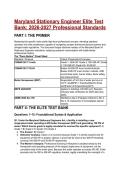
Maryland Stationary Engineer Elite Test
Bank: 2026-2027 Professional Standards
PART I: THE PRIMER
Mastering this specific niche yields high-level professional success, elevating standard
operators into elite practitioners capable of navigating complex thermomechanical systems and
stringent state regulations. This document forges absolute mastery of the Maryland Board of
Stationary Engineers standards, replacing academic memorization with battle-tested
professional intuition.
The "Panic Button" Cheat Sheet
Standard / Protocol Critical Thresholds & Formulas
COMAR 09.17 Limits Grade 1: ≥500 HP. Grade 2: 300-499 HP. Grade
3: 100-299 HP. Grade 4/5: 30-99 HP.
COMAR 09.17.02.04 Boilers 30-299 HP must monitor/indicate.
Boilers ≥300 HP must monitor, indicate, AND
record stack temp, burner status, flame safety,
and pressure/level.
Boiler Horsepower (BHP) Evaporation of 34.5 lbs of water per hour at
212°F. \text{BHP} = \frac{\text{lbs/hr} \times
\text{Factor of Evaporation}}{34.5}
BEPS 2026/2027 Applies to buildings ≥35,000 sq ft. Requires
3rd-party data verification for 2025 data (due
2026).
ASME 2025 Sec VIII Mandatory App 2 (Flanges) redirects to Div 2,
Sec 4.16. Subsection D consolidates special
vessels.
PART II: THE ELITE TEST BANK
Questions 1–15: Foundational Syntax & Application
Q1: Under the Maryland Stationary Engineers Act, a facility is installing a new
single-piece boiler operating at 450 boiler horsepower (BHP) and generating 150 PSI of
steam. Which license grade is legally mandated to oversee this specific equipment? A)
Grade 1 B) Grade 2 C) Grade 3 D) Grade 4
● The Answer: B) Grade 2
● Distractor Analysis: Option A is incorrect because Grade 1 is strictly required only for
equipment of 500 HP or greater. Options C and D fall far short of the 450 HP threshold,
covering 100-299 HP and 30-99 HP respectively.
● The Mentor's Analysis: Professional licensing in Maryland is dictated strictly by the
horsepower and operating pressure of the largest single piece of equipment, not the
cumulative total of the entire plant. Because this boiler operates at exactly 450 HP, it falls
precisely into the 300 to 499 HP regulatory bracket, legally mandating the oversight of a
, Grade 2 Stationary Engineer.
Q2: According to COMAR 09.17.02.04 regarding computerized monitoring systems, what
distinct functional requirement is imposed on a 350 HP steam boiler that is explicitly not required
for a 200 HP steam boiler? A) The system must monitor and indicate stack flue gas
temperature. B) The system must activate an audible alarm upon flame failure. C) The system
must record stack flue gas temperature, burner status, flame safety status, pressure, and water
level. D) The system must automatically blow down the boiler based on recorded TDS levels.
● The Answer: C) The system must record stack flue gas temperature, burner status, flame
safety status, pressure, and water level.
● Distractor Analysis: Options A and B represent basic requirements applied to both 200
HP and 350 HP boilers under COMAR regulations. Option D represents an automated
operational control function that is not legally mandated by this specific monitoring statute.
● The Mentor's Analysis: The legal distinction within COMAR 09.17.02.04 rests firmly at
the 300 HP threshold. Boilers operating between 30 and 299 HP merely require the
system to monitor and indicate critical parameters. Once the equipment crosses into 300
HP or more, the system must also continuously record these exact variables to provide
verifiable historical data for accident investigation and performance auditing.
Q3: The 2025 Edition of the ASME Boiler and Pressure Vessel Code (BPVC) introduced
significant structural changes to Section VIII, Division 1. When calculating flange design,
where does Mandatory Appendix 2 now legally direct the stationary engineer? A) Section
VIII, Division 1, Subsection D B) Section VIII, Division 2, Section 4.16 C) Section II, Part D
(Customary) D) Section I, Part PR
● The Answer: B) Section VIII, Division 2, Section 4.16
● Distractor Analysis: Option A refers to the newly created subsection for specific vessel
types (like heat exchangers and jacketed vessels), not standard flange calculations.
Option C deals exclusively with material properties and allowable stresses. Option D
governs power boiler rules, not pressure vessel flange geometry.
● The Mentor's Analysis: The 2025 ASME update represents a major global
harmonization effort between Division 1 and Division 2. To minimize discrepancies in
analytical results and streamline code maintenance, Division 1 design rules now
intentionally refer directly to Division 2 for equivalent calculation methods. Professional
intuition dictates that modern engineers must navigate fluidly between Div 1 for inspection
and Div 2 for these unified analytical design methods.
Q4: Under the Maryland Building Energy Performance Standards (BEPS) rolling out
through 2026 and 2027, a commercial building measuring 42,000 square feet must
comply with benchmarking mandates. What specific action is required by June 1, 2026,
regarding the 2025 calendar year energy data? A) The data must be submitted exclusively
via a state-proprietary Excel spreadsheet. B) The data must undergo verification by an
approved third-party verifier prior to submission. C) The facility must demonstrate immediate
net-zero direct greenhouse gas emissions. D) The facility must physically install an electric
boiler to replace fossil-fuel equipment.
● The Answer: B) The data must undergo verification by an approved third-party verifier
prior to submission.
● Distractor Analysis: Option A is false; the EPA ENERGY STAR Portfolio Manager is the
exclusively mandated tool. Option C represents the final target for 2040, not the
immediate 2026 mandate. Option D is a potential future strategic mitigation, not a 2026
statutory requirement.
● The Mentor's Analysis: The Climate Solutions Now Act (CSNA) established stringent
, BEPS regulations for covered buildings (≥35,000 sq ft). While basic benchmarking began
in 2025, the critical 2026 standard mandates that the submitted 2025 operational data be
third-party verified. This highly verified data serves as the absolute baseline for the
Energy Use Intensity (EUI) standards that the Maryland Department of the Environment
(MDE) will officially enforce beginning in 2027.
Q5: What is the exact thermodynamic definition of one Boiler Horsepower (BHP) as
utilized in mechanical capacity calculations across Maryland? A) The energy required to
raise the temperature of 1 lb of water by 1°F. B) The evaporation of 34.5 lbs of water per hour
from and at 212°F. C) The mechanical power required to drive a centrifugal feedwater pump at
3600 RPM. D) The heat absorbed during the phase change from liquid to vapor without a
temperature rise.
● The Answer: B) The evaporation of 34.5 lbs of water per hour from and at 212°F.
● Distractor Analysis: Option A defines the specific heat capacity of water (1 BTU). Option
C represents mechanical horsepower, not thermal boiler horsepower. Option D defines
the latent heat of vaporization.
● The Mentor's Analysis: Foundational syntax is non-negotiable in this industry. Boiler
horsepower is a strictly standardized metric of thermal output, mathematically defined as
exactly 34.5 lbs of steam generated per hour at a feed water temperature of 212°F. This
standardizes the rating of boilers globally, providing a baseline capacity measurement
regardless of varying operating pressures or fluctuating feedwater temperatures.
Q6: An accumulation test is performed on a Grade 1 power boiler to formally verify safety
valve capacity. Under what specific operational conditions is this test conducted? A) The
boiler is fired at minimum rate with the main steam stop valve fully open. B) The boiler is fired at
maximum firing rate with the main steam stop valve closed. C) The boiler is flooded completely
with cold water and pressurized to 1.5 times the MAWP. D) The safety valve is manually lifted
using the try-lever with the automated burner locked out.
● The Answer: B) The boiler is fired at maximum firing rate with the main steam stop valve
closed.
● Distractor Analysis: Option A only tests normal low-load steady-state operation. Option
C describes a hydrostatic pressure test, not an accumulation capacity test. Option D
represents a routine operational check of the valve's mechanical linkage, not a volumetric
capacity test.
● The Mentor's Analysis: An accumulation test proves that the safety valves possess
sufficient volumetric relieving capacity to prevent boiler overpressure in the absolute
worst-case scenario: maximum heat input with zero steam extraction. If the internal
pressure rises more than 6% above the maximum allowable working pressure (MAWP)
during this test, the valves are grossly undersized and legally fail inspection.
Q7: A safety valve on a high-pressure power boiler is set to dynamically pop at 250 psi.
According to operational standards, what is the minimum acceptable blowback
(blowdown) for this specific valve? A) 2 psi B) 5 psi C) 10 psi D) 15 psi
● The Answer: B) 5 psi
● Distractor Analysis: Option A is dangerously narrow, inevitably leading to destructive
valve chattering. Options C and D waste excessive amounts of steam and operational
thermal energy before reseating, harming plant efficiency.
● The Mentor's Analysis: Blowback is the engineered pressure differential between the
popping pressure and the reseating pressure. A minimum of 5 psi blowback is standard
for a 250 psi set point. This differential is critical; if the blowback is too short, the valve will
rapidly open and close (chatter), physically destroying the seating surfaces and eventually
Bank: 2026-2027 Professional Standards
PART I: THE PRIMER
Mastering this specific niche yields high-level professional success, elevating standard
operators into elite practitioners capable of navigating complex thermomechanical systems and
stringent state regulations. This document forges absolute mastery of the Maryland Board of
Stationary Engineers standards, replacing academic memorization with battle-tested
professional intuition.
The "Panic Button" Cheat Sheet
Standard / Protocol Critical Thresholds & Formulas
COMAR 09.17 Limits Grade 1: ≥500 HP. Grade 2: 300-499 HP. Grade
3: 100-299 HP. Grade 4/5: 30-99 HP.
COMAR 09.17.02.04 Boilers 30-299 HP must monitor/indicate.
Boilers ≥300 HP must monitor, indicate, AND
record stack temp, burner status, flame safety,
and pressure/level.
Boiler Horsepower (BHP) Evaporation of 34.5 lbs of water per hour at
212°F. \text{BHP} = \frac{\text{lbs/hr} \times
\text{Factor of Evaporation}}{34.5}
BEPS 2026/2027 Applies to buildings ≥35,000 sq ft. Requires
3rd-party data verification for 2025 data (due
2026).
ASME 2025 Sec VIII Mandatory App 2 (Flanges) redirects to Div 2,
Sec 4.16. Subsection D consolidates special
vessels.
PART II: THE ELITE TEST BANK
Questions 1–15: Foundational Syntax & Application
Q1: Under the Maryland Stationary Engineers Act, a facility is installing a new
single-piece boiler operating at 450 boiler horsepower (BHP) and generating 150 PSI of
steam. Which license grade is legally mandated to oversee this specific equipment? A)
Grade 1 B) Grade 2 C) Grade 3 D) Grade 4
● The Answer: B) Grade 2
● Distractor Analysis: Option A is incorrect because Grade 1 is strictly required only for
equipment of 500 HP or greater. Options C and D fall far short of the 450 HP threshold,
covering 100-299 HP and 30-99 HP respectively.
● The Mentor's Analysis: Professional licensing in Maryland is dictated strictly by the
horsepower and operating pressure of the largest single piece of equipment, not the
cumulative total of the entire plant. Because this boiler operates at exactly 450 HP, it falls
precisely into the 300 to 499 HP regulatory bracket, legally mandating the oversight of a
, Grade 2 Stationary Engineer.
Q2: According to COMAR 09.17.02.04 regarding computerized monitoring systems, what
distinct functional requirement is imposed on a 350 HP steam boiler that is explicitly not required
for a 200 HP steam boiler? A) The system must monitor and indicate stack flue gas
temperature. B) The system must activate an audible alarm upon flame failure. C) The system
must record stack flue gas temperature, burner status, flame safety status, pressure, and water
level. D) The system must automatically blow down the boiler based on recorded TDS levels.
● The Answer: C) The system must record stack flue gas temperature, burner status, flame
safety status, pressure, and water level.
● Distractor Analysis: Options A and B represent basic requirements applied to both 200
HP and 350 HP boilers under COMAR regulations. Option D represents an automated
operational control function that is not legally mandated by this specific monitoring statute.
● The Mentor's Analysis: The legal distinction within COMAR 09.17.02.04 rests firmly at
the 300 HP threshold. Boilers operating between 30 and 299 HP merely require the
system to monitor and indicate critical parameters. Once the equipment crosses into 300
HP or more, the system must also continuously record these exact variables to provide
verifiable historical data for accident investigation and performance auditing.
Q3: The 2025 Edition of the ASME Boiler and Pressure Vessel Code (BPVC) introduced
significant structural changes to Section VIII, Division 1. When calculating flange design,
where does Mandatory Appendix 2 now legally direct the stationary engineer? A) Section
VIII, Division 1, Subsection D B) Section VIII, Division 2, Section 4.16 C) Section II, Part D
(Customary) D) Section I, Part PR
● The Answer: B) Section VIII, Division 2, Section 4.16
● Distractor Analysis: Option A refers to the newly created subsection for specific vessel
types (like heat exchangers and jacketed vessels), not standard flange calculations.
Option C deals exclusively with material properties and allowable stresses. Option D
governs power boiler rules, not pressure vessel flange geometry.
● The Mentor's Analysis: The 2025 ASME update represents a major global
harmonization effort between Division 1 and Division 2. To minimize discrepancies in
analytical results and streamline code maintenance, Division 1 design rules now
intentionally refer directly to Division 2 for equivalent calculation methods. Professional
intuition dictates that modern engineers must navigate fluidly between Div 1 for inspection
and Div 2 for these unified analytical design methods.
Q4: Under the Maryland Building Energy Performance Standards (BEPS) rolling out
through 2026 and 2027, a commercial building measuring 42,000 square feet must
comply with benchmarking mandates. What specific action is required by June 1, 2026,
regarding the 2025 calendar year energy data? A) The data must be submitted exclusively
via a state-proprietary Excel spreadsheet. B) The data must undergo verification by an
approved third-party verifier prior to submission. C) The facility must demonstrate immediate
net-zero direct greenhouse gas emissions. D) The facility must physically install an electric
boiler to replace fossil-fuel equipment.
● The Answer: B) The data must undergo verification by an approved third-party verifier
prior to submission.
● Distractor Analysis: Option A is false; the EPA ENERGY STAR Portfolio Manager is the
exclusively mandated tool. Option C represents the final target for 2040, not the
immediate 2026 mandate. Option D is a potential future strategic mitigation, not a 2026
statutory requirement.
● The Mentor's Analysis: The Climate Solutions Now Act (CSNA) established stringent
, BEPS regulations for covered buildings (≥35,000 sq ft). While basic benchmarking began
in 2025, the critical 2026 standard mandates that the submitted 2025 operational data be
third-party verified. This highly verified data serves as the absolute baseline for the
Energy Use Intensity (EUI) standards that the Maryland Department of the Environment
(MDE) will officially enforce beginning in 2027.
Q5: What is the exact thermodynamic definition of one Boiler Horsepower (BHP) as
utilized in mechanical capacity calculations across Maryland? A) The energy required to
raise the temperature of 1 lb of water by 1°F. B) The evaporation of 34.5 lbs of water per hour
from and at 212°F. C) The mechanical power required to drive a centrifugal feedwater pump at
3600 RPM. D) The heat absorbed during the phase change from liquid to vapor without a
temperature rise.
● The Answer: B) The evaporation of 34.5 lbs of water per hour from and at 212°F.
● Distractor Analysis: Option A defines the specific heat capacity of water (1 BTU). Option
C represents mechanical horsepower, not thermal boiler horsepower. Option D defines
the latent heat of vaporization.
● The Mentor's Analysis: Foundational syntax is non-negotiable in this industry. Boiler
horsepower is a strictly standardized metric of thermal output, mathematically defined as
exactly 34.5 lbs of steam generated per hour at a feed water temperature of 212°F. This
standardizes the rating of boilers globally, providing a baseline capacity measurement
regardless of varying operating pressures or fluctuating feedwater temperatures.
Q6: An accumulation test is performed on a Grade 1 power boiler to formally verify safety
valve capacity. Under what specific operational conditions is this test conducted? A) The
boiler is fired at minimum rate with the main steam stop valve fully open. B) The boiler is fired at
maximum firing rate with the main steam stop valve closed. C) The boiler is flooded completely
with cold water and pressurized to 1.5 times the MAWP. D) The safety valve is manually lifted
using the try-lever with the automated burner locked out.
● The Answer: B) The boiler is fired at maximum firing rate with the main steam stop valve
closed.
● Distractor Analysis: Option A only tests normal low-load steady-state operation. Option
C describes a hydrostatic pressure test, not an accumulation capacity test. Option D
represents a routine operational check of the valve's mechanical linkage, not a volumetric
capacity test.
● The Mentor's Analysis: An accumulation test proves that the safety valves possess
sufficient volumetric relieving capacity to prevent boiler overpressure in the absolute
worst-case scenario: maximum heat input with zero steam extraction. If the internal
pressure rises more than 6% above the maximum allowable working pressure (MAWP)
during this test, the valves are grossly undersized and legally fail inspection.
Q7: A safety valve on a high-pressure power boiler is set to dynamically pop at 250 psi.
According to operational standards, what is the minimum acceptable blowback
(blowdown) for this specific valve? A) 2 psi B) 5 psi C) 10 psi D) 15 psi
● The Answer: B) 5 psi
● Distractor Analysis: Option A is dangerously narrow, inevitably leading to destructive
valve chattering. Options C and D waste excessive amounts of steam and operational
thermal energy before reseating, harming plant efficiency.
● The Mentor's Analysis: Blowback is the engineered pressure differential between the
popping pressure and the reseating pressure. A minimum of 5 psi blowback is standard
for a 250 psi set point. This differential is critical; if the blowback is too short, the valve will
rapidly open and close (chatter), physically destroying the seating surfaces and eventually