
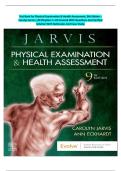
Test Bank for Physical Examination & Health Assessment, 9th Edition –
Carolyn Jarvis | All Chapters 1–32 Covered With Questions And Verified
Solution With Rationales And Case Study.
, TABLE OF CONTENT
1. Evidence-Based Assessment
2. Cultural Assessment
3. The Interview
4. The Complete Health History
5. Mental Status Assessment
6. Substance Use Assessment
7. Family Violence and Human Trafficking
8. Assessment Techniques and Safety in the Clinical Setting
9. General Survey and Measurement
10. Vital Signs
11. Pain Assessment
12. Nutrition Assessment
13. Skin, Hair, and Nails
14. Head, Face, Neck, and Regional Lymphatics
15. Eyes
16. Ears
17. Nose, Mouth, and Throat
18. Breasts, Axillae, and Regional Lymphatics
19. Thorax and Lungs
20. Heart and Neck Vessels
21. Peripheral Vascular System and Lymphatic System
22. Abdomen
23. Musculoskeletal System
24. Neurologic System
25. Male Genitourinary System
26. Anus, Rectum, and Prostate
27. Female Genitourinary System
28. The Complete Health Assessment: Adult
29. The Complete Physical Assessment: Infant, Young Child, and Adolescent
30. Bedside Assessment and Electronic Documentation
31. Pregnancy
32. Functional Assessment of the Older Adult
Chapter 1: Evidence-Based Assessment
Multiple Choice Questions
1. The primary goal of evidence-based assessment is to:
,A. Reduce patient interaction
B. Use tradition in clinical decisions
C. Integrate best research evidence with clinical expertise and patient preferences
D. Replace clinical judgment
Correct Answer: C
Rationale:
Evidence-based assessment combines current research, clinical expertise, and patient values to
provide optimal care. It does not replace judgment but strengthens it.
2. Which source provides the highest level of evidence?
A. Expert opinion
B. Case study
C. Randomized controlled trial
D. Textbook
Correct Answer: C
Rationale:
Randomized controlled trials (RCTs) minimize bias and provide strong evidence for clinical decisions.
3. What does the PICO framework stand for?
A. Patient, Intervention, Comparison, Outcome
B. Problem, Idea, Control, Outcome
C. Patient, Idea, Control, Observation
D. Problem, Intervention, Control, Observation
Correct Answer: A
Rationale:
PICO helps formulate clinical questions to guide research and evidence gathering.
4. Clinical expertise refers to:
A. Using only textbooks
B. Nurse’s accumulated skills and experience
C. Ignoring research
D. Patient opinions only
Correct Answer: B
Rationale:
Clinical expertise is built from experience, skills, and judgment in practice.
5. Evidence-based practice improves patient outcomes by:
, A. Increasing errors
B. Standardizing outdated care
C. Using proven interventions
D. Ignoring patient preferences
Correct Answer: C
Rationale:
Using scientifically validated interventions leads to safer and more effective care.
6. Which is a reliable source of evidence?
A. Social media posts
B. Peer-reviewed journals
C. Personal blogs
D. Opinions
Correct Answer: B
Rationale:
Peer-reviewed journals ensure research quality and credibility.
7. What is a systematic review?
A. Opinion summary
B. Collection of unrelated studies
C. Summary of multiple high-quality studies
D. Single experiment
Correct Answer: C
Rationale:
Systematic reviews synthesize findings from multiple studies, offering strong evidence.
8. Patient preferences in evidence-based care mean:
A. Ignoring patient wishes
B. Forcing treatment
C. Respecting values and choices
D. Only following protocols
Correct Answer: C
Rationale:
Patient-centered care requires incorporating individual beliefs and values.
9. Which step comes first in evidence-based practice?
Carolyn Jarvis | All Chapters 1–32 Covered With Questions And Verified
Solution With Rationales And Case Study.
, TABLE OF CONTENT
1. Evidence-Based Assessment
2. Cultural Assessment
3. The Interview
4. The Complete Health History
5. Mental Status Assessment
6. Substance Use Assessment
7. Family Violence and Human Trafficking
8. Assessment Techniques and Safety in the Clinical Setting
9. General Survey and Measurement
10. Vital Signs
11. Pain Assessment
12. Nutrition Assessment
13. Skin, Hair, and Nails
14. Head, Face, Neck, and Regional Lymphatics
15. Eyes
16. Ears
17. Nose, Mouth, and Throat
18. Breasts, Axillae, and Regional Lymphatics
19. Thorax and Lungs
20. Heart and Neck Vessels
21. Peripheral Vascular System and Lymphatic System
22. Abdomen
23. Musculoskeletal System
24. Neurologic System
25. Male Genitourinary System
26. Anus, Rectum, and Prostate
27. Female Genitourinary System
28. The Complete Health Assessment: Adult
29. The Complete Physical Assessment: Infant, Young Child, and Adolescent
30. Bedside Assessment and Electronic Documentation
31. Pregnancy
32. Functional Assessment of the Older Adult
Chapter 1: Evidence-Based Assessment
Multiple Choice Questions
1. The primary goal of evidence-based assessment is to:
,A. Reduce patient interaction
B. Use tradition in clinical decisions
C. Integrate best research evidence with clinical expertise and patient preferences
D. Replace clinical judgment
Correct Answer: C
Rationale:
Evidence-based assessment combines current research, clinical expertise, and patient values to
provide optimal care. It does not replace judgment but strengthens it.
2. Which source provides the highest level of evidence?
A. Expert opinion
B. Case study
C. Randomized controlled trial
D. Textbook
Correct Answer: C
Rationale:
Randomized controlled trials (RCTs) minimize bias and provide strong evidence for clinical decisions.
3. What does the PICO framework stand for?
A. Patient, Intervention, Comparison, Outcome
B. Problem, Idea, Control, Outcome
C. Patient, Idea, Control, Observation
D. Problem, Intervention, Control, Observation
Correct Answer: A
Rationale:
PICO helps formulate clinical questions to guide research and evidence gathering.
4. Clinical expertise refers to:
A. Using only textbooks
B. Nurse’s accumulated skills and experience
C. Ignoring research
D. Patient opinions only
Correct Answer: B
Rationale:
Clinical expertise is built from experience, skills, and judgment in practice.
5. Evidence-based practice improves patient outcomes by:
, A. Increasing errors
B. Standardizing outdated care
C. Using proven interventions
D. Ignoring patient preferences
Correct Answer: C
Rationale:
Using scientifically validated interventions leads to safer and more effective care.
6. Which is a reliable source of evidence?
A. Social media posts
B. Peer-reviewed journals
C. Personal blogs
D. Opinions
Correct Answer: B
Rationale:
Peer-reviewed journals ensure research quality and credibility.
7. What is a systematic review?
A. Opinion summary
B. Collection of unrelated studies
C. Summary of multiple high-quality studies
D. Single experiment
Correct Answer: C
Rationale:
Systematic reviews synthesize findings from multiple studies, offering strong evidence.
8. Patient preferences in evidence-based care mean:
A. Ignoring patient wishes
B. Forcing treatment
C. Respecting values and choices
D. Only following protocols
Correct Answer: C
Rationale:
Patient-centered care requires incorporating individual beliefs and values.
9. Which step comes first in evidence-based practice?


