1|Page
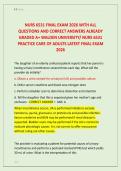
NURS 6531 FINAL EXAM 2026 WITH ALL
QUESTIONS AND CORRECT ANSWERS ALREADY
GRADED A+ WALDEN UNIVERSITY/ NURS 6531
PRACTICE CARE OF ADULTS LATEST FINAL EXAM
2026
The daughter of an elderly confused patient reports that her parent is
having urinary incontinence several times each day. What will the
provider do initially?
a. Obtain a urine sample for urinalysis (UA) and possible culture
b. Order serum creatinine and blood urea nitrogen tests
c. Perform a bladder scan to determine distention and retention
d. Tell the daughter that this is expected given her mother's age and
confusion - CORRECT ANSWER = ANS: A
When incontinence occurs, UA is performed initially to exclude
hematuria, pyuria, glucosuria, or proteinuria and possible infection.
Serum creatinine and BUN may be performed if renal disease is
suspected. Bladder scans may be performed if the UA is normal to
evaluate physiologic causes. It is not correct to offer reassurance
without ruling out other causes.
The provider is evaluating a patient for potential causes of urinary
incontinence and performs a postvoid residual (PVR) test which yields
30 mL of urine. What is the interpretation of this
pg. 1
,2|Page
result?
a. The patient may have overflow incontinence.
b. The patient probably has a urinary tract infection (UTI).
c. This is a normal result.
d. This represents incomplete emptying. - CORRECT ANSWER = ANS: C
A PVR less than 50 mL is considered normal and this result does not
indicate any abnormality.
The provider is counseling a patient who has stress incontinence about
ways to minimize accidents. What will the provider suggest initially?
a. Increasing fluid intake to dilute the urine
b. Referral to a physical therapist
c. Taking pseudoephedrine daily
d. Voiding every 2 hours during the day - CORRECT ANSWER = ANS: D
Timed voiding is useful to help minimize stress incontinence and is used
initially. Increasing fluid intake will increase symptoms. PT referral may
be done if other measures fail to help with exercises to strengthen the
pelvic floor muscles. Pseudoephedrine is useful, but not an initial
therapy.
An older male patient reports urinary frequency, back pain, and
nocturia. A dipstick urinalysis reveals hematuria. What will the provider
do next to evaluate this condition?
a. Order a PSA and perform a digital rectal exam (DRE)
pg. 2
,3|Page
b. Refer for a biopsy
c. Refer the patient to a urologist
d. Schedule a transurethral ultrasound (TRUS) - CORRECT ANSWER =
ANS: A
Patients with symptoms of potential prostate cancer should be
screened with PSA and DRE. Referral to a urologist is the next step even
with normal findings, since PSA is occasionally normal. The urologist
may order TRUS or biopsy.
An older male patient has a screening prostate-specific antigen (PSA)
which is 12 ng/mL. What does this value indicate?
a. A normal result
b. Benign prostatic hypertrophy
c. Early prostate cancer
d. Prostate cancer - CORRECT ANSWER = ANS: D
A PSA greater than 10 ng/mL suggests prostate cancer. A level between
4 and 10 ng/mL may be early prostate cancer or a benign condition. A
level less than 4 ng/mL is normal.
A patient is diagnosed with prostate cancer and diagnostic testing
reveals disease that has gone past the prostatic capsule without
evidence of metastasis. The patient does not wish to undergo
treatment. What will the provider tell this patient?
a. Chemotherapy is indicated to provide cure for this cancer.
pg. 3
, 4|Page
b. Monitoring prostate-specific antigen (PSA) with regular digital rectal
examination (DRE) is an acceptable option.
c. Palliative radiation therapy is necessary to improve quality of life.
d. This level of disease requires intervention with hormonal therapy. -
CORRECT ANSWER = ANS: B
This patient has stage T2 prostate cancer which may be managed with
watchful waiting which includes PSA and DRE evaluation.
Chemotherapy, palliative radiation therapy, and hormonal therapy are
not required.
A male patient reports nocturia and daytime urinary frequency and
urgency without changes in the force of the urine stream. What is the
likely cause of this?
a. Bladder outlet obstruction
b. Lower urinary tract symptoms (LUTS)
c. Prostate cancer
d. Urinary tract infection (UTI) - CORRECT ANSWER = ANS: B
Lower urinary tract symptoms (LUTS) result from irritative changes in
the lower tract. Bladder outlet obstruction causes hesitancy, decreased
caliber and force of the urine stream, and postvoid dribbling. Diagnosis
of prostate cancer and UTI require further testing and are less likely
causes.
A 70-year-old male reports urinary hesitancy, postvoid dribbling, and a
diminished urine stream. A digital rectal exam (DRE) reveals an enlarged
pg. 4
NURS 6531 FINAL EXAM 2026 WITH ALL
QUESTIONS AND CORRECT ANSWERS ALREADY
GRADED A+ WALDEN UNIVERSITY/ NURS 6531
PRACTICE CARE OF ADULTS LATEST FINAL EXAM
2026
The daughter of an elderly confused patient reports that her parent is
having urinary incontinence several times each day. What will the
provider do initially?
a. Obtain a urine sample for urinalysis (UA) and possible culture
b. Order serum creatinine and blood urea nitrogen tests
c. Perform a bladder scan to determine distention and retention
d. Tell the daughter that this is expected given her mother's age and
confusion - CORRECT ANSWER = ANS: A
When incontinence occurs, UA is performed initially to exclude
hematuria, pyuria, glucosuria, or proteinuria and possible infection.
Serum creatinine and BUN may be performed if renal disease is
suspected. Bladder scans may be performed if the UA is normal to
evaluate physiologic causes. It is not correct to offer reassurance
without ruling out other causes.
The provider is evaluating a patient for potential causes of urinary
incontinence and performs a postvoid residual (PVR) test which yields
30 mL of urine. What is the interpretation of this
pg. 1
,2|Page
result?
a. The patient may have overflow incontinence.
b. The patient probably has a urinary tract infection (UTI).
c. This is a normal result.
d. This represents incomplete emptying. - CORRECT ANSWER = ANS: C
A PVR less than 50 mL is considered normal and this result does not
indicate any abnormality.
The provider is counseling a patient who has stress incontinence about
ways to minimize accidents. What will the provider suggest initially?
a. Increasing fluid intake to dilute the urine
b. Referral to a physical therapist
c. Taking pseudoephedrine daily
d. Voiding every 2 hours during the day - CORRECT ANSWER = ANS: D
Timed voiding is useful to help minimize stress incontinence and is used
initially. Increasing fluid intake will increase symptoms. PT referral may
be done if other measures fail to help with exercises to strengthen the
pelvic floor muscles. Pseudoephedrine is useful, but not an initial
therapy.
An older male patient reports urinary frequency, back pain, and
nocturia. A dipstick urinalysis reveals hematuria. What will the provider
do next to evaluate this condition?
a. Order a PSA and perform a digital rectal exam (DRE)
pg. 2
,3|Page
b. Refer for a biopsy
c. Refer the patient to a urologist
d. Schedule a transurethral ultrasound (TRUS) - CORRECT ANSWER =
ANS: A
Patients with symptoms of potential prostate cancer should be
screened with PSA and DRE. Referral to a urologist is the next step even
with normal findings, since PSA is occasionally normal. The urologist
may order TRUS or biopsy.
An older male patient has a screening prostate-specific antigen (PSA)
which is 12 ng/mL. What does this value indicate?
a. A normal result
b. Benign prostatic hypertrophy
c. Early prostate cancer
d. Prostate cancer - CORRECT ANSWER = ANS: D
A PSA greater than 10 ng/mL suggests prostate cancer. A level between
4 and 10 ng/mL may be early prostate cancer or a benign condition. A
level less than 4 ng/mL is normal.
A patient is diagnosed with prostate cancer and diagnostic testing
reveals disease that has gone past the prostatic capsule without
evidence of metastasis. The patient does not wish to undergo
treatment. What will the provider tell this patient?
a. Chemotherapy is indicated to provide cure for this cancer.
pg. 3
, 4|Page
b. Monitoring prostate-specific antigen (PSA) with regular digital rectal
examination (DRE) is an acceptable option.
c. Palliative radiation therapy is necessary to improve quality of life.
d. This level of disease requires intervention with hormonal therapy. -
CORRECT ANSWER = ANS: B
This patient has stage T2 prostate cancer which may be managed with
watchful waiting which includes PSA and DRE evaluation.
Chemotherapy, palliative radiation therapy, and hormonal therapy are
not required.
A male patient reports nocturia and daytime urinary frequency and
urgency without changes in the force of the urine stream. What is the
likely cause of this?
a. Bladder outlet obstruction
b. Lower urinary tract symptoms (LUTS)
c. Prostate cancer
d. Urinary tract infection (UTI) - CORRECT ANSWER = ANS: B
Lower urinary tract symptoms (LUTS) result from irritative changes in
the lower tract. Bladder outlet obstruction causes hesitancy, decreased
caliber and force of the urine stream, and postvoid dribbling. Diagnosis
of prostate cancer and UTI require further testing and are less likely
causes.
A 70-year-old male reports urinary hesitancy, postvoid dribbling, and a
diminished urine stream. A digital rectal exam (DRE) reveals an enlarged
pg. 4