

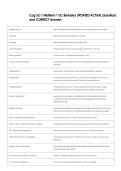
Cog Sci 1 Midterm 1 UC Berkeley UPDATED ACTUAL Questions
and CORRECT Answers
oligodendrocyte glial cell responsible for myelinating axons, thus insulating action potentials
astrocyte glial cell responsible for bringing in nutrients
microglia glial cell responsible for cleaning up dead cells
neurotransmission electrical signal through neuron translated chemically to next cell
resting potential a neuron at rest is charged at approximately -70mV
stimulus (action potential) something that causes the current neuron to depolarize toward the threshold
potential
depolarization when all Na+ channels open if the threshold of excitation is reached
repolarization the peak action potential where K+ channels open and begin to leave the cell,
causing the cell to be less positive. The action potential is sent.
hyperpolarization the refractory period where an action potential cannot fire because K+ keeps
leaving, making the action potential even more negative than normal
Kandel's experiment used sea slugs and classical conditioning to link the tail electrocution and
touching of the gill, so if the tail was touched, the gill would retract (shows
Hebbian learning)
Hebbian learning neurons that fire together wire together (if two cells consistently fire at the same
time, then the strength of the connection between them will grow stronger)
MEG (magnetoencephalography) superconducting sensors measure neuronal electrical activity
fMRI (functional magnetic resonance imaging) magnetism used to measure blood oxygen levels (blood flow) (low temporal)
EEG (electroencephalogram) electrodes placed on scalp measures ionic current voltage fluctuations
PET (positron emission tomography) fast-decaying radio-tracers & detector array measure oxygen or glucose (low
temporal)
single & multi-unit recording micro-electrodes measure electro-phyiological response of individual neurons
(highly invasive, high spatial)
TMS (transcranial magnetic stimulation) magnetic stimulation produces temporary virtual brain lesions
CT (computed tomography) x-ray used to map tissue density (highly invasive, low spatial)
, spatial resolution the accuracy with which one can measure where an event is occurring
temporal resolution how close in time you can get to when the neurons fire
BMI (brain machine interface) any system that detects/generates/modifies neural activity to accomplish a task
(neuroprosthetics)
single neuron activity activity detected by invasive electrodes with high temporal resolution, mixed
long-term results, and moderate spatial resolution
aggregate activity activity detected by EEG, fMRI, can be non/minimally invasive, has low temporal
resolution but wide spatial coverage and is stable over time
multi-electrode arrays arrays used to detect single neuron activity that delivers spike waveforms that can
be sorted by computer algorithms to distinguish different neurons' signals (why
one electrode can measure multiple neurons)
LFP (local field potential) anything electrical potential around the neuron
Ryan Neely's research (rats and apple juice) experiment with an electrode in V1 area of rat, if they did what researchers
wanted, they got apple juice, showing instrumental learning
Ryan Neely's research (rats and Jaws) experiment where some rats were given Jaws (deactivating basal ganglia neurons)
and some weren't, showing that the basal ganglia is important in helping us learn,
but not necessary once something has been learned
test of self control goal of experiment where kid is given option to eat marshmallow now or get two
later
classical interpretation of marshmallow experiment kids who can't practice self-control is doomed later in life (exaggerated view)
Celeste Kidd's new experiment experiment alters reliability conditions of marshmallow-like experiment
goals of Celeste Kidd's new experiment experiment shows that children's self-control may actually reflect the reliability of
their upbringing, and not their own personal self-discipline
Goldilocks effect explains how we allocate our attention because we want something that is neither
too familiar nor too foreign to us
surprisal why kids pay attention more to things that are surprising but not too much, rather
than something at either extreme
rational learner this learner's goal is to maximize learning by paying attention to the one thing
they can learn the most about
learning rate hypothesis one is more likely to pay attention to something that you can learn more about
quicker (hypothesis)
and CORRECT Answers
oligodendrocyte glial cell responsible for myelinating axons, thus insulating action potentials
astrocyte glial cell responsible for bringing in nutrients
microglia glial cell responsible for cleaning up dead cells
neurotransmission electrical signal through neuron translated chemically to next cell
resting potential a neuron at rest is charged at approximately -70mV
stimulus (action potential) something that causes the current neuron to depolarize toward the threshold
potential
depolarization when all Na+ channels open if the threshold of excitation is reached
repolarization the peak action potential where K+ channels open and begin to leave the cell,
causing the cell to be less positive. The action potential is sent.
hyperpolarization the refractory period where an action potential cannot fire because K+ keeps
leaving, making the action potential even more negative than normal
Kandel's experiment used sea slugs and classical conditioning to link the tail electrocution and
touching of the gill, so if the tail was touched, the gill would retract (shows
Hebbian learning)
Hebbian learning neurons that fire together wire together (if two cells consistently fire at the same
time, then the strength of the connection between them will grow stronger)
MEG (magnetoencephalography) superconducting sensors measure neuronal electrical activity
fMRI (functional magnetic resonance imaging) magnetism used to measure blood oxygen levels (blood flow) (low temporal)
EEG (electroencephalogram) electrodes placed on scalp measures ionic current voltage fluctuations
PET (positron emission tomography) fast-decaying radio-tracers & detector array measure oxygen or glucose (low
temporal)
single & multi-unit recording micro-electrodes measure electro-phyiological response of individual neurons
(highly invasive, high spatial)
TMS (transcranial magnetic stimulation) magnetic stimulation produces temporary virtual brain lesions
CT (computed tomography) x-ray used to map tissue density (highly invasive, low spatial)
, spatial resolution the accuracy with which one can measure where an event is occurring
temporal resolution how close in time you can get to when the neurons fire
BMI (brain machine interface) any system that detects/generates/modifies neural activity to accomplish a task
(neuroprosthetics)
single neuron activity activity detected by invasive electrodes with high temporal resolution, mixed
long-term results, and moderate spatial resolution
aggregate activity activity detected by EEG, fMRI, can be non/minimally invasive, has low temporal
resolution but wide spatial coverage and is stable over time
multi-electrode arrays arrays used to detect single neuron activity that delivers spike waveforms that can
be sorted by computer algorithms to distinguish different neurons' signals (why
one electrode can measure multiple neurons)
LFP (local field potential) anything electrical potential around the neuron
Ryan Neely's research (rats and apple juice) experiment with an electrode in V1 area of rat, if they did what researchers
wanted, they got apple juice, showing instrumental learning
Ryan Neely's research (rats and Jaws) experiment where some rats were given Jaws (deactivating basal ganglia neurons)
and some weren't, showing that the basal ganglia is important in helping us learn,
but not necessary once something has been learned
test of self control goal of experiment where kid is given option to eat marshmallow now or get two
later
classical interpretation of marshmallow experiment kids who can't practice self-control is doomed later in life (exaggerated view)
Celeste Kidd's new experiment experiment alters reliability conditions of marshmallow-like experiment
goals of Celeste Kidd's new experiment experiment shows that children's self-control may actually reflect the reliability of
their upbringing, and not their own personal self-discipline
Goldilocks effect explains how we allocate our attention because we want something that is neither
too familiar nor too foreign to us
surprisal why kids pay attention more to things that are surprising but not too much, rather
than something at either extreme
rational learner this learner's goal is to maximize learning by paying attention to the one thing
they can learn the most about
learning rate hypothesis one is more likely to pay attention to something that you can learn more about
quicker (hypothesis)


