

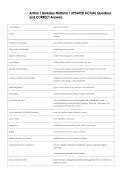
Anthro 1 Berkeley Midterm 1 UPDATED ACTUAL Questions
and CORRECT Answers
Anthropology The study of humans
holism the view that mind, body, individuals, society, and the environment affect one
another
4 fields of anthropology sociocultural, archaeological, biological, linguistic
sociocultural anthropology studies living human cultures
linguistic anthropology studies human language in cultural contexts
archaeology studies material remains of human activity in the past
biological anthropology study of human variation, past and present with an emphasis of evolutionary,
physiological, and biological perspectives
evolution of biological anthropology modernism and less bias in science over time: went from eurocentric, hierarchical,
eugenics to primotology, molecular genetics
paleoathropology study of human anatomy and behavior in the fossil record
primatololgy study of primate behavior, biology, ecology, conservation
pre evolutionary views stasis: world is fixed and unchanging, great chain of being: life is a series of
creations reflecting increasingly perfect organisms, the devine "watchmaker" that
is gods plan as revealed by creation
Famous people of the scientific revolution copernicus, galileo, keppler, descartes, newton
age of contact when expeditions took place
copernicus challenges the idea the earth was the center of the universe
galileo work that the universe was a place of motion
keppler, descartes, and newton established laws of physics, motion, and gravity
people important in classification john ray: category of species in classification, groups of organisms ability to
reproduce
carolus linnaeus: class order, added humans
misconception in fossils johann bennger: colleagues placed fake fossils, suggested there was evidence of
biblical accounts
, leonardo da vinci looked at fossil patterns near water and saw geological formations
expanding scales of time fossils and teh immensity of time
1. uniformitarianism
2. deep time (earth has been here for a while)
steno superposition (rocks layer, theory of fossilization
william smith faunal sequence-- fossils can succeed each other vertically and horizontally at
the same time
Evolution before darwin erasmus darwin: suggested environment was shaping changing organisms
jean baptiste de lamark: favorable actions become so habitual they become
biologically based and passed on
laws of lamark use and disuse
inheritance of aquired characteristics
charles lyell estimated earth was older. Argued fossils in layers show incremental shifts in time
thomas marthus human dangers of unconstrained reproduction with respect to resources
more resources = more population = scarcity/death
alfred wallace independently discovered logic of natural selection, prompting Darwin to release
the orgin
name of darwins voyage HMS Beagle
darwin experimented with selective breeding, artificial selection
darwins selective breeding realize animal and plant breeders can modify their stocks over generations by
selective breeding
Ingredients for evolution Charles Darwin 1850s 1 "grandchildren like grandfathers" =traits are inherited
2. tendency to small change especially with physical change= physical variation
across siblings
3. great fertility in proportion to support of parents = more competition in
offspring leads to better traits
Ingredients by Lewontin 1978 Heredity
individual variation
overproduction leads to differences in survival and future preproduction
fact vs theory vs hypothesis fact: objective stement based on observation
theory: structures of ideas that explain and interpret facts
hypothesis: educated guess prediction of new facts
and CORRECT Answers
Anthropology The study of humans
holism the view that mind, body, individuals, society, and the environment affect one
another
4 fields of anthropology sociocultural, archaeological, biological, linguistic
sociocultural anthropology studies living human cultures
linguistic anthropology studies human language in cultural contexts
archaeology studies material remains of human activity in the past
biological anthropology study of human variation, past and present with an emphasis of evolutionary,
physiological, and biological perspectives
evolution of biological anthropology modernism and less bias in science over time: went from eurocentric, hierarchical,
eugenics to primotology, molecular genetics
paleoathropology study of human anatomy and behavior in the fossil record
primatololgy study of primate behavior, biology, ecology, conservation
pre evolutionary views stasis: world is fixed and unchanging, great chain of being: life is a series of
creations reflecting increasingly perfect organisms, the devine "watchmaker" that
is gods plan as revealed by creation
Famous people of the scientific revolution copernicus, galileo, keppler, descartes, newton
age of contact when expeditions took place
copernicus challenges the idea the earth was the center of the universe
galileo work that the universe was a place of motion
keppler, descartes, and newton established laws of physics, motion, and gravity
people important in classification john ray: category of species in classification, groups of organisms ability to
reproduce
carolus linnaeus: class order, added humans
misconception in fossils johann bennger: colleagues placed fake fossils, suggested there was evidence of
biblical accounts
, leonardo da vinci looked at fossil patterns near water and saw geological formations
expanding scales of time fossils and teh immensity of time
1. uniformitarianism
2. deep time (earth has been here for a while)
steno superposition (rocks layer, theory of fossilization
william smith faunal sequence-- fossils can succeed each other vertically and horizontally at
the same time
Evolution before darwin erasmus darwin: suggested environment was shaping changing organisms
jean baptiste de lamark: favorable actions become so habitual they become
biologically based and passed on
laws of lamark use and disuse
inheritance of aquired characteristics
charles lyell estimated earth was older. Argued fossils in layers show incremental shifts in time
thomas marthus human dangers of unconstrained reproduction with respect to resources
more resources = more population = scarcity/death
alfred wallace independently discovered logic of natural selection, prompting Darwin to release
the orgin
name of darwins voyage HMS Beagle
darwin experimented with selective breeding, artificial selection
darwins selective breeding realize animal and plant breeders can modify their stocks over generations by
selective breeding
Ingredients for evolution Charles Darwin 1850s 1 "grandchildren like grandfathers" =traits are inherited
2. tendency to small change especially with physical change= physical variation
across siblings
3. great fertility in proportion to support of parents = more competition in
offspring leads to better traits
Ingredients by Lewontin 1978 Heredity
individual variation
overproduction leads to differences in survival and future preproduction
fact vs theory vs hypothesis fact: objective stement based on observation
theory: structures of ideas that explain and interpret facts
hypothesis: educated guess prediction of new facts


