
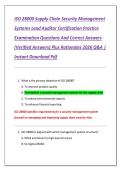
ISO 28000 Supply Chain Security Management
Systems Lead Auditor Certification Practice
Examination Questions And Correct Answers
(Verified Answers) Plus Rationales 2026 Q&A |
Instant Download Pdf
1. What is the primary objective of ISO 28000?
A. To improve product quality
B. To establish a security management system for the supply chain
C. To reduce environmental impacts
D. To enhance financial reporting
ISO 28000 specifies requirements for a security management system
focused on managing and improving supply chain security risks.
2. ISO 28000 is aligned with which management system structure?
A. PDCA and Annex SL high-level structure
B. Six Sigma DMAIC
, C. Balanced Scorecard
D. COBIT framework
A. PDCA and Annex SL high-level structure
ISO 28000 follows the Plan-Do-Check-Act cycle and aligns with the Annex
SL framework for management system standards.
3. In ISO 28000, “security risk” refers to:
A. Financial loss due to market changes
B. Likelihood of a security-related event and its consequences
C. Customer dissatisfaction
D. Product nonconity
Security risk combines the probability of a security incident and its
potential impact on the supply chain.
4. Which clause addresses leadership and commitment?
A. Clause 4
B. Clause 5
C. Clause 5
D. Clause 9
Clause 5 requires top management to demonstrate leadership and
commitment to the security management system.
, 5. What is the purpose of a security policy?
A. To define marketing objectives
B. To list all procedures
C. To provide a framework for security objectives and commitments
D. To outline audit schedules
The security policy sets direction and commitment to meet security
objectives and comply with requirements.
6. Context of the organization includes:
A. Only internal issues
B. Only external issues
C. Internal and external issues relevant to security objectives
D. Financial audits
Understanding internal and external issues ensures risks and opportunities
affecting supply chain security are addressed.
7. Interested parties in ISO 28000 may include:
A. Regulators
B. Customers
C. Suppliers
D. All of the above
, Interested parties include any stakeholders that can affect or be affected
by supply chain security.
8. The scope of the security management system must:
A. Be verbal only
B. Be documented and available
C. Cover only headquarters
D. Exclude outsourced processes
The scope must be documented and clearly define boundaries and
applicability.
9. Risk assessment in ISO 28000 should:
A. Be performed once
B. Be outsourced entirely
C. Be systematic and ongoing
D. Focus only on financial threats
Security risk assessment must be systematic and periodically reviewed.
10. Security objectives must be:
A. Confidential
B. Financially focused
Systems Lead Auditor Certification Practice
Examination Questions And Correct Answers
(Verified Answers) Plus Rationales 2026 Q&A |
Instant Download Pdf
1. What is the primary objective of ISO 28000?
A. To improve product quality
B. To establish a security management system for the supply chain
C. To reduce environmental impacts
D. To enhance financial reporting
ISO 28000 specifies requirements for a security management system
focused on managing and improving supply chain security risks.
2. ISO 28000 is aligned with which management system structure?
A. PDCA and Annex SL high-level structure
B. Six Sigma DMAIC
, C. Balanced Scorecard
D. COBIT framework
A. PDCA and Annex SL high-level structure
ISO 28000 follows the Plan-Do-Check-Act cycle and aligns with the Annex
SL framework for management system standards.
3. In ISO 28000, “security risk” refers to:
A. Financial loss due to market changes
B. Likelihood of a security-related event and its consequences
C. Customer dissatisfaction
D. Product nonconity
Security risk combines the probability of a security incident and its
potential impact on the supply chain.
4. Which clause addresses leadership and commitment?
A. Clause 4
B. Clause 5
C. Clause 5
D. Clause 9
Clause 5 requires top management to demonstrate leadership and
commitment to the security management system.
, 5. What is the purpose of a security policy?
A. To define marketing objectives
B. To list all procedures
C. To provide a framework for security objectives and commitments
D. To outline audit schedules
The security policy sets direction and commitment to meet security
objectives and comply with requirements.
6. Context of the organization includes:
A. Only internal issues
B. Only external issues
C. Internal and external issues relevant to security objectives
D. Financial audits
Understanding internal and external issues ensures risks and opportunities
affecting supply chain security are addressed.
7. Interested parties in ISO 28000 may include:
A. Regulators
B. Customers
C. Suppliers
D. All of the above
, Interested parties include any stakeholders that can affect or be affected
by supply chain security.
8. The scope of the security management system must:
A. Be verbal only
B. Be documented and available
C. Cover only headquarters
D. Exclude outsourced processes
The scope must be documented and clearly define boundaries and
applicability.
9. Risk assessment in ISO 28000 should:
A. Be performed once
B. Be outsourced entirely
C. Be systematic and ongoing
D. Focus only on financial threats
Security risk assessment must be systematic and periodically reviewed.
10. Security objectives must be:
A. Confidential
B. Financially focused



