

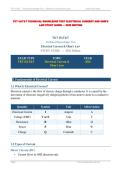
TKT IIAT&T | Technical Knowledge Test | Electrical Current & Ohm's Law 2026 Study Guide
TKT IIAT&T TECHNICAL KNOWLEDGE TEST ELECTRICAL CURRENT AND OHM'S
LAW STUDY GUIDE — 2026 EDITION
TKT IIAT&T
Technical Knowledge Test
Electrical Current & Ohm's Law
STUDY GUIDE — 2026 Edition
EXAM TYPE TOPIC YEAR
TKT IIAT&T Electrical Current & 2026
Ohm's Law
1. Fundamentals of Electrical Current
1.1 What Is Electrical Current?
Electrical current is the flow of electric charge through a conductor. It is caused by the
movement of electrons (negatively charged particles) from atom to atom in a conductive
material.
Quantity Symbol Unit Abbreviation
Electrical Current I Ampere A
Voltage (EMF) V or E Volt V
Resistance R Ohm Ω
Power P Watt W
Charge Q Coulomb C
1.2 Types of Current
Direct Current (DC)
• Current flows in ONE direction only
Page 1 For test preparation use only
, TKT IIAT&T | Technical Knowledge Test | Electrical Current & Ohm's Law 2026 Study Guide
• Produced by batteries, solar cells, and DC generators
• Common in electronic circuits, vehicles, and portable devices
• Voltage level is constant (does not alternate)
• Example: 12V car battery, 9V transistor battery
Alternating Current (AC)
• Current reverses direction periodically
• Produced by AC generators (alternators)
• Standard household power (120V/60Hz in US; 220V/50Hz in many countries)
• More efficient for long-distance transmission
• Example: wall outlets, industrial power, motors
1.3 Conductors, Insulators & Semiconductors
Type Description Examples
Conductor Allows electrons to flow Copper, silver, gold,
freely (low resistance) aluminum, iron
Insulator Resists electron flow (very Rubber, plastic, glass,
high resistance) ceramic, air
Semiconductor Conducts under certain Silicon, germanium,
conditions diodes, transistors
2. Ohm's Law
2.1 The Law Defined
Ohm's Law states that the current through a conductor between two points is directly
proportional to the voltage across the two points and inversely proportional to the
resistance between them.
V=IxR I=V/R R=V/I
Voltage Current Resistance
2.2 Formula Quick Reference
Page 2 For test preparation use only
TKT IIAT&T TECHNICAL KNOWLEDGE TEST ELECTRICAL CURRENT AND OHM'S
LAW STUDY GUIDE — 2026 EDITION
TKT IIAT&T
Technical Knowledge Test
Electrical Current & Ohm's Law
STUDY GUIDE — 2026 Edition
EXAM TYPE TOPIC YEAR
TKT IIAT&T Electrical Current & 2026
Ohm's Law
1. Fundamentals of Electrical Current
1.1 What Is Electrical Current?
Electrical current is the flow of electric charge through a conductor. It is caused by the
movement of electrons (negatively charged particles) from atom to atom in a conductive
material.
Quantity Symbol Unit Abbreviation
Electrical Current I Ampere A
Voltage (EMF) V or E Volt V
Resistance R Ohm Ω
Power P Watt W
Charge Q Coulomb C
1.2 Types of Current
Direct Current (DC)
• Current flows in ONE direction only
Page 1 For test preparation use only
, TKT IIAT&T | Technical Knowledge Test | Electrical Current & Ohm's Law 2026 Study Guide
• Produced by batteries, solar cells, and DC generators
• Common in electronic circuits, vehicles, and portable devices
• Voltage level is constant (does not alternate)
• Example: 12V car battery, 9V transistor battery
Alternating Current (AC)
• Current reverses direction periodically
• Produced by AC generators (alternators)
• Standard household power (120V/60Hz in US; 220V/50Hz in many countries)
• More efficient for long-distance transmission
• Example: wall outlets, industrial power, motors
1.3 Conductors, Insulators & Semiconductors
Type Description Examples
Conductor Allows electrons to flow Copper, silver, gold,
freely (low resistance) aluminum, iron
Insulator Resists electron flow (very Rubber, plastic, glass,
high resistance) ceramic, air
Semiconductor Conducts under certain Silicon, germanium,
conditions diodes, transistors
2. Ohm's Law
2.1 The Law Defined
Ohm's Law states that the current through a conductor between two points is directly
proportional to the voltage across the two points and inversely proportional to the
resistance between them.
V=IxR I=V/R R=V/I
Voltage Current Resistance
2.2 Formula Quick Reference
Page 2 For test preparation use only


