
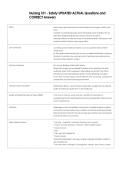
Nursing 101 - Safety UPDATED ACTUAL Questions and
CORRECT Answers
Safety basic human need, second only to survival needs such as oxygen, nutrition, and
fluids.
Accidents or unintentional injuries are the 4th leading cause of deaths in the US.
Estimated 130,000 people die each year as a result of accidents.
Poisoning is listed as number one cause of unintentional death, followed by motor
vehicle accidents, firearms, drowning and fires.
Joint Commission accrediting body for healthcare facilities, each year publishes National Patient
Safety Goals.
Ex. 2016 goals include improving the accuracy or patient identification, improving
the safety of medication use, reducing the risk of healthcare associated infections,
and preventing mistakes in surgery.
Institute of Medicine Err is Human: Building a Safer Health System:
Stated that it is simply not acceptable for patients to be harmed by the same
healthcare system that is supposed to offer healing and comfort. Five critical
principles to ensure safe healthcare systems: Provide leadership, recognize
human limits in process design, promote effective team functioning, anticipate the
unexpected, and create a learning environment.
American Nurse's Association Health System Reform - recommends six major public changed that can raise the
quality of healthcare. Quality Aim 1 is safe healthcare.
Quality and Safety Education for Nurses (QSEN) a task force to improve nursing education, identified and described six
competencies that all nursing students should have by graduation. Safety is one of
those competencies.
Medicare federal agency that has identified "never events" or hospital acquired conditions.
costly errors that cause serious injury or death, and that are mostly preventable
(falls, injuries from restraints). They will no longer pay institutions for care required
to treat the effects of such errors.
Safety Hazards at Home * Poisoning - medication, household chemicals, lead, cosmetics.
* Carbon monoxide poisoning - treatment- 100% humidified oxygen.
* Scalds and burns
* Fires
* Falls - age >65 at highest risk
* Firearms injuries
*Suffocation/Asphyxiation- drowning, choking, smoke/gas inhalation, children 0-
4yrs at highest risk.
* Take home toxins- pathogenic microorganisms, asbestos, lead, mercury, arsenic.
, Safety Hazards in the Healthcare Facility -Falls
-Equipment Related Accidents
-Fires/Electrical Hazards
-Restraints
-Side Rails
-Mercury Exposure
-Biological Hazard
-Improper pt. ID.
-Medication Errors
Infant/Toddler can't recognize the danger, kids love to touch, eat, explore,
At high risk for-drowning, falls, choking, poison.
Drowning is the leading cause of death followed by motor vehicle accidents.
Falls, Choking, SIDS and ingesting poisons are the other critical safety concerns.
Preschooler (3-5 years) learn to initiate tasks and carry out plans, or they feel guilty about efforts to be
independent.
Play outside more (playgrounds, Pools.)
Accidental Deaths - Motor vehicle injuries are a major cause, along with drowning,
fires and poisoning.
Nonfatal injuries - falls are the primary cause of nonfatal injuries.
Adult supervision is essential.
School-Age Child 6-12 years
Involved more with activities outside the home. Injuries are often related to sports,
skateboarding, bicycle riding, and playground injuries. Most common are bone
and muscle injuries.
Accidental deaths - motor vehicle continue to be the leading cause in this age-
group
Nonfatal injuries - falls are the leading cause of nonfatal injuries.
CORRECT Answers
Safety basic human need, second only to survival needs such as oxygen, nutrition, and
fluids.
Accidents or unintentional injuries are the 4th leading cause of deaths in the US.
Estimated 130,000 people die each year as a result of accidents.
Poisoning is listed as number one cause of unintentional death, followed by motor
vehicle accidents, firearms, drowning and fires.
Joint Commission accrediting body for healthcare facilities, each year publishes National Patient
Safety Goals.
Ex. 2016 goals include improving the accuracy or patient identification, improving
the safety of medication use, reducing the risk of healthcare associated infections,
and preventing mistakes in surgery.
Institute of Medicine Err is Human: Building a Safer Health System:
Stated that it is simply not acceptable for patients to be harmed by the same
healthcare system that is supposed to offer healing and comfort. Five critical
principles to ensure safe healthcare systems: Provide leadership, recognize
human limits in process design, promote effective team functioning, anticipate the
unexpected, and create a learning environment.
American Nurse's Association Health System Reform - recommends six major public changed that can raise the
quality of healthcare. Quality Aim 1 is safe healthcare.
Quality and Safety Education for Nurses (QSEN) a task force to improve nursing education, identified and described six
competencies that all nursing students should have by graduation. Safety is one of
those competencies.
Medicare federal agency that has identified "never events" or hospital acquired conditions.
costly errors that cause serious injury or death, and that are mostly preventable
(falls, injuries from restraints). They will no longer pay institutions for care required
to treat the effects of such errors.
Safety Hazards at Home * Poisoning - medication, household chemicals, lead, cosmetics.
* Carbon monoxide poisoning - treatment- 100% humidified oxygen.
* Scalds and burns
* Fires
* Falls - age >65 at highest risk
* Firearms injuries
*Suffocation/Asphyxiation- drowning, choking, smoke/gas inhalation, children 0-
4yrs at highest risk.
* Take home toxins- pathogenic microorganisms, asbestos, lead, mercury, arsenic.
, Safety Hazards in the Healthcare Facility -Falls
-Equipment Related Accidents
-Fires/Electrical Hazards
-Restraints
-Side Rails
-Mercury Exposure
-Biological Hazard
-Improper pt. ID.
-Medication Errors
Infant/Toddler can't recognize the danger, kids love to touch, eat, explore,
At high risk for-drowning, falls, choking, poison.
Drowning is the leading cause of death followed by motor vehicle accidents.
Falls, Choking, SIDS and ingesting poisons are the other critical safety concerns.
Preschooler (3-5 years) learn to initiate tasks and carry out plans, or they feel guilty about efforts to be
independent.
Play outside more (playgrounds, Pools.)
Accidental Deaths - Motor vehicle injuries are a major cause, along with drowning,
fires and poisoning.
Nonfatal injuries - falls are the primary cause of nonfatal injuries.
Adult supervision is essential.
School-Age Child 6-12 years
Involved more with activities outside the home. Injuries are often related to sports,
skateboarding, bicycle riding, and playground injuries. Most common are bone
and muscle injuries.
Accidental deaths - motor vehicle continue to be the leading cause in this age-
group
Nonfatal injuries - falls are the leading cause of nonfatal injuries.


