

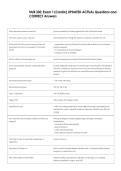
NUR 330: Exam 1 (Cardio) UPDATED ACTUAL Questions and
CORRECT Answers
What does blood pressure measure? the force exerted by the blood against the walls of the blood vessels
What does cardiac output measure? the total blood flow through the systemic or pulmonic circulation per min
What does the stroke volume measure? how is it - measured the amount of blood put out by the left ventricle in one contraction
measured? and what is the average CO of a healthy (systolic=squeeze)
adult? - it is measured by an echocardiogram
- average CO is 70 mL (4-8 liters)
What is systemic vascular resistance? the force opposing the movement of blood within the blood vessels
Does vasoconstriction increase or decrease blood Increase (helpful hint: think about moving through a crowd/ party of 100 people- if
pressure? the room is smaller you are gonna have to do a lot more pushing and shoving
(pressure) to get to the door than you would if the room was big and had a 100
people.
Normal blood pressure range= < 120 mmHg/ <80 mmHg
Elevated blood pressure= 120-129/ <80 mmHg
Stage 1 Hypertension 130-139/ 80-89 mmHg
Stage 2 HTN 140 or higher/ 90 or higher mmHg
Hyptertensive crisis > 180/ >120 mmHg (helpful hint: the main digit of the systolic and diastolic have
switched from what a normal BP would be- rather than 120/ 80 its now 180/ 120
mmHg)
How does HTN crisis emergency differ from HTN crisis HTN crisis emergency includes targeted organ damage and requires
urgency? hospitalization
- can lead to HTN encephalopathy
- renal insufficiency
- cardiac decompensation
- aortic dissection (tear of inner layers of aorta)
What does it mean to say primary hypertension is Cause is unknown
idiopathic?
Secondary HTN refers to... HTN as a result of another disease/ disorder, state, or treatment (kidney disease,
pregnancy, medications, etc.)
Why is HTN called the silent killer? Patients are often asymptomatic until there is severe signs such as fatigue,
dizziness, palpitation, angina, and SOB
, What are some of the first signs of HTN? achy head (Headache), blurred vision, and chest pain (help hint: the ABCs of HTN)
How does HTN lead to Left ventricular hypertrophy? The heart has to overcompensate and therefore works harder to push the blood
out of the left ventricular in order to get it to the rest of the body, this increased in
pressure thickens the muscles of the left ventricle
Does left ventricular hypertrophy indicate a stronger No! Just because the muscle is thicker does not mean it is stronger (think of a
heart? body builder, they LOOK the strongest but can't lift for shit- its cosmetic muscle
build up not functional muscle build up)
How does retinopathy indicate HTN Smaller vessels are easier to rupture as a result of increased BP and can indicate
concurrent damage to vessels in the heart, brain, and kidneys
What are some reasons diagnostic labs are run for an - identify or rule out secondary HTN
patient with HTN? - evaluate target organ disease
- establish a baseline BEFORE starting therapy
Why would ambulatory blood pressure monitoring Patients with white coat syndrome may experience an elevated blood pressure at
(ABPM) be beneficial for patients with white coat the idea of going to the doctor, or whilst at the appointment because they are
syndrome? nervous about the results. Measuring the BP in the office/ hospital does not give
an accurate reading for individuals who have white coat syndrome. ABPM is
noninvasive and automated, keeping a diary/ record of the patient BP at different
intervals over 24 hours
Scenario: Patient goes into their annual checkup and has Since it is the first increased blood pressure reading for the patient the HCP will
an increased BP of 129/83 mmHg. What is the response of emphasize the important of maintaining a healthy lifestyle- educating the patient
the HCP? of the AHA Life's Simple 7 and DASH diet
Scenario: 6 months after their annual visit, where they had The HCP will stress the importance of lifestyle modifications
an increased BP of 129/83 mmHg, the patient's BP is 132/
87 mmHg- what is the HCP's response?
Scenario: 6 months after their second doctor's visit and 1 The HCP will prescribe the patient medication to control their HTN
year after their annual visit (where they recorded an
increased BP) the patient's BP is 142/90 mmHg, what is
the HCP's response?
What is resistant HTN? Resistant HTN is failure to reach a goal BP after medications are prescribed, it
increases the patients risk for stroke or MI
What are the two primary actions of anti-HTN decrease circulating blood volume and reduce SVR
medications?
Centrally acting alpha-agonist Example: Clonidine
Example: Action: decreases HR and causes vasodilation
Action: Side Effects: dry mouth
Side Effects:
CORRECT Answers
What does blood pressure measure? the force exerted by the blood against the walls of the blood vessels
What does cardiac output measure? the total blood flow through the systemic or pulmonic circulation per min
What does the stroke volume measure? how is it - measured the amount of blood put out by the left ventricle in one contraction
measured? and what is the average CO of a healthy (systolic=squeeze)
adult? - it is measured by an echocardiogram
- average CO is 70 mL (4-8 liters)
What is systemic vascular resistance? the force opposing the movement of blood within the blood vessels
Does vasoconstriction increase or decrease blood Increase (helpful hint: think about moving through a crowd/ party of 100 people- if
pressure? the room is smaller you are gonna have to do a lot more pushing and shoving
(pressure) to get to the door than you would if the room was big and had a 100
people.
Normal blood pressure range= < 120 mmHg/ <80 mmHg
Elevated blood pressure= 120-129/ <80 mmHg
Stage 1 Hypertension 130-139/ 80-89 mmHg
Stage 2 HTN 140 or higher/ 90 or higher mmHg
Hyptertensive crisis > 180/ >120 mmHg (helpful hint: the main digit of the systolic and diastolic have
switched from what a normal BP would be- rather than 120/ 80 its now 180/ 120
mmHg)
How does HTN crisis emergency differ from HTN crisis HTN crisis emergency includes targeted organ damage and requires
urgency? hospitalization
- can lead to HTN encephalopathy
- renal insufficiency
- cardiac decompensation
- aortic dissection (tear of inner layers of aorta)
What does it mean to say primary hypertension is Cause is unknown
idiopathic?
Secondary HTN refers to... HTN as a result of another disease/ disorder, state, or treatment (kidney disease,
pregnancy, medications, etc.)
Why is HTN called the silent killer? Patients are often asymptomatic until there is severe signs such as fatigue,
dizziness, palpitation, angina, and SOB
, What are some of the first signs of HTN? achy head (Headache), blurred vision, and chest pain (help hint: the ABCs of HTN)
How does HTN lead to Left ventricular hypertrophy? The heart has to overcompensate and therefore works harder to push the blood
out of the left ventricular in order to get it to the rest of the body, this increased in
pressure thickens the muscles of the left ventricle
Does left ventricular hypertrophy indicate a stronger No! Just because the muscle is thicker does not mean it is stronger (think of a
heart? body builder, they LOOK the strongest but can't lift for shit- its cosmetic muscle
build up not functional muscle build up)
How does retinopathy indicate HTN Smaller vessels are easier to rupture as a result of increased BP and can indicate
concurrent damage to vessels in the heart, brain, and kidneys
What are some reasons diagnostic labs are run for an - identify or rule out secondary HTN
patient with HTN? - evaluate target organ disease
- establish a baseline BEFORE starting therapy
Why would ambulatory blood pressure monitoring Patients with white coat syndrome may experience an elevated blood pressure at
(ABPM) be beneficial for patients with white coat the idea of going to the doctor, or whilst at the appointment because they are
syndrome? nervous about the results. Measuring the BP in the office/ hospital does not give
an accurate reading for individuals who have white coat syndrome. ABPM is
noninvasive and automated, keeping a diary/ record of the patient BP at different
intervals over 24 hours
Scenario: Patient goes into their annual checkup and has Since it is the first increased blood pressure reading for the patient the HCP will
an increased BP of 129/83 mmHg. What is the response of emphasize the important of maintaining a healthy lifestyle- educating the patient
the HCP? of the AHA Life's Simple 7 and DASH diet
Scenario: 6 months after their annual visit, where they had The HCP will stress the importance of lifestyle modifications
an increased BP of 129/83 mmHg, the patient's BP is 132/
87 mmHg- what is the HCP's response?
Scenario: 6 months after their second doctor's visit and 1 The HCP will prescribe the patient medication to control their HTN
year after their annual visit (where they recorded an
increased BP) the patient's BP is 142/90 mmHg, what is
the HCP's response?
What is resistant HTN? Resistant HTN is failure to reach a goal BP after medications are prescribed, it
increases the patients risk for stroke or MI
What are the two primary actions of anti-HTN decrease circulating blood volume and reduce SVR
medications?
Centrally acting alpha-agonist Example: Clonidine
Example: Action: decreases HR and causes vasodilation
Action: Side Effects: dry mouth
Side Effects:


