

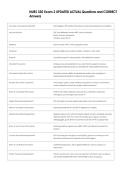
NURS 330 Exam 2 UPDATED ACTUAL Questions and CORRECT
Answers
How does a nurse prevent infection? Hand Hygiene, PPE, Isolation Precautions, Environmental Cleaning, Immunizations
Labs for Infection CBC with differential: monitor WBC count for infection
Blood Cultures: bacteremia
Urinalysis: assess for UTI
Epidemic Spreads rapidly within a finite geographical area
Pandemic Spreads rapidly across several countries, continents, or the world
Endemic Consistently present in the population, with relatively low spread
Standard Precautions Strategy of assuming all patients may carry infectious agents and using
appropriate barrier precautions for all healthcare worker-patient interactions
Transmission-Based Precautions Precautions used in addition to standard precautions when contagious or
epidemiologically significant organisms are recognized
Standard Precautions Components Hand hygiene, gloves, proper handling of equipment and linens, environmental
control, prevention of injury from sharps, patient placement
When to use Droplet Precautions Patients with certain respiratory viruses (ex. flu), confirmed or suspected
meningococcal meningitis, parvovirus B-19
Droplet Precautions Requirements HCP and guests must wear surgical mask while in room and a private room
When to use Airborne Precautions Suspected/confirmed TB or COVID-19 (depends on hospital)
Airborne Precautions Requirements Negative pressure room with door closed, patients can go to medically necessary
tests/procedures, HCP must wear N-95, isolation gown, gloves, and face
shield/goggles, guests (if they must enter) should wear N-95 or surgical mask
When to use Contact Precautions Multi-drug resistant organisms (ex. MRSA, VRE), Cystic fibrosis (to protect the
patient)
Contact Precaution Requirements HCP must wear gown and gloves, hand hygiene, guests do not need gown and
gloves but should know the importance or hand hygiene
When to use Enteric Precaution Confirmed/suspected C. Diff. or gastroenteritis (ex. norovirus, rotavirus, or
adenovirus)
Enteric Precaution Requirements Patient in private room, clean room and equipment with bleach, gown and gloves
with HAND HYGIENE WITH SOAP AND WATER for HCP and guests
, Catheter-Associated Urinary Tract Infections (CAUTIs) Most common device related Hospital Acquired Infection (approx 30%); risk
increases 5% each day catheter is in place
CAUTI symptoms fever, lower abdominal pain or tenderness, cloudy urine, blood in urine, confusion
(older adults)
How to prevent CAUTIs Daily assessment of catheter necessity, aseptic technique during insertion, daily
catheter care, keep drainage bag below bladder level and off of floor
Advance Directives Components 1. Durable Power of Attorney
2. Medical Power of Attorney
3. Living Wills
What are Advance Directives Written means for communicating care choices
Durable Power of Attorney for Health Care Appointment of a decision-maker, completed when capacitated, rights and
responsibilites
Living Wills Prepared while patient has decisional capacity
DNR Form confirms that if cardiopulmonary arrest occurs no resuscitative measures are
initiated
Components of EOL decision making in ICU Create a clam environment, clarify the situation, identify patient/family goals, and
review the process with patient and family
"Not so Good" Nurse for EOL Care Assumes family would be alone, too much sedation, cannot adjust the
environment, removes themselves as much as they can, not in touch with their own
feeling/attitudes about death, "another day, another shift," more intrusive,
disconnected, fixated on the rules
A "Bad" Death "drama surrounding the death," lack of acceptance and decision making, feeling
helpless
The "Good" EOL nurse Showing emotion (not too much), advocacy, being able to set the environment,
can feel the sitatuion, attention to detail, makes the patient look comfortable,
comfort measures, brings in resources (ex. chaplin, social worker, etc.),
understands death is a personal experience (will break the rules if necessary),
empathy, quiet and calm, clarifies and educates
A "Good" Death Adequate comfort and symptom control, everyone's on board and prepared,
family's and patients needs are taken care of, person does not die alone, knowing
that you don't always have to talk, ensuring closure
Normal Fasting BG 70-100mg/dL
Normal Hemoglobin A1c <6.0%
Answers
How does a nurse prevent infection? Hand Hygiene, PPE, Isolation Precautions, Environmental Cleaning, Immunizations
Labs for Infection CBC with differential: monitor WBC count for infection
Blood Cultures: bacteremia
Urinalysis: assess for UTI
Epidemic Spreads rapidly within a finite geographical area
Pandemic Spreads rapidly across several countries, continents, or the world
Endemic Consistently present in the population, with relatively low spread
Standard Precautions Strategy of assuming all patients may carry infectious agents and using
appropriate barrier precautions for all healthcare worker-patient interactions
Transmission-Based Precautions Precautions used in addition to standard precautions when contagious or
epidemiologically significant organisms are recognized
Standard Precautions Components Hand hygiene, gloves, proper handling of equipment and linens, environmental
control, prevention of injury from sharps, patient placement
When to use Droplet Precautions Patients with certain respiratory viruses (ex. flu), confirmed or suspected
meningococcal meningitis, parvovirus B-19
Droplet Precautions Requirements HCP and guests must wear surgical mask while in room and a private room
When to use Airborne Precautions Suspected/confirmed TB or COVID-19 (depends on hospital)
Airborne Precautions Requirements Negative pressure room with door closed, patients can go to medically necessary
tests/procedures, HCP must wear N-95, isolation gown, gloves, and face
shield/goggles, guests (if they must enter) should wear N-95 or surgical mask
When to use Contact Precautions Multi-drug resistant organisms (ex. MRSA, VRE), Cystic fibrosis (to protect the
patient)
Contact Precaution Requirements HCP must wear gown and gloves, hand hygiene, guests do not need gown and
gloves but should know the importance or hand hygiene
When to use Enteric Precaution Confirmed/suspected C. Diff. or gastroenteritis (ex. norovirus, rotavirus, or
adenovirus)
Enteric Precaution Requirements Patient in private room, clean room and equipment with bleach, gown and gloves
with HAND HYGIENE WITH SOAP AND WATER for HCP and guests
, Catheter-Associated Urinary Tract Infections (CAUTIs) Most common device related Hospital Acquired Infection (approx 30%); risk
increases 5% each day catheter is in place
CAUTI symptoms fever, lower abdominal pain or tenderness, cloudy urine, blood in urine, confusion
(older adults)
How to prevent CAUTIs Daily assessment of catheter necessity, aseptic technique during insertion, daily
catheter care, keep drainage bag below bladder level and off of floor
Advance Directives Components 1. Durable Power of Attorney
2. Medical Power of Attorney
3. Living Wills
What are Advance Directives Written means for communicating care choices
Durable Power of Attorney for Health Care Appointment of a decision-maker, completed when capacitated, rights and
responsibilites
Living Wills Prepared while patient has decisional capacity
DNR Form confirms that if cardiopulmonary arrest occurs no resuscitative measures are
initiated
Components of EOL decision making in ICU Create a clam environment, clarify the situation, identify patient/family goals, and
review the process with patient and family
"Not so Good" Nurse for EOL Care Assumes family would be alone, too much sedation, cannot adjust the
environment, removes themselves as much as they can, not in touch with their own
feeling/attitudes about death, "another day, another shift," more intrusive,
disconnected, fixated on the rules
A "Bad" Death "drama surrounding the death," lack of acceptance and decision making, feeling
helpless
The "Good" EOL nurse Showing emotion (not too much), advocacy, being able to set the environment,
can feel the sitatuion, attention to detail, makes the patient look comfortable,
comfort measures, brings in resources (ex. chaplin, social worker, etc.),
understands death is a personal experience (will break the rules if necessary),
empathy, quiet and calm, clarifies and educates
A "Good" Death Adequate comfort and symptom control, everyone's on board and prepared,
family's and patients needs are taken care of, person does not die alone, knowing
that you don't always have to talk, ensuring closure
Normal Fasting BG 70-100mg/dL
Normal Hemoglobin A1c <6.0%


