

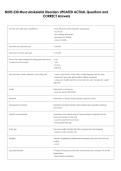
NURS 330 Musculoskeletal Disorders UPDATED ACTUAL Questions and
CORRECT Answers
what are some older adult considerations - bone density loss (most important- osteoporosis)
- muscle loss
- joint cartilage deterioration
- decreased joint flexibility
- reduced mobility
time frame for acute back pain < 3 months
time frame for chronic back pain > 3 months
what is the order of diagnostic testing going from least - x-ray
invasive to most invasive - U/S
- CT scan
- MRI scan
lower back pain causes, assessment, and nursing care - causes: weak muscles, muscle strain, unstable ligaments and disc issues
- assessment: nerve pain, gait, sensation, reflexes, tenderness
- nursing care: mobility education, body mechanics, pain management, weight-
reduction
bursitis inflammation of a bursa sac
- bursa sac prevent joint friction
tendonitis inflammation of tendon sheaths typically caused by overuse
Impingement syndrome impaired movement of rotator cuff of shoulder, due to repetitive overhead
movement
carpal tunnel syndrome compression of the median nerve as it passes between the ligament and the
bones and tendons of the wrist
- caused by repetitive hand motions
- have positive Tinel's sign
Tinel's sign "pins and needles" sensation felt when an injured nerve site is tapped
- tapped on palm and pain is felt
ganglion collection of gelatinous material near tendons/joints; they are round, firm and
swollen.
- a cyst
Dupuytren Disease A nodular thickening and contraction of the palmar fascia, resulting in 4th and 5th
finger flexion.
- tissue thickens and tightens
, what is the nursing care for all wrist disorders steroid injections
Phalen's sign numbness or tingling with pressing backs of hands together in acute flexion for 60
seconds
pre-op care for upper extremity disorders for the wrist thorough assessment of pain, mobility, limitations
- want a good assessment to be able to compare after.
post-op care for upper extremity disorders for the wrist - Hourly neurovascular assessment x24hr
- Compare limbs, pre-op and post-op findings
- Demonstrate mobility
- Dressing care
- Prescribed mobility exercises/Rehabilitation
- Pain management
- Assisting and encouraging in independent ADLs
- Elevation of limb
Hallux Valgus (Bunion) an abnormal enlargement of the joint at the base of the great toe
- toe deviates laterally
- redness, pain, swelling will be there
Plantar Fasciitis inflammation of plantar fascia, connective tissue of the sole of the foot, due to
repetitive injury; common cause of heel pain
Onychogryphosis (Ingrown Toenail) free edge of nail penetrates the skin
- risk for infection, pain, swelling
promoting healthy feet/nursing management - Encourage properly fitting shoes
- Orthotic devices• Education on management of underlying diseases - DM, PVD,
RA
- Promotion of rest, elevation, physiotherapy
- Monitoring skin of foot daily
- Surgery
nursing management pre-op for foot surgery Assessment of gait, mobility, neurovascular status of the foot, planning home care
nursing management post-op for foot surgery Assessment of neurovascular status of foot and exposed toes every 1-2hr x 24hr
- Compare affected foot to unaffected foot
- Manage pain
- Elevation of affected limb
- Monitor and change dressings as needed
- Follow weight bearing advisements from surgical team
- Ensuring proper use of assistive devices
- *Prevention of DVT*
what is osteoarthritis degenerative joint disease
- cartilage gets broken down- wear and tear. there is less cushion in the joints.
why are women more commonly affected by because of menopause- loss of estrogen production
osteoarthritis
CORRECT Answers
what are some older adult considerations - bone density loss (most important- osteoporosis)
- muscle loss
- joint cartilage deterioration
- decreased joint flexibility
- reduced mobility
time frame for acute back pain < 3 months
time frame for chronic back pain > 3 months
what is the order of diagnostic testing going from least - x-ray
invasive to most invasive - U/S
- CT scan
- MRI scan
lower back pain causes, assessment, and nursing care - causes: weak muscles, muscle strain, unstable ligaments and disc issues
- assessment: nerve pain, gait, sensation, reflexes, tenderness
- nursing care: mobility education, body mechanics, pain management, weight-
reduction
bursitis inflammation of a bursa sac
- bursa sac prevent joint friction
tendonitis inflammation of tendon sheaths typically caused by overuse
Impingement syndrome impaired movement of rotator cuff of shoulder, due to repetitive overhead
movement
carpal tunnel syndrome compression of the median nerve as it passes between the ligament and the
bones and tendons of the wrist
- caused by repetitive hand motions
- have positive Tinel's sign
Tinel's sign "pins and needles" sensation felt when an injured nerve site is tapped
- tapped on palm and pain is felt
ganglion collection of gelatinous material near tendons/joints; they are round, firm and
swollen.
- a cyst
Dupuytren Disease A nodular thickening and contraction of the palmar fascia, resulting in 4th and 5th
finger flexion.
- tissue thickens and tightens
, what is the nursing care for all wrist disorders steroid injections
Phalen's sign numbness or tingling with pressing backs of hands together in acute flexion for 60
seconds
pre-op care for upper extremity disorders for the wrist thorough assessment of pain, mobility, limitations
- want a good assessment to be able to compare after.
post-op care for upper extremity disorders for the wrist - Hourly neurovascular assessment x24hr
- Compare limbs, pre-op and post-op findings
- Demonstrate mobility
- Dressing care
- Prescribed mobility exercises/Rehabilitation
- Pain management
- Assisting and encouraging in independent ADLs
- Elevation of limb
Hallux Valgus (Bunion) an abnormal enlargement of the joint at the base of the great toe
- toe deviates laterally
- redness, pain, swelling will be there
Plantar Fasciitis inflammation of plantar fascia, connective tissue of the sole of the foot, due to
repetitive injury; common cause of heel pain
Onychogryphosis (Ingrown Toenail) free edge of nail penetrates the skin
- risk for infection, pain, swelling
promoting healthy feet/nursing management - Encourage properly fitting shoes
- Orthotic devices• Education on management of underlying diseases - DM, PVD,
RA
- Promotion of rest, elevation, physiotherapy
- Monitoring skin of foot daily
- Surgery
nursing management pre-op for foot surgery Assessment of gait, mobility, neurovascular status of the foot, planning home care
nursing management post-op for foot surgery Assessment of neurovascular status of foot and exposed toes every 1-2hr x 24hr
- Compare affected foot to unaffected foot
- Manage pain
- Elevation of affected limb
- Monitor and change dressings as needed
- Follow weight bearing advisements from surgical team
- Ensuring proper use of assistive devices
- *Prevention of DVT*
what is osteoarthritis degenerative joint disease
- cartilage gets broken down- wear and tear. there is less cushion in the joints.
why are women more commonly affected by because of menopause- loss of estrogen production
osteoarthritis


