
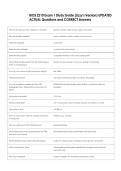
BIOS 2210 Exam 1 Study Guide (Lizzy's Version) UPDATED
ACTUAL Questions and CORRECT Answers
What are the types and main categories of microbes? Bacteria, archaea, fungi, Protozoa, algae, viruses prions
How are microbes classified? shape, metabolism, genetic material, cell wall structure
Where are microbes? everywhere
Define the term pathogen A microbe that causes disease
Define the term parasite an organism that lives on or in a host, causing harm
History: What was discovered in the mid 1960s that gave Antonie van Leeuwenhoek's microscope, leading to microbiology
"birth" to microbiology?
How high can compound light microscopes magnify? 40x-1000x
What is biochemistry? the study of chemical processes occurring in living things
Can you recognize our modern day tree of life Classified life into three domains using 16S rRNA, a molecular marker for
(phylogenetic tree) - Woese and Fox...and what is 16S phylogeny
rRNA?
Typical size of bacteria? ~0.2-2.0 µm
What is a micrometer? unit of measurement used to measure bacteria; one-millionth of a meter
Typical size of virus? ~20-300 nm
What was discovered in 1940s that changes the practice Antibiotics (e.g., penicillin)
of medicine?
Who was well known for this 1940s discovery? Alexander Fleming
What molecular structure was discovered in the 1950s DNA double helix; found by James Watson and Francis Crick
and who was involved?
What is the field of study called molecular biology? studies the molecular basis of biological activity (genetic mechanisms)
Define endosymbiotic theory mitochondria and chloroplasts originated from bacteria and ancestors of
eukaryotic cells
Who is Lynn Margulis? American biologist who developed endosymbiotic theory
, What is germ theory? The theory that diseases are caused by microorganisms, not mystical forces
Microbes microscopic organisms
Microorganisms organisms that are too small to be seen with the unaided eye
Cellular having to do with cells
Acellular Not made up of or containing cells
Eukaryotic Cell that has a nucleus
Prokaryotic cells that do not have a nucleus
ACTUAL Questions and CORRECT Answers
What are the types and main categories of microbes? Bacteria, archaea, fungi, Protozoa, algae, viruses prions
How are microbes classified? shape, metabolism, genetic material, cell wall structure
Where are microbes? everywhere
Define the term pathogen A microbe that causes disease
Define the term parasite an organism that lives on or in a host, causing harm
History: What was discovered in the mid 1960s that gave Antonie van Leeuwenhoek's microscope, leading to microbiology
"birth" to microbiology?
How high can compound light microscopes magnify? 40x-1000x
What is biochemistry? the study of chemical processes occurring in living things
Can you recognize our modern day tree of life Classified life into three domains using 16S rRNA, a molecular marker for
(phylogenetic tree) - Woese and Fox...and what is 16S phylogeny
rRNA?
Typical size of bacteria? ~0.2-2.0 µm
What is a micrometer? unit of measurement used to measure bacteria; one-millionth of a meter
Typical size of virus? ~20-300 nm
What was discovered in 1940s that changes the practice Antibiotics (e.g., penicillin)
of medicine?
Who was well known for this 1940s discovery? Alexander Fleming
What molecular structure was discovered in the 1950s DNA double helix; found by James Watson and Francis Crick
and who was involved?
What is the field of study called molecular biology? studies the molecular basis of biological activity (genetic mechanisms)
Define endosymbiotic theory mitochondria and chloroplasts originated from bacteria and ancestors of
eukaryotic cells
Who is Lynn Margulis? American biologist who developed endosymbiotic theory
, What is germ theory? The theory that diseases are caused by microorganisms, not mystical forces
Microbes microscopic organisms
Microorganisms organisms that are too small to be seen with the unaided eye
Cellular having to do with cells
Acellular Not made up of or containing cells
Eukaryotic Cell that has a nucleus
Prokaryotic cells that do not have a nucleus


