

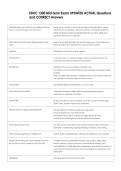
EDUC 1300 Mid-term Exam UPDATED ACTUAL Questions
and CORRECT Answers
What information can you find on your syllabus and how It gives you an overview of the course including a course description, contact
can you use this throughout the semester? information for your professor, resources you'll need, and learning outcomes.
Taking advantage of rubrics and grading information as well as writing down
important dates into your calendar.
What does the book say about asking questions during Make sure you really think about the question being sure to check spelling and
class? grammar. Make sure to indicate the course and your ID number.
Plagiarism Presenting someone else's work as your own.
Constructivism To actively construct or create knowledge, making connections between new
information and what has been previously learned.
Self-efficacy Whether or not you can successfully complete a task.
if you believe you can do the task then you are more likely to do better in tough
situations.
When you believe the information is important and you want to learn is when you
are more likely to have the desire and drive to work.
Paraphrasing Capturing the idea of another person in your own words.
Peer-reviewed journal articles A theoretical or research-written work that has been deemed worthy o
publication by professors in the field.
3R and SQ3R 3R: Read the material, recite the material, and review or read the material again.
SQ3R: Survey, question, read, recite, and review.
What are West's four stages of development? Absolute: Believes that there is a right and wrong answer
Personal: Opinions are what really matter
Rules-based: Values rules to compare and judge opinions or claims.
Evaluative: Formal strategies to evaluate opinions and evidence
What is Bloom's Taxonomy? The various levels of knowing in which you first need to be able to remember
information, understanding, applying analyzing, evaluation, and creating.
What is Gardner's eight types of Intelligence? Musical, spatial, bodily/kinesthetic, interpersonal, intrapersonal, and naturalist.
What is Critical Thinking, how does it develop, and what An ability to think in a sophisticated manner, to ask questions, define terms,
do you have to have in order to use it in school? examine evidence, analyze assumptions, avoid emotional reasoning, resist
oversimplification, consider alternative interpretations, and tolerate uncertainty. In
order to use it in school you need to have knowledge base, self-efficacy, and
desire/drive
Highlighting Must bring attention to the important points.
and CORRECT Answers
What information can you find on your syllabus and how It gives you an overview of the course including a course description, contact
can you use this throughout the semester? information for your professor, resources you'll need, and learning outcomes.
Taking advantage of rubrics and grading information as well as writing down
important dates into your calendar.
What does the book say about asking questions during Make sure you really think about the question being sure to check spelling and
class? grammar. Make sure to indicate the course and your ID number.
Plagiarism Presenting someone else's work as your own.
Constructivism To actively construct or create knowledge, making connections between new
information and what has been previously learned.
Self-efficacy Whether or not you can successfully complete a task.
if you believe you can do the task then you are more likely to do better in tough
situations.
When you believe the information is important and you want to learn is when you
are more likely to have the desire and drive to work.
Paraphrasing Capturing the idea of another person in your own words.
Peer-reviewed journal articles A theoretical or research-written work that has been deemed worthy o
publication by professors in the field.
3R and SQ3R 3R: Read the material, recite the material, and review or read the material again.
SQ3R: Survey, question, read, recite, and review.
What are West's four stages of development? Absolute: Believes that there is a right and wrong answer
Personal: Opinions are what really matter
Rules-based: Values rules to compare and judge opinions or claims.
Evaluative: Formal strategies to evaluate opinions and evidence
What is Bloom's Taxonomy? The various levels of knowing in which you first need to be able to remember
information, understanding, applying analyzing, evaluation, and creating.
What is Gardner's eight types of Intelligence? Musical, spatial, bodily/kinesthetic, interpersonal, intrapersonal, and naturalist.
What is Critical Thinking, how does it develop, and what An ability to think in a sophisticated manner, to ask questions, define terms,
do you have to have in order to use it in school? examine evidence, analyze assumptions, avoid emotional reasoning, resist
oversimplification, consider alternative interpretations, and tolerate uncertainty. In
order to use it in school you need to have knowledge base, self-efficacy, and
desire/drive
Highlighting Must bring attention to the important points.


