6.3.2 POPULATIONS AND SUSTAINABILITY
a. the factors that determine size of a population
Population size and carrying capacity:
- The size of a population is determined by the balance between the death rate
(mortality) and the rate of reproduction.
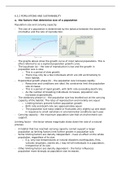
- The graphs above show the growth curve of most natural populations. This is
often referred to as a sigmoid population growth curve.
- The lag phase (a) – the rate of reproduction is low and the growth in
population size is slow.
o This is a period of slow growth.
o There may only be a few individuals which are still acclimatising to
their habitat.
- Exponential growth phase (b) – the population size increases rapidly.
o Resources and conditions are ideal. No constraints limit the population
size increase.
o This is a period of rapid growth, with birth rate exceeding death rate.
o As the number of breeding individuals increases, population size
increases exponentially.
- The stationary phase (c) – the population size has levelled out at the carrying
capacity of the habitat. The rates of reproduction and morality are equal.
o Limiting factors prevent further population growth.
o Birth rate and death rate are approximately equal.
o The population size stays stable or fluctuates very slightly up and down
in response to small variations in environmental conditions each year.
- Carrying capacity – the maximum population size that an environment can
support.
Limiting factor – the factor whose magnitude slows down the rate of a natural
process.
- A habitat that has reached carrying capacity cannot support a larger
population as limiting factors limit further growth in population size.
- Some limiting factors are density independent – have an effect on the whole
population, regardless of its size.
o E.g. very low temperatures or natural disasters (earthquakes, fires,
volcanic eruptions, storms etc.) may kill all individuals in a population,
irrespective of its size.
- Other limiting factors are density dependent – the factor influences
population more strongly as population size increases.
, o The availability of resources like food, water, light, oxygen, nesting
sites, shelter.
o Levels of parasitism, predation from other species and intensity of
competition for resources (with individuals of both the same species
and of other species) may increase as population size rises.
- Limiting factors can also be sorted into biotic and abiotic factors.
Migration:
- As well as birth and death rate, migration also has an important effect on
population growth.
- Immigration - the movement of organisms into a particular area, increasing
population size.
- Emigration – the movement of organisms away from a particular area,
decreasing population size.
b. interactions between populations
Predator-prey relationships:
- Predator – an animal that hunts other animals (prey) for food.
- Predation can act as a limiting factor on a prey’s population size, which in
turn can affect the predator’s population size.
o When prey population size increases, more food is available for the
predators, allowing more to survive and reproduce. This causes
predator population to increase.
o The increased predator population eats more prey organisms, causing
a decline in prey population. The death rate of the prey population
exceeds birth rate.
o The reduced prey population can no longer support the large predator
population. Intraspecific competition for food increases and predator
population declines.
o Reduced predator numbers result in less of the prey population being
killed. More prey organisms survive and reproduce, increasing the prey
population.
o The cycle repeats.
- The above graph comes from an experiment conducted in a laboratory, where
the predators only ate one type of prey, and predation was the main limiting
factor on the prey’s population.
- However, in the wild, predators often eat more than one type of prey, and
there are many other limiting factors. Studies in the wild thus yield graphs of
a similar, but not so well-defined, shape.
a. the factors that determine size of a population
Population size and carrying capacity:
- The size of a population is determined by the balance between the death rate
(mortality) and the rate of reproduction.
- The graphs above show the growth curve of most natural populations. This is
often referred to as a sigmoid population growth curve.
- The lag phase (a) – the rate of reproduction is low and the growth in
population size is slow.
o This is a period of slow growth.
o There may only be a few individuals which are still acclimatising to
their habitat.
- Exponential growth phase (b) – the population size increases rapidly.
o Resources and conditions are ideal. No constraints limit the population
size increase.
o This is a period of rapid growth, with birth rate exceeding death rate.
o As the number of breeding individuals increases, population size
increases exponentially.
- The stationary phase (c) – the population size has levelled out at the carrying
capacity of the habitat. The rates of reproduction and morality are equal.
o Limiting factors prevent further population growth.
o Birth rate and death rate are approximately equal.
o The population size stays stable or fluctuates very slightly up and down
in response to small variations in environmental conditions each year.
- Carrying capacity – the maximum population size that an environment can
support.
Limiting factor – the factor whose magnitude slows down the rate of a natural
process.
- A habitat that has reached carrying capacity cannot support a larger
population as limiting factors limit further growth in population size.
- Some limiting factors are density independent – have an effect on the whole
population, regardless of its size.
o E.g. very low temperatures or natural disasters (earthquakes, fires,
volcanic eruptions, storms etc.) may kill all individuals in a population,
irrespective of its size.
- Other limiting factors are density dependent – the factor influences
population more strongly as population size increases.
, o The availability of resources like food, water, light, oxygen, nesting
sites, shelter.
o Levels of parasitism, predation from other species and intensity of
competition for resources (with individuals of both the same species
and of other species) may increase as population size rises.
- Limiting factors can also be sorted into biotic and abiotic factors.
Migration:
- As well as birth and death rate, migration also has an important effect on
population growth.
- Immigration - the movement of organisms into a particular area, increasing
population size.
- Emigration – the movement of organisms away from a particular area,
decreasing population size.
b. interactions between populations
Predator-prey relationships:
- Predator – an animal that hunts other animals (prey) for food.
- Predation can act as a limiting factor on a prey’s population size, which in
turn can affect the predator’s population size.
o When prey population size increases, more food is available for the
predators, allowing more to survive and reproduce. This causes
predator population to increase.
o The increased predator population eats more prey organisms, causing
a decline in prey population. The death rate of the prey population
exceeds birth rate.
o The reduced prey population can no longer support the large predator
population. Intraspecific competition for food increases and predator
population declines.
o Reduced predator numbers result in less of the prey population being
killed. More prey organisms survive and reproduce, increasing the prey
population.
o The cycle repeats.
- The above graph comes from an experiment conducted in a laboratory, where
the predators only ate one type of prey, and predation was the main limiting
factor on the prey’s population.
- However, in the wild, predators often eat more than one type of prey, and
there are many other limiting factors. Studies in the wild thus yield graphs of
a similar, but not so well-defined, shape.