

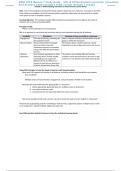
D096 D169 Module 7 Study Guide - UDL & Differentiated Instruction | Questions
And Answers, Latest Update | 100% Correct Answers | Graded
Module 7: Differentiating Instruction to Meet Diverse Learner Needs
Note: You are encouraged to download the Study Guide to document your responses. If you plan to print the
Study Guide and complete it by hand (recommended), expand the tables after you download it to provide
more space to enter a complete response.
Learning Objective: The candidate designs differentiated learning experiences that align to the needs of
students with a variety of exceptionalities.
Principles of UDL:
What is Universal Design for Learning (UDL)?
UDL is an approach to curriculum that minimizes barriers and maximizes learning for all students.
Variability Description Examples of how to provide in a classroom
Engagement The why of learning, motivating for When a teacher minimizes the distractions that are
the students to learn going on within the classroom
Representation Present information in multiple The teacher allows a student who has a visual
forms of media, ways that impairment access to large print text so he can see
materials/resources are provided
using many different presentation
formats
Action & Give students opportunity to show The teacher uses multiple different learning
Expression what they know. Provide models activities so that everyone learn in the class is able
and feedback and support for to learn in a way that best suits their learning style
different levels of proficiency. A
variety of ways how we asses how
students demonstrate those skills
Using UDL Principles to Meet the Needs of Learners with Exceptionalities:
How does UDL support the learning of all students, including students with disabilities and students
who are gifted?
Multiple means of representation, engagement, and presentation. Flexible for all students
Describe the three initial steps for applying UDL in a classroom.
1. Define appropriate goals that allow for multiple means of attainment
2. Asses diverse learner needs
3. Evaluate barriers that may exist within the current curriculum
List some examples of UDL that a teacher can use to meet the needs of every student in a classroom.
Posted lesson goals/giving students something to work towards, assignment options- multiple ways to work
on an assignment , regular feedback, digital and audio text
How Differentiation Enables Teachers to Meet the Individual Learning Needs
And Answers, Latest Update | 100% Correct Answers | Graded
Module 7: Differentiating Instruction to Meet Diverse Learner Needs
Note: You are encouraged to download the Study Guide to document your responses. If you plan to print the
Study Guide and complete it by hand (recommended), expand the tables after you download it to provide
more space to enter a complete response.
Learning Objective: The candidate designs differentiated learning experiences that align to the needs of
students with a variety of exceptionalities.
Principles of UDL:
What is Universal Design for Learning (UDL)?
UDL is an approach to curriculum that minimizes barriers and maximizes learning for all students.
Variability Description Examples of how to provide in a classroom
Engagement The why of learning, motivating for When a teacher minimizes the distractions that are
the students to learn going on within the classroom
Representation Present information in multiple The teacher allows a student who has a visual
forms of media, ways that impairment access to large print text so he can see
materials/resources are provided
using many different presentation
formats
Action & Give students opportunity to show The teacher uses multiple different learning
Expression what they know. Provide models activities so that everyone learn in the class is able
and feedback and support for to learn in a way that best suits their learning style
different levels of proficiency. A
variety of ways how we asses how
students demonstrate those skills
Using UDL Principles to Meet the Needs of Learners with Exceptionalities:
How does UDL support the learning of all students, including students with disabilities and students
who are gifted?
Multiple means of representation, engagement, and presentation. Flexible for all students
Describe the three initial steps for applying UDL in a classroom.
1. Define appropriate goals that allow for multiple means of attainment
2. Asses diverse learner needs
3. Evaluate barriers that may exist within the current curriculum
List some examples of UDL that a teacher can use to meet the needs of every student in a classroom.
Posted lesson goals/giving students something to work towards, assignment options- multiple ways to work
on an assignment , regular feedback, digital and audio text
How Differentiation Enables Teachers to Meet the Individual Learning Needs


