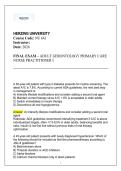
HERZING UNIVERSITY
Course Code: NU 661
Instructor:
Date: 2026
FINAL EXAM – ADULT GERONTOLOGY PRIMARY CARE
NURSE PRACTITIONER I
A 62-year-old patient with type 2 diabetes presents for routine screening. The
latest A1C is 7.8%. According to current ADA guidelines, the next best step
in management is:
A) Intensify lifestyle modifications and consider adding a second oral agent
B) Maintain current therapy since A1C < 8% is acceptable in older adults
C) Switch immediately to insulin therapy
D) Discontinue all oral hypoglycemics
Answer: A) Intensify lifestyle modifications and consider adding a second oral
agent
Rationale: ADA guidelines recommend intensifying treatment if A1C is above
individualized targets, often <7.5-8.0% in older adults, balancing benefits and
risks. Insulin is not first line without previous trials of oral therapy
optimization.
A 45-year-old patient presents with newly diagnosed hypertension. Which of
the following should be included as first-line pharmacotherapy according to
JNC-8 guidelines?
A) Beta-blockers alone
B) Thiazide diuretics or ACE inhibitors
C) Alpha-blockers
D) Calcium channel blockers only in black patients
1
,Answer: B) Thiazide diuretics or ACE inhibitors
Rationale: JNC-8 recommends thiazides, ACE inhibitors, ARBs, or CCBs as
first-line. Beta-blockers and alpha-blockers are not first-line unless specific
indications exist.
True or False: The USPSTF recommends annual colorectal cancer
screening in adults aged 45-75 years.
Answer: False
Rationale: USPSTF recommends colorectal cancer screening beginning at
age 45 but not necessarily annually. The preferred intervals vary by
screening modality (e.g., colonoscopy every 10 years).
Fill in the blank: According to the GOLD guidelines, the primary
pharmacological treatment for COPD patients with frequent exacerbations
and a high eosinophil count is ___________.
Answer: inhaled corticosteroids (ICS) combined with long-acting
bronchodilators
Rationale: GOLD promotes ICS + LABA or LAMA in patients at risk of
exacerbations and eosinophilia to reduce inflammation and exacerbation
frequency.
A 55-year-old woman with a history of major depressive disorder is being
considered for antidepressant therapy. Which class of medications is most
commonly recommended as first-line treatment?
A) MAO inhibitors
B) Selective serotonin reuptake inhibitors (SSRIs)
C) Tricyclic antidepressants
D) Benzodiazepines
Answer: B) Selective serotonin reuptake inhibitors (SSRIs)
Rationale: SSRIs balance efficacy with tolerability and safety. MAO inhibitors
and tricyclics have more contraindications and side effects.
True or False: The initial evaluation of a patient with newly suspected heart
failure should include B-type natriuretic peptide (BNP) testing.
Answer: True
Rationale: BNP or NT-proBNP is recommended to help differentiate heart
failure from other causes of dyspnea and guide early diagnosis.
Fill in the blank: The most appropriate cancer screening test for lung cancer
in a 60-year-old heavy smoker is ___________.
Answer: low-dose computed tomography (LDCT) scan
2
, Rationale: USPSTF endorses annual LDCT for lung cancer screening in
adults aged 50-80 years with significant smoking history.
In the assessment of chronic kidney disease (CKD), an estimated glomerular
filtration rate (eGFR) less than ______ ml/min/1.73 m² indicates stage 3
CKD.
A) 45
B) 60
C) 90
D) 30
Answer: B) 60
Rationale: CKD stage 3 is defined as eGFR between 30-59 ml/min/1.73 m²,
stage 3a (45-59) and 3b (30-44).
True or False: Annual influenza vaccination is recommended for all adults,
including those over 65 years of age, as per CDC guidelines.
Answer: True
Rationale: Annual flu vaccination reduces morbidity and mortality, especially
in high-risk groups including older adults.
A 70-year-old individual with COPD complains of increasing dyspnea. Pulse
oximetry reading is 88%. The best immediate management is:
A) Start systemic corticosteroids
B) Provide supplemental oxygen to maintain saturation above 90%
C) Initiate antibiotics
D) Schedule pulmonary function tests
Answer: B) Provide supplemental oxygen to maintain saturation above 90%
Rationale: Hypoxemia requires oxygen therapy to prevent hypoxic
complications. Further evaluations follow.
Fill in the blank: The key biomarker for cardiac muscle injury in suspected
acute coronary syndrome is __________.
Answer: troponin I or T
Rationale: Troponins are highly sensitive and specific markers for myocardial
injury and are standard in ACS diagnosis.
True or False: The American Diabetes Association recommends annual
screening for diabetic retinopathy starting at diagnosis in type 1 diabetes and
within 5 years post-diagnosis for type 2 diabetes.
Answer: True
Rationale: Retinopathy develops later in type 1; type 2 diabetes often is
3
Course Code: NU 661
Instructor:
Date: 2026
FINAL EXAM – ADULT GERONTOLOGY PRIMARY CARE
NURSE PRACTITIONER I
A 62-year-old patient with type 2 diabetes presents for routine screening. The
latest A1C is 7.8%. According to current ADA guidelines, the next best step
in management is:
A) Intensify lifestyle modifications and consider adding a second oral agent
B) Maintain current therapy since A1C < 8% is acceptable in older adults
C) Switch immediately to insulin therapy
D) Discontinue all oral hypoglycemics
Answer: A) Intensify lifestyle modifications and consider adding a second oral
agent
Rationale: ADA guidelines recommend intensifying treatment if A1C is above
individualized targets, often <7.5-8.0% in older adults, balancing benefits and
risks. Insulin is not first line without previous trials of oral therapy
optimization.
A 45-year-old patient presents with newly diagnosed hypertension. Which of
the following should be included as first-line pharmacotherapy according to
JNC-8 guidelines?
A) Beta-blockers alone
B) Thiazide diuretics or ACE inhibitors
C) Alpha-blockers
D) Calcium channel blockers only in black patients
1
,Answer: B) Thiazide diuretics or ACE inhibitors
Rationale: JNC-8 recommends thiazides, ACE inhibitors, ARBs, or CCBs as
first-line. Beta-blockers and alpha-blockers are not first-line unless specific
indications exist.
True or False: The USPSTF recommends annual colorectal cancer
screening in adults aged 45-75 years.
Answer: False
Rationale: USPSTF recommends colorectal cancer screening beginning at
age 45 but not necessarily annually. The preferred intervals vary by
screening modality (e.g., colonoscopy every 10 years).
Fill in the blank: According to the GOLD guidelines, the primary
pharmacological treatment for COPD patients with frequent exacerbations
and a high eosinophil count is ___________.
Answer: inhaled corticosteroids (ICS) combined with long-acting
bronchodilators
Rationale: GOLD promotes ICS + LABA or LAMA in patients at risk of
exacerbations and eosinophilia to reduce inflammation and exacerbation
frequency.
A 55-year-old woman with a history of major depressive disorder is being
considered for antidepressant therapy. Which class of medications is most
commonly recommended as first-line treatment?
A) MAO inhibitors
B) Selective serotonin reuptake inhibitors (SSRIs)
C) Tricyclic antidepressants
D) Benzodiazepines
Answer: B) Selective serotonin reuptake inhibitors (SSRIs)
Rationale: SSRIs balance efficacy with tolerability and safety. MAO inhibitors
and tricyclics have more contraindications and side effects.
True or False: The initial evaluation of a patient with newly suspected heart
failure should include B-type natriuretic peptide (BNP) testing.
Answer: True
Rationale: BNP or NT-proBNP is recommended to help differentiate heart
failure from other causes of dyspnea and guide early diagnosis.
Fill in the blank: The most appropriate cancer screening test for lung cancer
in a 60-year-old heavy smoker is ___________.
Answer: low-dose computed tomography (LDCT) scan
2
, Rationale: USPSTF endorses annual LDCT for lung cancer screening in
adults aged 50-80 years with significant smoking history.
In the assessment of chronic kidney disease (CKD), an estimated glomerular
filtration rate (eGFR) less than ______ ml/min/1.73 m² indicates stage 3
CKD.
A) 45
B) 60
C) 90
D) 30
Answer: B) 60
Rationale: CKD stage 3 is defined as eGFR between 30-59 ml/min/1.73 m²,
stage 3a (45-59) and 3b (30-44).
True or False: Annual influenza vaccination is recommended for all adults,
including those over 65 years of age, as per CDC guidelines.
Answer: True
Rationale: Annual flu vaccination reduces morbidity and mortality, especially
in high-risk groups including older adults.
A 70-year-old individual with COPD complains of increasing dyspnea. Pulse
oximetry reading is 88%. The best immediate management is:
A) Start systemic corticosteroids
B) Provide supplemental oxygen to maintain saturation above 90%
C) Initiate antibiotics
D) Schedule pulmonary function tests
Answer: B) Provide supplemental oxygen to maintain saturation above 90%
Rationale: Hypoxemia requires oxygen therapy to prevent hypoxic
complications. Further evaluations follow.
Fill in the blank: The key biomarker for cardiac muscle injury in suspected
acute coronary syndrome is __________.
Answer: troponin I or T
Rationale: Troponins are highly sensitive and specific markers for myocardial
injury and are standard in ACS diagnosis.
True or False: The American Diabetes Association recommends annual
screening for diabetic retinopathy starting at diagnosis in type 1 diabetes and
within 5 years post-diagnosis for type 2 diabetes.
Answer: True
Rationale: Retinopathy develops later in type 1; type 2 diabetes often is
3